Topic 4.10 Notes – The Second Great Awakening
What the Second Great Awakening Was
This was a Protestant revival movement that began in the 1790s and peaked in the 1820s and 1830s. It made religion more evangelical, emotional, and participatory. The center of religious life became the personal conversion experience, where an individual chose repentance and salvation.
Older Calvinism had stressed predestination, the idea that God had already determined who would be saved. Revivalists pushed toward free will and individual responsibility. You were supposed to act now, repent now, and change your life now.
Like the First Great Awakening, this movement used rebirth and itinerant preachers. In the new United States, though, it fit a republic shaped by democracy, westward expansion, mobility, and organized moral reform.
Why the Second Great Awakening Happened
These causes worked together. The movement makes the most sense when you see it as religion adapting to a new nation. One region where revivalism became especially intense was western and central New York, often called the Burned-over District.
- Democratic culture mattered because expanding white male political participation made Americans suspicious of elites and inherited authority. Revivalists matched that mood by saying salvation was open to ordinary people, not just learned ministers or socially prominent families.
- Backlash against rational religion mattered because some Americans disliked restrained worship and Enlightenment-style religion such as Deism and Unitarianism. Evangelicals answered with emotion, revelation, and spiritual experience.
- Market revolution pressures mattered because commercialization, wage labor, factory towns, and new transportation weakened older community ties. Revival religion offered identity, discipline, and moral order.
- Mobility mattered because people kept moving west and socially upward or downward. Older church structures could not keep up with scattered populations.
- Disestablishment mattered because there was no single national church. Denominations had to compete for followers, so they used new methods to attract people.
How Revivalism Spread
The main engines were Methodists, Baptists, camp meetings, and communication networks.
Methodists
- Circuit riders traveled huge territories and preached wherever people gathered.
- Francis Asbury built the Methodist circuit system.
- This flexible style fit frontier life, where towns often lacked permanent ministers.
Baptists
- Baptist churches were decentralized, with strong local control.
- Locally rooted ministers could preach without elite seminary training.
- That made Baptist growth fast, cheap, and well suited to mobile communities.
Camp meetings
Camp meetings brought scattered frontier families together for multi-day outdoor revivals. They mixed preaching, singing, prayer, and dramatic public conversions, like the large outdoor gathering shown here.
- Cane Ridge revival in Kentucky, 1801
- Barton W. Stone, a key figure linked to Cane Ridge
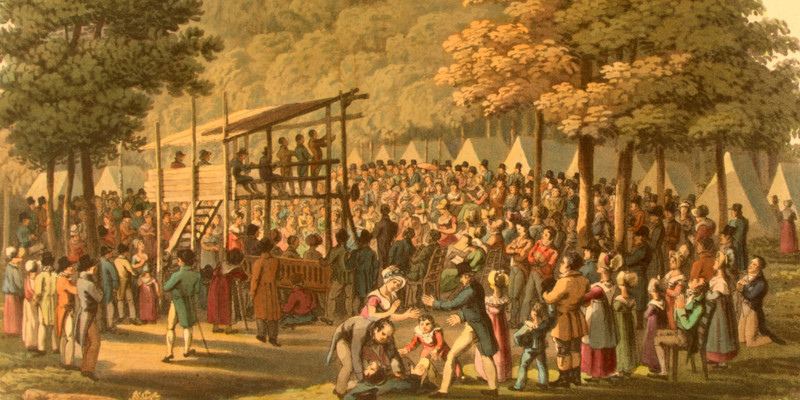
Frontier camp meeting
Communication and regional variation
Roads, canals, newspapers, pamphlets, denominational presses, and missionary societies spread revival news and methods.
- West and South used camp meetings, circuit riders, and frontier preaching.
- Northeast saw more organized urban revivals and voluntary societies.
- New England split between Unitarian liberalism and renewed evangelicalism.
Finney, New Measures, and Religious Experimentation
The best-known revivalist was Charles Grandison Finney, active in the Burned-over District of upstate New York. He taught that conversion was a choice. Sinners did not need to wait passively for grace.
His new measures included:
- protracted meetings
- direct emotional preaching
- public prayer for individuals
- women praying publicly in mixed gatherings
- the anxious bench
- organized follow-up for converts
The Rochester revival of 1830 to 1831 showed revivalism in a growing canal city shaped by commerce and middle-class discipline. Finney also promoted perfectionism, the belief that people and society could be morally improved.
This climate also encouraged new religions:
- Church of Jesus Christ of Latter-day Saints
- Joseph Smith
- Book of Mormon (1830)
- Brigham Young
- Great Salt Lake migration beginning in 1846
Why It Mattered
The revival reshaped American religion and culture.
- Methodists and Baptists grew rapidly and changed the denominational map.
- Women gained larger roles as converts, organizers, fundraisers, and reformers, even without equal formal authority.
- Lay participation and voluntary religious associations expanded.
- Americans became more likely to believe people could improve themselves and improve society.
This leads straight into reform movements such as temperance, abolitionism, prison reform, education reform, and women’s activism.
Key Takeaways
Second Great Awakening
Protestant revival movement beginning in the 1790s and peaking in the 1820s and 1830s that emphasized emotional conversion, free will, popular participation, and moral improvement
Religious Disestablishment
Removal of government support for established churches, forcing denominations to compete for voluntary members through missions, accessible preaching, and revivals
Enlightenment Rationalism
Reliance on reason and nature rather than traditional revelation, provoking an evangelical response centered on faith, emotion, and personal conversion
Deism
Enlightenment belief in a creator understood through reason and nature rather than traditional revelation or church doctrine
Unitarianism
Liberal Protestant movement that rejected the Trinity and emphasized reason, moral progress, and human improvement
Predestination vs. Free Will
Predestination held that God had already chosen the saved; revivalists increasingly taught that individuals could freely repent, reject sin, and choose salvation
Evangelicalism
Protestant Christianity centered on personal conversion, emotional preaching, active evangelization, and individual moral responsibility
Democratization and Individualism
Expanding popular politics and distrust of inherited privilege encouraged religion that offered salvation and participation to ordinary people
Market Revolution and Revivalism
Commercialization, wage labor, and urban growth disrupted older communities, leading churches to offer moral discipline, identity, and social support
Geographic Mobility and the Frontier
Rapid western migration created scattered settlements without stable churches, increasing demand for itinerant ministers, camp meetings, and flexible denominations
Circuit Riders
Itinerant Methodist ministers who repeatedly traveled assigned territories to preach, administer sacraments, and organize frontier congregations
Francis Asbury
Methodist leader who helped build the national circuit-rider system that spread Methodism among dispersed populations
Camp Meetings
Multiday outdoor frontier gatherings where itinerant ministers used preaching, prayer, and song to seek emotional public conversions
Cane Ridge Revival
Major 1801 Kentucky camp meeting associated with Barton W. Stone that featured cross-denominational preaching and intense emotional responses
Barton W. Stone
Presbyterian minister associated with organizing the influential Cane Ridge revival in Kentucky in 1801
Burned-over District
Upstate and western New York region repeatedly swept by revivals and known for numerous religious experiments and reform organizations
Charles Grandison Finney
Leading revivalist who taught that sin was voluntary, conversion was an immediate choice, and deliberate methods could persuade people to repent
New Measures
Finney’s deliberate revival techniques, including prolonged meetings, urgent preaching, public prayer, women’s public participation, and the anxious bench
Anxious Bench
Conspicuous front seat used in Finney’s revivals for people publicly considering conversion
Perfectionism
Belief associated with Finney that individuals and society could make extraordinary moral progress and, in some versions, overcome voluntary sin
Church of Jesus Christ of Latter-day Saints
Church founded by Joseph Smith as a restoration of original Christianity amid the religious experimentation of the Burned-over District
Joseph Smith
Founder of the Latter-day Saint movement who reported revelations and published the Book of Mormon in 1830
First Great Awakening vs. Second Great Awakening
The colonial First emphasized revival under Edwards and Whitefield; the Second arose amid democracy, migration, disestablishment, and markets and stressed free will and organized moral improvement
Methodist and Baptist Expansion
Rapid denominational growth driven by accessible conversion preaching and flexible organizations suited to mobile and dispersed populations
Notes
Second Great Awakening
Protestant revival movement beginning in the 1790s and peaking in the 1820s and 1830s that emphasized emotional conversion, free will, popular participation, and moral improvement
Religious Disestablishment
Removal of government support for established churches, forcing denominations to compete for voluntary members through missions, accessible preaching, and revivals
Enlightenment Rationalism
Reliance on reason and nature rather than traditional revelation, provoking an evangelical response centered on faith, emotion, and personal conversion
Deism
Enlightenment belief in a creator understood through reason and nature rather than traditional revelation or church doctrine
Unitarianism
Liberal Protestant movement that rejected the Trinity and emphasized reason, moral progress, and human improvement
Predestination vs. Free Will
Predestination held that God had already chosen the saved; revivalists increasingly taught that individuals could freely repent, reject sin, and choose salvation
Evangelicalism
Protestant Christianity centered on personal conversion, emotional preaching, active evangelization, and individual moral responsibility
Democratization and Individualism
Expanding popular politics and distrust of inherited privilege encouraged religion that offered salvation and participation to ordinary people
Market Revolution and Revivalism
Commercialization, wage labor, and urban growth disrupted older communities, leading churches to offer moral discipline, identity, and social support
Geographic Mobility and the Frontier
Rapid western migration created scattered settlements without stable churches, increasing demand for itinerant ministers, camp meetings, and flexible denominations
Circuit Riders
Itinerant Methodist ministers who repeatedly traveled assigned territories to preach, administer sacraments, and organize frontier congregations
Francis Asbury
Methodist leader who helped build the national circuit-rider system that spread Methodism among dispersed populations
Camp Meetings
Multiday outdoor frontier gatherings where itinerant ministers used preaching, prayer, and song to seek emotional public conversions
Cane Ridge Revival
Major 1801 Kentucky camp meeting associated with Barton W. Stone that featured cross-denominational preaching and intense emotional responses
Barton W. Stone
Presbyterian minister associated with organizing the influential Cane Ridge revival in Kentucky in 1801
Burned-over District
Upstate and western New York region repeatedly swept by revivals and known for numerous religious experiments and reform organizations
Charles Grandison Finney
Leading revivalist who taught that sin was voluntary, conversion was an immediate choice, and deliberate methods could persuade people to repent
New Measures
Finney’s deliberate revival techniques, including prolonged meetings, urgent preaching, public prayer, women’s public participation, and the anxious bench
Anxious Bench
Conspicuous front seat used in Finney’s revivals for people publicly considering conversion
Perfectionism
Belief associated with Finney that individuals and society could make extraordinary moral progress and, in some versions, overcome voluntary sin
Church of Jesus Christ of Latter-day Saints
Church founded by Joseph Smith as a restoration of original Christianity amid the religious experimentation of the Burned-over District
Joseph Smith
Founder of the Latter-day Saint movement who reported revelations and published the Book of Mormon in 1830
First Great Awakening vs. Second Great Awakening
The colonial First emphasized revival under Edwards and Whitefield; the Second arose amid democracy, migration, disestablishment, and markets and stressed free will and organized moral improvement
Methodist and Baptist Expansion
Rapid denominational growth driven by accessible conversion preaching and flexible organizations suited to mobile and dispersed populations
