Topic 9.5 Notes – Migration and Immigration in the 1990s and 2000s
How Migration and Immigration Reshaped the United States after 1980
Migration means movement within the U.S. Immigration means movement into the U.S. from abroad. This topic is about both, because they happened together and often fed each other.
The main pattern was simple. Americans kept moving toward the South and West, and immigration rose sharply from Latin America and Asia. Like earlier periods in U.S. history, people moved for jobs, family connections, safety, and opportunity. The major change was where immigrants came from. After the Immigration and Nationality Act of 1965, the biggest source regions shifted from Europe to Latin America and Asia.
The map below captures the long-running shift toward the Sun Belt that continued after 1980.
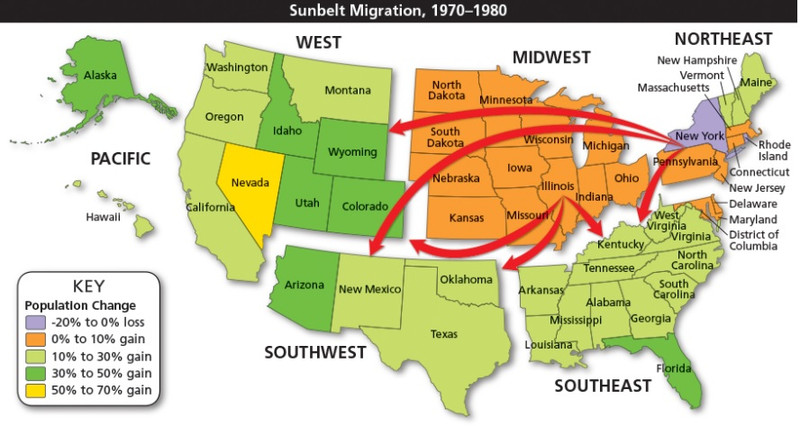
Sun Belt migration, 1970s
That produced four effects you want to keep in your head:
- Sun Belt metros grew fast in population and economic power.
- Employers got labor for a service, tech, and postindustrial economy.
- The country became more diverse in language, religion, and culture.
- Politics changed through reapportionment, new voting blocs, and fights over immigration.
Why the South and West Kept Growing
The Sun Belt stretches from the Southeast and Florida through Texas, the Southwest, and California. Its growth started earlier, but after 1980 it kept accelerating.
Pull factors
- Jobs grew in defense, aerospace, energy, electronics, telecommunications, finance, health care, tourism, construction, and technology.
- Lower housing and land costs attracted families and businesses in many places.
- Lower taxes, weaker unions, and right-to-work laws appealed to employers.
- Air conditioning, highways, airports, and suburbs made hot, spread-out metros practical.
- Retirees moved to places like Florida and Arizona.
- Federal spending kept flowing to military bases, defense contractors, and NASA-related development.
Push factors from the Frost Belt and Rust Belt
Older Northeast and Midwest cities lost people as deindustrialization weakened steel, auto, and heavy manufacturing.
Effects
- Reapportionment shifted House seats and electoral votes toward Florida, Texas, Arizona, Nevada, and California.
- States such as New York, Pennsylvania, Ohio, and Michigan lost relative influence.
- Sun Belt growth strengthened suburban politics, business-friendly policies, and often conservatism.
- Politics were not uniform. California became reliably Democratic, and Texas, Arizona, Nevada, Georgia, and Florida became more mixed and competitive.
- Fast growth also meant sprawl, traffic, crowded schools and utilities, water shortages, air pollution, and wildfire risk.
Why Immigration from Latin America and Asia Increased
U.S. law opened the door, and push-pull forces kept migration going.
- 1965 Immigration and Nationality Act ended national-origins quotas and encouraged family reunification, which helped chain migration.
- Refugee Act of 1980 created a formal refugee process.
- Immigration Reform and Control Act of 1986 legalized about 2.7 million unauthorized immigrants, but future unauthorized immigration continued.
- Immigration Act of 1990 raised legal immigration ceilings and expanded employment visas.
- 1996 laws increased enforcement, and after 9/11 immigration became more tied to national security.
Latin American immigration
Mexico was the largest single source country. Migrants also came from Central America, South America, and the Caribbean. Civil wars and repression in El Salvador, Guatemala, and Nicaragua pushed many out. NAFTA deepened economic integration but had mixed effects, including disruption for some Mexican farmers.
Key destinations included Los Angeles, San Diego, Houston, El Paso, Miami, New York, Chicago, farm regions in California, Texas, and Florida, and newer destinations in the Southeast, Great Plains, and Midwest. Miami shows Latino diversity, including Cuban, Puerto Rican, Dominican, Mexican, Salvadoran, Colombian and other communities. Puerto Ricans moving to the mainland are migrants, not immigrants, because they are U.S. citizens.
Asian immigration
Major origins included China, India, the Philippines, Korea, Vietnam, plus Cambodian and Laotian refugees. People arrived through family reunification, work visas, student paths, and refugee admissions.
- Indian immigrants became especially visible in medicine, engineering, and IT.
- Filipino immigrants were prominent in nursing and health care.
- Chinese and Korean immigrants built business and professional communities.
Asian American is not one experience. The model minority stereotype hides major differences in class, education, and refugee history.
Effects of Immigration on the Economy, Culture, and Politics
Immigration fit the needs of the modern economy. Immigrants worked in agriculture, construction, food processing, hospitality, domestic work, health care, universities, science, and technology. They filled both low-wage and high-skill jobs and also started businesses. Unauthorized workers were especially vulnerable to exploitation.
Culturally, immigration expanded Spanish-language media and spread Asian and Latin American food, music, and religion. The country saw growth in Catholic, Muslim, Hindu, Buddhist, Sikh, and evangelical communities. The foreign-born share and Hispanic/Latino share of the population rose, and Hispanics/Latinos became the largest minority group by the early 2000s.
Politics became more heated. Debates centered on border security, deportation, public services, bilingual education, assimilation, and a path to citizenship.
California Proposition 187 is the key case. In 1994 it tried to deny many public services to unauthorized immigrants. Federal courts blocked it, but it still mattered because it mobilized Latino voters and hurt California Republicans over time. DACA in 2012 showed that the country still had no broad immigration settlement.
Key Takeaways
Migration vs. Immigration
Migration is movement within a country; immigration is movement into a country from abroad
Natural Increase
Population growth caused by births exceeding deaths, rather than by migration or immigration
Sun Belt
The growing South and West, where jobs, lower costs, warm weather, retirement, and federal spending attracted migrants and increased regional influence
Rust Belt (Frost Belt)
Older industrial areas of the Northeast and Midwest weakened by deindustrialization and the decline of heavy-industry employment
Reapportionment
Redistribution of House seats after each census; population growth shifted seats and electoral votes toward southern and western states
Push Factors vs. Pull Factors
Push factors drive people from an origin, while pull factors attract them to a destination
Immigration and Nationality Act of 1965
Ended national-origins quotas and prioritized family reunification and occupational skills, encouraging increased immigration from Latin America and Asia
Chain Migration
Process in which immigrants sponsor close relatives who may later become eligible to sponsor additional family members
Refugee Act of 1980
Created a more systematic federal process for admitting people fleeing persecution or a well-founded fear of persecution
Refugee vs. Asylum Seeker
A refugee seeks protection from outside the United States; an asylum seeker requests comparable protection at the border or from within the country
Immigration Reform and Control Act of 1986 (IRCA)
Legalized about 2.7 million qualifying unauthorized immigrants and prohibited knowingly employing unauthorized workers, but did not end unauthorized immigration
Immigration Act of 1990
Raised legal immigration ceilings, expanded employment-based immigration, and created the diversity visa program
Transnational Communities
Communities whose migrants maintain family, economic, political, and cultural connections across national borders
Remittances
Money migrants send to relatives in their countries of origin
North American Free Trade Agreement (NAFTA)
The 1994 agreement integrating the U.S., Mexican, and Canadian economies; it expanded trade but disrupted some Mexican farms and local markets
New Destination Communities
Southeastern, Great Plains, and Midwestern communities that developed growing Latino populations through meatpacking, construction, agriculture, and service employment
Hispanic or Latino
An ethnic classification, not a race; by the early 2000s Hispanics or Latinos were the largest U.S. minority population measured by the census
Model Minority Stereotype
The misleading idea that Asian Americans are uniformly prosperous and professionally successful, obscuring differences and poverty among communities
Unauthorized or Undocumented Immigrant
A person living in the United States without current authorization, after unlawful entry or expiration of a valid visa
California Proposition 187
A 1994 initiative seeking to deny most state services to unauthorized immigrants; courts blocked it, but it mobilized Latino voters and hurt California Republicans
Deferred Action for Childhood Arrivals (DACA)
A 2012 executive policy granting eligible unauthorized immigrants brought as children temporary protection from removal and work authorization, not permanent status
Barack Obama
President whose administration established DACA in 2012 after Congress failed to enact comprehensive immigration reform
Post-1980 Immigration from Latin America
The largest source of post-1980 immigration, led by Mexico and driven by wage differences, labor demand, family networks, and political or criminal violence
Post-1980 Immigration from Asia
Increased immigration through family, employment, education, and refugee channels, especially from China, India, the Philippines, Korea, and Vietnam
Notes
Migration vs. Immigration
Migration is movement within a country; immigration is movement into a country from abroad
Natural Increase
Population growth caused by births exceeding deaths, rather than by migration or immigration
Sun Belt
The growing South and West, where jobs, lower costs, warm weather, retirement, and federal spending attracted migrants and increased regional influence
Rust Belt (Frost Belt)
Older industrial areas of the Northeast and Midwest weakened by deindustrialization and the decline of heavy-industry employment
Reapportionment
Redistribution of House seats after each census; population growth shifted seats and electoral votes toward southern and western states
Push Factors vs. Pull Factors
Push factors drive people from an origin, while pull factors attract them to a destination
Immigration and Nationality Act of 1965
Ended national-origins quotas and prioritized family reunification and occupational skills, encouraging increased immigration from Latin America and Asia
Chain Migration
Process in which immigrants sponsor close relatives who may later become eligible to sponsor additional family members
Refugee Act of 1980
Created a more systematic federal process for admitting people fleeing persecution or a well-founded fear of persecution
Refugee vs. Asylum Seeker
A refugee seeks protection from outside the United States; an asylum seeker requests comparable protection at the border or from within the country
Immigration Reform and Control Act of 1986 (IRCA)
Legalized about 2.7 million qualifying unauthorized immigrants and prohibited knowingly employing unauthorized workers, but did not end unauthorized immigration
Immigration Act of 1990
Raised legal immigration ceilings, expanded employment-based immigration, and created the diversity visa program
Transnational Communities
Communities whose migrants maintain family, economic, political, and cultural connections across national borders
Remittances
Money migrants send to relatives in their countries of origin
North American Free Trade Agreement (NAFTA)
The 1994 agreement integrating the U.S., Mexican, and Canadian economies; it expanded trade but disrupted some Mexican farms and local markets
New Destination Communities
Southeastern, Great Plains, and Midwestern communities that developed growing Latino populations through meatpacking, construction, agriculture, and service employment
Hispanic or Latino
An ethnic classification, not a race; by the early 2000s Hispanics or Latinos were the largest U.S. minority population measured by the census
Model Minority Stereotype
The misleading idea that Asian Americans are uniformly prosperous and professionally successful, obscuring differences and poverty among communities
Unauthorized or Undocumented Immigrant
A person living in the United States without current authorization, after unlawful entry or expiration of a valid visa
California Proposition 187
A 1994 initiative seeking to deny most state services to unauthorized immigrants; courts blocked it, but it mobilized Latino voters and hurt California Republicans
Deferred Action for Childhood Arrivals (DACA)
A 2012 executive policy granting eligible unauthorized immigrants brought as children temporary protection from removal and work authorization, not permanent status
Barack Obama
President whose administration established DACA in 2012 after Congress failed to enact comprehensive immigration reform
Post-1980 Immigration from Latin America
The largest source of post-1980 immigration, led by Mexico and driven by wage differences, labor demand, family networks, and political or criminal violence
Post-1980 Immigration from Asia
Increased immigration through family, employment, education, and refugee channels, especially from China, India, the Philippines, Korea, and Vietnam
