Topic 7.9 Notes – The Great Depression
How the Great Depression Happened
The Depression grew out of the 1920s economy. The U.S. had become more urban and industrial, with large corporations, mass production, electrification, cars, advertising, chain stores, and new consumer habits like installment buying. People could buy radios, refrigerators, and automobiles on credit, which helped the boom grow fast.
That boom was real, but it was uneven. Productivity and corporate profits rose faster than wages and farm income. That meant factories and farms could produce a lot, but many Americans could not afford to buy enough of it.
The key APUSH distinction is this: the stock market crash was the trigger and accelerator, not the whole cause.
The Main Causes of the Depression
Overproduction and underconsumption
Factories and farms produced more goods than people could buy at existing prices. Unsold goods piled up, so businesses cut production, laid off workers, and lowered wages. Then demand fell even more.
In agriculture, low prices made things worse in a brutal way. Farmers often grew more crops to cover fixed debts like mortgages and equipment loans, which created even bigger surpluses and pushed prices lower.
Unequal distribution of income and consumer debt
A lot of wealth sat at the top, so many workers and farmers lacked purchasing power. Credit hid that problem for a while.
- Installment buying kept demand going for cars, radios, refrigerators, and other durable goods.
- Once jobs looked shaky, families cut spending fast.
- Debt became harder to repay, especially when wages fell.
Stock market speculation
By the late 1920s, stock prices had risen beyond many companies’ actual value. People bought because they expected prices to keep rising.
- Buying on margin meant paying only part of the stock price and borrowing the rest.
- That magnified gains when prices rose and magnified losses when prices fell.
- Black Thursday was October 24, 1929.
- Black Tuesday was October 29, 1929.
- By 1932, stock values had fallen nearly 90 percent from their peak.
The panic on Wall Street helped turn speculation into a much wider crisis.
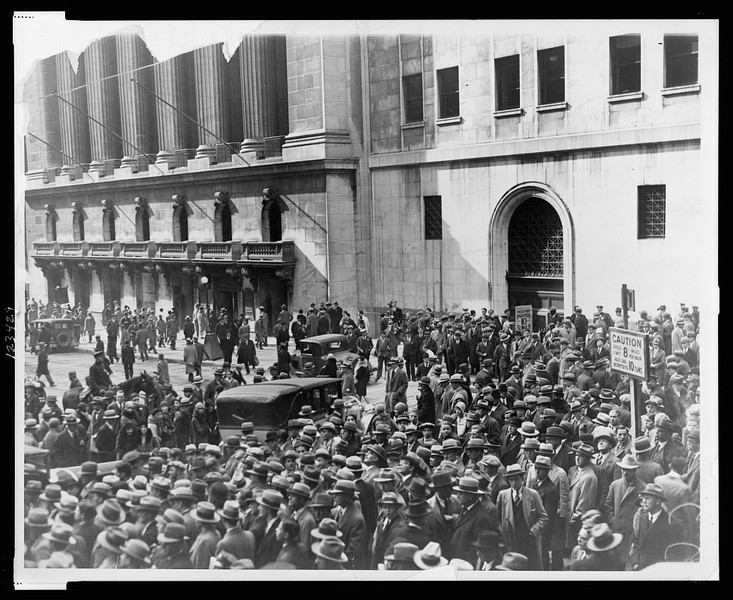
Crowd outside the New York Stock Exchange, 1929
Banking weakness and Federal Reserve failures
This is one of the most tested causes because students often forget how central banks were.
- The U.S. had thousands of small banks and no FDIC, so deposits were not insured.
- Bank runs wiped out savings when frightened depositors rushed to withdraw money.
- More than 9,000 banks failed from 1930 to 1933.
- The Federal Reserve failed to act aggressively as lender of last resort.
- The money supply shrank by about one-third from 1929 to 1933.
- Deflation made debt heavier because the dollars you repaid were worth more than the dollars you borrowed.
International problems
The Depression spread through a weak world economy.
- After World War I, European debt and German reparations depended on U.S. loans.
- When American lending dried up after 1929, the whole system shook.
- The Hawley-Smoot Tariff of 1930 raised duties, led to retaliation, and reduced world trade, hurting farmers especially.
How the Crisis Fed on Itself
This is why a recession became the worst depression in U.S. history:
- Crash and fear cut spending and investment.
- Businesses lowered production.
- Layoffs and wage cuts reduced demand.
- Defaults increased.
- Banks failed and credit dried up.
- More firms collapsed and unemployment rose again.
Deflation made people delay purchases and made debts harder to repay, so the cycle kept feeding itself.
- Unemployment rose from about 3 percent in 1929 to about 25 percent in 1933.
- About 13 million people were unemployed.
- GDP fell about 29 percent.
- Industrial production fell by nearly half.
- Farm prices and incomes collapsed, and foreclosures rose.
What the Depression Looked Like in Daily Life
The economic collapse became a human crisis fast. Breadlines, soup kitchens, evictions, and Hoovervilles showed that private charity and local government could not handle a national emergency.
Families adapted however they could.
- Many delayed marriage, had fewer children, or doubled up with relatives.
- People searched for work by rail and road.
- Women often expanded unpaid or informal labor, but many faced criticism for “taking men’s jobs.”
The burden was unequal.
- African Americans were often “last hired, first fired.”
- Mexican Americans and Mexican immigrants faced discrimination and repatriation drives. Many expelled people were actually U.S. citizens.
Agriculture and the Dust Bowl
The Dust Bowl did not cause the Depression, but it made rural suffering far worse. Drought plus overplowing of Great Plains grasslands led to severe erosion.
- Hardest-hit states included Oklahoma, Texas, Kansas, Colorado, and New Mexico
- Black Sunday was April 14, 1935
- Many migrants went west to California
- “Okies” became a common label for these migrants
The map shows both the core Dust Bowl region in the southern Plains and the migration routes that carried many farm families west, especially into California.
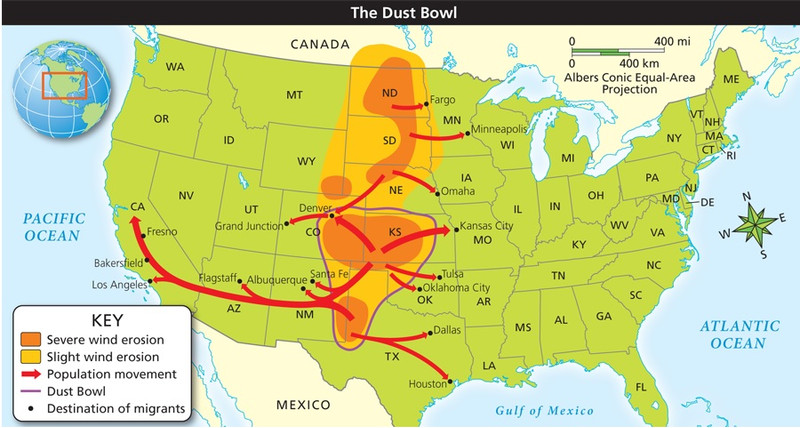
Dust Bowl migration map
That migration became one of the most memorable human stories of the 1930s. Dorothea Lange’s Migrant Mother has become an iconic image of the hardship faced by displaced farm families.
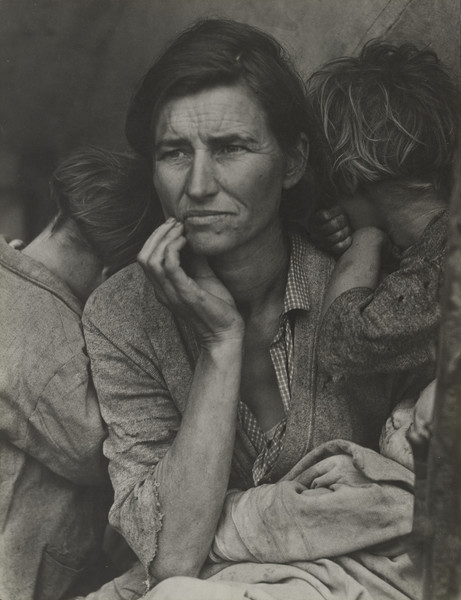
Dorothea Lange, Migrant Mother
Hoover, the Political Turning Point, and Why It Mattered
Hoover believed in voluntary cooperation, local relief, limited direct federal aid, and balanced budgets. He did act more than earlier presidents, which is worth remembering.
- Hoover Dam and other public works
- Reconstruction Finance Corporation loans to banks and businesses
- Federal Home Loan Bank Act
- Emergency Relief and Construction Act
Still, his response did not match mass unemployment and hunger. He also signed Hawley-Smoot and the Revenue Act of 1932, which raised taxes during the downturn.
The Bonus Army crisis destroyed public confidence further. In 1932, veterans demanded early bonus payments, and troops under Douglas MacArthur removed them. That looked harsh and out of touch.
In the election of 1932, Franklin D. Roosevelt promised a “new deal for the American people” and crushed Hoover. The Depression weakened faith in laissez-faire and increased support for bank regulation, federal relief, public jobs, labor protections, old-age insurance, and unemployment insurance. That shift set up the New Deal and a stronger regulatory state with a limited welfare state.
Key Takeaways
Great Depression
Severe economic collapse beginning in 1929, reaching its low point in 1933 with about 25% unemployment, and ending fully only with World War II mobilization
Agricultural Crisis of the 1920s
Postwar overproduction and declining demand lowered farm prices, leaving indebted farmers unable to pay mortgages, loans, and taxes
Overproduction and Underconsumption
Farms and factories produced more than consumers could afford, causing inventories, falling prices, production cuts, and layoffs
Unequal Distribution of Income
Profits and productivity outpaced many wages, concentrating wealth and leaving mass purchasing power too weak to sustain production
Installment Buying / Consumer Credit
Purchasing goods through borrowed money and future payments, which supported 1920s consumption but left households burdened with debt
Deflation
A general fall in prices and wages that reduced revenue, encouraged delayed purchases, and increased the real burden of fixed debts
Stock Market Speculation
Buying stocks mainly in expectation of reselling them at higher prices, creating a bubble unsupported by company earnings
Buying on Margin
Purchasing stock with a small down payment and borrowed funds, magnifying losses and forced selling when prices fell
Bank Run
A rush by depositors to withdraw money that could collapse a bank because banks kept only a fraction of deposits in cash
Federal Reserve Policy During the Great Depression
The Fed tightened credit before the crash and then failed to supply enough liquidity as lender of last resort, allowing banks and credit to collapse
Monetary Contraction
The roughly one-third decline in the money supply from 1929 to 1933, which restricted credit, caused deflation, and deepened the downturn
Gold Standard
A system tying currencies to gold that discouraged monetary expansion and spread deflation as governments protected their gold reserves
Hawley–Smoot Tariff
The 1930 law raising U.S. import duties to historic levels, provoking retaliation and further reducing international trade and American exports
Hooverville
A shantytown built by homeless people during the Depression and named sarcastically for President Herbert Hoover
Mexican Repatriation
The encouraged or coerced removal of hundreds of thousands of people of Mexican descent during the 1930s, including many U.S. citizens
Dust Bowl
Drought and wind erosion on overplowed Great Plains farmland that ruined farms and intensified Depression-era poverty and migration
Okies
Often-derogatory name for Great Plains migrants, especially from Oklahoma, who traveled west and frequently became low-paid California farmworkers
Dorothea Lange
Documentary photographer whose Depression-era images, especially Migrant Mother, built public awareness of rural poverty and displacement
Migrant Mother
Dorothea Lange’s 1936 photograph of Florence Owens Thompson and her children, symbolizing migrant families’ insecurity and hardship
Herbert Hoover
President who expanded federal intervention but favored voluntary cooperation and local relief, resisted direct federal aid, and failed to halt the collapse
Reconstruction Finance Corporation
Hoover’s 1932 agency that lent federal money to banks, railroads, insurers, and other institutions to stabilize credit
Bonus Army
World War I veterans who marched on Washington in 1932 for early bonus payments and were forcibly removed by troops under Douglas MacArthur
Election of 1932
Franklin D. Roosevelt decisively defeated Herbert Hoover after promising a “new deal,” signaling voters’ willingness to accept broader federal responsibility for relief and recovery
Franklin D. Roosevelt
Democratic victor in 1932 whose promise of a new deal represented voters’ acceptance of a more active federal response to the Depression
Modern American Liberalism
The belief that federal regulation and social provision are necessary to protect meaningful freedom and economic security in an industrial society
Limited Welfare State
A system in which the federal government regulates capitalism and reduces insecurity without replacing private property, markets, or private employment
Stock Market Crash of 1929
The prolonged market collapse beginning in 1929 that destroyed wealth and confidence and accelerated the decline of an already vulnerable economy
Black Tuesday
October 29, 1929, when panic selling culminated in severe stock-market losses during the crash
Bank Failures
The collapse of more than 9,000 banks from 1930 to 1933, erasing savings, restricting credit, and deepening the Depression
Notes
Great Depression
Severe economic collapse beginning in 1929, reaching its low point in 1933 with about 25% unemployment, and ending fully only with World War II mobilization
Agricultural Crisis of the 1920s
Postwar overproduction and declining demand lowered farm prices, leaving indebted farmers unable to pay mortgages, loans, and taxes
Overproduction and Underconsumption
Farms and factories produced more than consumers could afford, causing inventories, falling prices, production cuts, and layoffs
Unequal Distribution of Income
Profits and productivity outpaced many wages, concentrating wealth and leaving mass purchasing power too weak to sustain production
Installment Buying / Consumer Credit
Purchasing goods through borrowed money and future payments, which supported 1920s consumption but left households burdened with debt
Deflation
A general fall in prices and wages that reduced revenue, encouraged delayed purchases, and increased the real burden of fixed debts
Stock Market Speculation
Buying stocks mainly in expectation of reselling them at higher prices, creating a bubble unsupported by company earnings
Buying on Margin
Purchasing stock with a small down payment and borrowed funds, magnifying losses and forced selling when prices fell
Bank Run
A rush by depositors to withdraw money that could collapse a bank because banks kept only a fraction of deposits in cash
Federal Reserve Policy During the Great Depression
The Fed tightened credit before the crash and then failed to supply enough liquidity as lender of last resort, allowing banks and credit to collapse
Monetary Contraction
The roughly one-third decline in the money supply from 1929 to 1933, which restricted credit, caused deflation, and deepened the downturn
Gold Standard
A system tying currencies to gold that discouraged monetary expansion and spread deflation as governments protected their gold reserves
Hawley–Smoot Tariff
The 1930 law raising U.S. import duties to historic levels, provoking retaliation and further reducing international trade and American exports
Hooverville
A shantytown built by homeless people during the Depression and named sarcastically for President Herbert Hoover
Mexican Repatriation
The encouraged or coerced removal of hundreds of thousands of people of Mexican descent during the 1930s, including many U.S. citizens
Dust Bowl
Drought and wind erosion on overplowed Great Plains farmland that ruined farms and intensified Depression-era poverty and migration
Okies
Often-derogatory name for Great Plains migrants, especially from Oklahoma, who traveled west and frequently became low-paid California farmworkers
Dorothea Lange
Documentary photographer whose Depression-era images, especially Migrant Mother, built public awareness of rural poverty and displacement
Migrant Mother
Dorothea Lange’s 1936 photograph of Florence Owens Thompson and her children, symbolizing migrant families’ insecurity and hardship
Herbert Hoover
President who expanded federal intervention but favored voluntary cooperation and local relief, resisted direct federal aid, and failed to halt the collapse
Reconstruction Finance Corporation
Hoover’s 1932 agency that lent federal money to banks, railroads, insurers, and other institutions to stabilize credit
Bonus Army
World War I veterans who marched on Washington in 1932 for early bonus payments and were forcibly removed by troops under Douglas MacArthur
Election of 1932
Franklin D. Roosevelt decisively defeated Herbert Hoover after promising a “new deal,” signaling voters’ willingness to accept broader federal responsibility for relief and recovery
Franklin D. Roosevelt
Democratic victor in 1932 whose promise of a new deal represented voters’ acceptance of a more active federal response to the Depression
Modern American Liberalism
The belief that federal regulation and social provision are necessary to protect meaningful freedom and economic security in an industrial society
Limited Welfare State
A system in which the federal government regulates capitalism and reduces insecurity without replacing private property, markets, or private employment
Stock Market Crash of 1929
The prolonged market collapse beginning in 1929 that destroyed wealth and confidence and accelerated the decline of an already vulnerable economy
Black Tuesday
October 29, 1929, when panic selling culminated in severe stock-market losses during the crash
Bank Failures
The collapse of more than 9,000 banks from 1930 to 1933, erasing savings, restricting credit, and deepening the Depression
