Topic 5.12 Notes – Comparison in Period 5
What the Civil War Changed in American Values
Before the war, expansion after 1844 kept forcing the same question into new places. Would the United States grow as a nation of free labor or slave labor?
- Manifest Destiny gave expansion a moral glow and helped justify the annexation of Texas, the Mexican-American War, and the Mexican Cession.
- Each new territory reopened the slavery fight. The Compromise of 1850 tried to settle the question, but the Kansas-Nebraska Act reopened it by letting settlers vote on slavery in territories the Missouri Compromise had closed to it.
- Northerners often backed free labor, the idea that people should sell their own work and have a chance to rise.
- Southern elites defended slavery as a positive good, not just a necessary evil.
- Abolitionists attacked slavery as immoral, even as many white Northerners still rejected racial equality.
Expansion kept intensifying sectional conflict, especially after Texas annexation and the Mexican Cession added huge western lands.
Politics cracked under that pressure.
- The Whig Party collapsed.
- The Republican Party rose by opposing slavery’s expansion.
- Dred Scott v. Sandford said Black people could not be citizens and Congress could not ban slavery in the territories.
- Lincoln’s election in 1860 convinced many slave states that their power was slipping, and secession followed.
Questions about national identity were wider than slavery alone.
- Irish and German immigrants increased nativist fears.
- Westward settlement meant the displacement of American Indians and pressure on Mexican Americans in the Southwest.
- U.S. expansion also reached outward through the Treaty of Wangxia, Commodore Matthew Perry’s expedition, and the Treaty of Kanagawa.
The Four Biggest Effects of the Civil War
These effects matter most because they changed the nation’s core values in different ways.
Preservation of the Union
Union victory settled secession in practice. States could not just leave.
- The North had more manpower, more industry, stronger railroads, and stronger national leadership under Lincoln.
- Better Union strategy and the Confederacy’s weakening position turned those advantages into victory.
- This established federal supremacy over state claims of sovereignty.
This was one of the most durable outcomes because it did not get rolled back after 1877.
Destruction of Slavery and the Meaning of Freedom
The war began to save the Union. It became a war against slavery over time.
- Enslaved people pushed this change by escaping, refusing labor, and aiding Union forces.
- The Second Confiscation Act and the Union victory at Antietam opened the way for the Emancipation Proclamation.
- The proclamation made abolition a Union war aim and allowed Black enlistment.
- Nearly 200,000 African American soldiers and sailors served.
- The Gettysburg Address tied victory to a “new birth of freedom.”
- The Thirteenth Amendment permanently abolished slavery.
Freedom meant more than legal release. Freedpeople sought family reunion, marriage, churches, schools, control of labor, and movement. Still, Black Codes, sharecropping, the crop-lien system, and no broad land redistribution limited that freedom.
Citizenship, Equality, and Political Participation
Reconstruction tried to answer who counted as a full American.
| Measure | What it did |
|---|---|
| Civil Rights Act of 1866 | Declared birthright citizenship and basic civil rights |
| Fourteenth Amendment | Overturned Dred Scott; birthright citizenship, due process, equal protection |
| Fifteenth Amendment | Barred denial of voting rights by race, color, or previous condition of servitude |
Black men voted, held office, joined conventions, and helped build public schools. But Ku Klux Klan terror, weak enforcement, and hostile court rulings undercut equality.
Women’s rights activists split here. Stanton and Anthony opposed a settlement that enfranchised Black men but not women. Lucy Stone and others supported the amendments anyway. Native peoples and Mexican Americans still faced exclusion, and “Indians not taxed” showed the limits of inclusion.
Expansion of Federal Power
The war made the national government stronger in daily life.
- Wartime power grew through conscription, taxes, paper currency, and the national banking system.
- Republicans also passed the Homestead Act and backed the transcontinental railroad.
- Reconstruction expanded federal responsibility through the Freedmen’s Bureau, Reconstruction Acts of 1867, and Enforcement Acts.
- Andrew Johnson fought Congressional Republicans and was impeached.
The key limit is easy to miss. Federal power grew, but federal commitment to protecting rights faded by 1877.
Which Effect Was Most Significant
A strong comparison needs a clear standard.
- Pick immediacy, durability, or long-term reach.
- Make a claim about the most significant effect.
- Compare it directly to another effect.
- Explain why the other one mattered less by that standard.
- By immediacy and human impact, emancipation was biggest because about four million people were freed.
- By completeness and durability, preservation of the Union was strongest because secession stayed settled.
- By long-term constitutional importance, the Fourteenth Amendment reached furthest because later civil rights struggles depended on it.
- By practical enforcement at the time, equality was weakest because white resistance and Northern retreat crippled Reconstruction.
Why the Civil War’s Legacy Was Transformative but Incomplete
The war ended slavery and secession. It did not end racial hierarchy.
- Freedom advanced further than equality.
- National power advanced further than protection of rights.
- By 1877, sectional reunion mattered more to many white Northerners than defending freedpeople.
Memory of the war stayed contested.
- Union memory stressed national survival.
- African American memory stressed emancipation and Black military service.
- The Lost Cause minimized slavery and defended white Southern resistance.
Images of Black Union soldiers became part of that memory, especially for African Americans who tied the war to emancipation and military service.
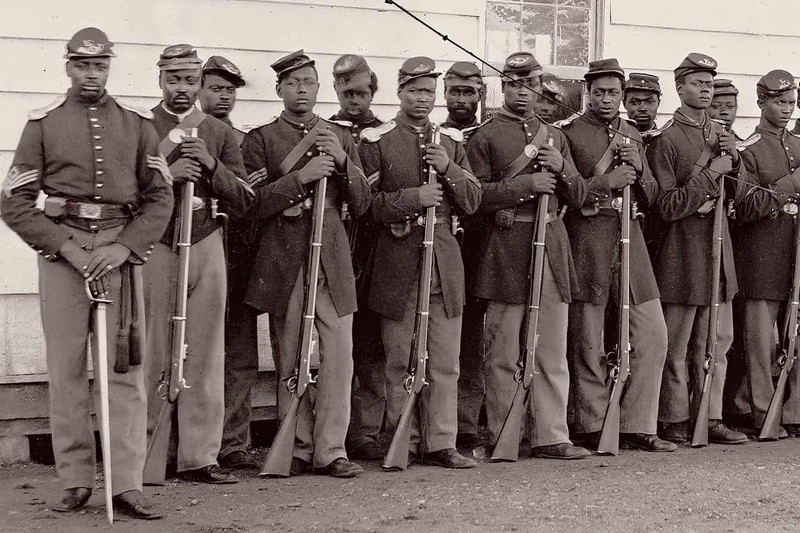
African American Union soldiers during the Civil War
