Topic 6.5 Notes – Technological Innovation
How Technological Innovation Drove the Second Industrial Revolution
Industrial growth after 1865 came from a whole chain working together, not from one inventor having one smart idea. The pattern looked like this:
- resource extraction pulled up coal, iron ore, oil, copper, and timber
- industrial processing turned them into steel, kerosene, machinery, and wiring
- transportation and communication networks moved goods and information fast
- larger markets let firms sell nationally
- lower costs encouraged more mechanization and expansion
That’s the key AP point. An invention mattered most when businesses could use it on a broad commercial scale.
Earlier tools already existed, including patents, factories, railroads, steam power, interchangeable parts, and the telegraph. After the Civil War, those older pieces were used on a much bigger, more connected scale.
Conditions that pushed innovation forward:
- Natural resources were abundant. The U.S. had rich deposits of coal, iron ore, petroleum, copper, and huge forests.
- Railroads linked mines, forests, oil fields, farms, and factories, so resources could actually be used.
- Population growth from immigration and internal migration gave businesses both workers and customers.
- The patent system rewarded invention and made investors more willing to fund new ideas.
- Private capital, along with some government help for infrastructure, financed expansion.
A national railroad map like this helps connect those conditions. The dense web of lines shows how resources and finished goods could move across regions, which made large-scale industrial growth possible.
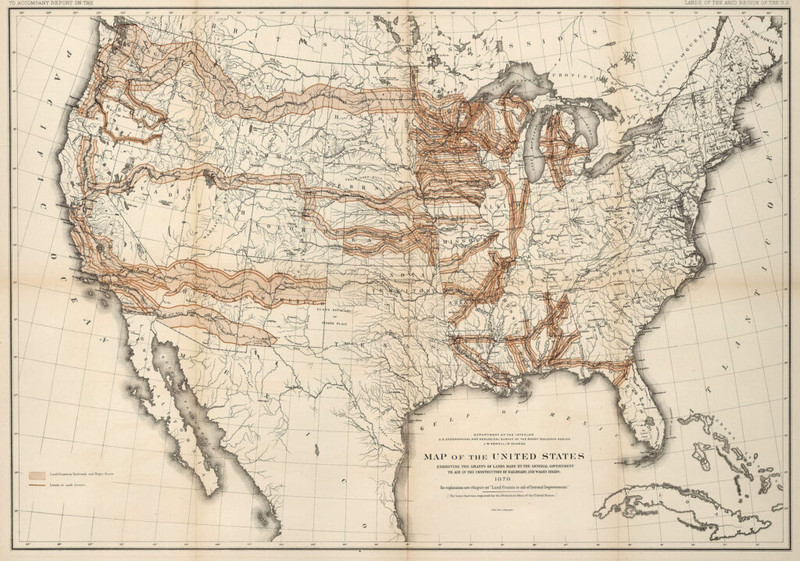
U.S. railroad network, late 1800s
The Big Technologies That Expanded Production
These technologies worked together. Steel built the system, oil fueled parts of it, electricity powered it, and communication and transportation let it spread.
Steel and heavy industry
- The Bessemer process and William Kelly’s similar work made steel faster and cheaper to produce.
- Open-hearth furnaces later gave producers better control and let them reuse scrap.
- Andrew Carnegie became the best-known steel industrialist by using efficient large-scale production.
- Cheap steel transformed the economy. It made stronger railroad tracks, factory machines, bridges, ships, tools, and wire possible.
- The Brooklyn Bridge opened in 1883 and showed what steel could do.
- Steel-frame construction plus elevators made skyscrapers possible. The Home Insurance Building in Chicago, completed in 1885, is a classic early example.
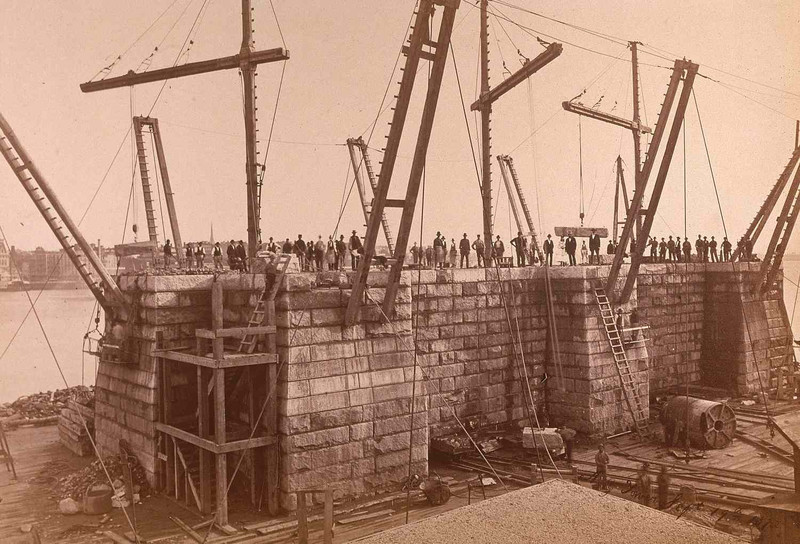
Brooklyn Bridge under construction
Petroleum and industrial energy
- Edwin Drake’s 1859 well at Titusville, Pennsylvania launched commercial oil extraction.
- The main product in this period was kerosene for lighting, not gasoline.
- Petroleum also provided lubricants for factory machinery.
- John D. Rockefeller and Standard Oil dominated refining and distribution.
- Pipelines, tank cars, and refineries turned crude oil into a mass commodity.
- Coal still remained the main industrial power source in the Gilded Age.
Electricity as a system
- Thomas Edison developed a practical incandescent light bulb in 1879.
- Pearl Street Station in 1882 showed that central power generation could serve many customers.
- In the War of Currents, Edison backed DC, which worked over short distances. George Westinghouse and Nikola Tesla pushed AC, which worked better over long distances.
- The Niagara Falls hydroelectric project in the 1890s proved large-scale generation and transmission.
- Electricity powered lights, motors, elevators, streetcars, and new electrical industries.
Networks That Created a National Market
Communication networks
- Samuel F. B. Morse and Morse code made the telegraph practical.
- Telegraph lines often followed railroad routes, which linked communication to transportation.
- Businesses used telegraphs for prices, orders, shipments, and coordination.
- Western Union dominated telegraph service.
- Cyrus Field’s transatlantic cable in 1866 connected the U.S. and Europe far more quickly.
- Alexander Graham Bell received a telephone patent in 1876.
- Telephone exchanges made phone communication practical across networks.
- AT&T grew out of Bell’s system.
- Telephone operators, many of them women, became a new kind of job.
Transportation improvements
- Railroads tied together raw materials, factories, farms, and consumers.
- Important improvements included steel rails, Westinghouse air brake (1869), automatic couplers, and standardized track gauge.
- Telegraph systems helped railroads coordinate movement.
- Standard time zones were adopted in 1883 so national schedules could work.
- Refrigerated railroad cars changed food distribution. Gustavus Swift used them in Chicago meatpacking so dressed beef could be shipped east instead of live cattle.
- Electric streetcars, elevated railways, and commuter lines pushed cities outward.
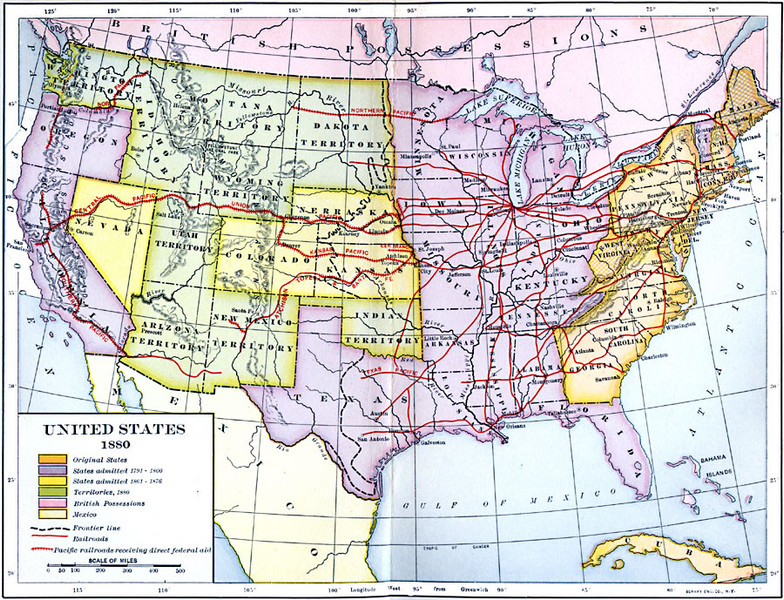
U.S. railroad network, 1880
How Mechanization Changed Work, Business, and Daily Life
Factories produced more by combining mechanization, standardization, division of labor, and continuous-process production. Machine tools and interchangeable parts made products more uniform and easier to repair.
- Industries like meatpacking used narrow, repetitive tasks. This was before Ford’s 1913 moving assembly line, which is outside this topic’s main period.
- The Linotype machine, typewriters, and faster printing presses supported mass newspapers and modern business offices.
- Work changed in mixed ways:
- less need for some old craft skills
- more demand for engineers, machinists, electricians, managers, clerical workers, and operators
- more repetitive, machine-paced, dangerous labor
- Society changed too:
- lower prices and more standardized goods
- growth of large corporations because machinery and networks required huge capital
- more urbanization, western resource extraction, and national integration
- uneven access, since cities and wealthier users got electricity and telephones first
- environmental damage from mining, coal smoke, oil waste, deforestation, and urban pollution
Key Takeaways
Second Industrial Revolution
Post–Civil War transformation centered on steel, petroleum, electricity, machinery, and national transportation and communication networks
Patent System
Legal protection for inventors’ claims that encouraged experimentation, investment, and commercialization
Open-Hearth Furnace
Steelmaking method that provided greater control over steel’s composition and allowed the use of scrap metal
Andrew Carnegie
Steel industrialist whose companies adopted new machinery and efficient methods to increase output and lower costs
Steel-Frame Skyscraper
Tall urban building made possible by strong steel frames, elevators, and demand for concentrated commercial space
Edwin Drake
Drilled a commercially successful oil well near Titusville, Pennsylvania, in 1859, demonstrating systematic petroleum extraction
Petroleum Refining
Process that separated crude oil into useful products such as kerosene and industrial lubricants
Thomas Edison
Developed a commercially practical incandescent lamp and an integrated system of generators, wiring, and direct-current distribution
War of Currents: Direct Current vs. Alternating Current
Edison’s short-range DC competed with Westinghouse’s AC, which could transmit electricity efficiently over much longer distances
Nikola Tesla
Inventor whose patents and electrical innovations contributed to the alternating-current system promoted by George Westinghouse
Western Union
Dominant telegraph company whose extensive network connected businesses and markets across the nation
Telephone Exchange
Central switching office that connected many telephone subscribers instead of limiting service to two fixed points
Steel Rails
Stronger and more durable than iron rails, allowing railroads to carry heavier loads with greater reliability
Westinghouse Air Brake
Patented in 1869, it allowed train crews to apply brakes throughout a train from the locomotive
Standardized Track Gauge
Uniform distance between rails that allowed trains and cars to move between different companies’ lines without unloading cargo
Standard Time Zones
Uniform regional times adopted by railroads in 1883 to eliminate confusion caused by local solar time
Electric Streetcars
Electric urban transit that replaced many horse-drawn lines and enabled cities to expand outward
Interchangeable Parts
Standardized components that simplified assembly, enabled machine production, and made repairs easier
Mechanization
Use of machines to perform tasks previously done by hand, increasing speed and output
Standardization
Making products and parts to uniform specifications so they could be produced consistently on a large scale
Division of Labor
Separation of production into specialized, repeated tasks performed by different workers
Continuous-Process Production
Uninterrupted industrial processing used especially in steelmaking and petroleum refining to increase output
Large-Scale Production
Coordinated use of machinery, standardized parts, specialized labor, raw materials, and distribution to produce goods in great quantities
Linotype Machine
1880s machine that set type rapidly and helped make mass-circulation newspapers practical
Typewriter
Commercial office machine that increased the speed and standardization of correspondence and expanded clerical work
Henry Bessemer
British inventor who developed and publicized the Bessemer steelmaking process during the 1850s
Bessemer Process
Steelmaking process that forced air through molten iron to remove impurities, making steel faster and cheaper to produce
John D. Rockefeller
Industrialist whose Standard Oil became dominant in petroleum refining and distribution
Standard Oil
Rockefeller’s dominant petroleum refining and distribution company
George Westinghouse
Inventor and industrialist who patented the railroad air brake and promoted alternating-current electrical distribution
Incandescent Lamp
Commercially practical electric light developed by Edison and his researchers in 1879
Samuel F. B. Morse
Helped develop a practical electrical telegraph and the coded signaling system known as Morse code
Telegraph
Electrical communication system that sent coded messages rapidly over wires, helping coordinate railroads, businesses, and markets
Cyrus Field
Organizer whose efforts produced a durable transatlantic telegraph cable in 1866
Transatlantic Telegraph Cable
Durable 1866 cable that allowed messages between North America and Europe to cross the Atlantic in minutes
Alexander Graham Bell
Inventor who received a major telephone patent in 1876 and demonstrated the electrical transmission of speech
Telephone
Technology that transmitted speech electrically, allowing businesses and individuals to communicate directly over distance
Gustavus Swift
Meatpacking entrepreneur who used refrigerated railroad cars to ship dressed beef from Chicago to distant markets
Refrigerated Railroad Car
Railcar that carried meat, dairy products, fruits, and vegetables over long distances without rapid spoilage
Automatic Coupler
Railroad device that linked cars automatically, reducing the danger of coupling them by hand
Coal
The Gilded Age’s principal industrial fuel, powering locomotives, steam engines, factories, furnaces, and steel production
Notes
Second Industrial Revolution
Post–Civil War transformation centered on steel, petroleum, electricity, machinery, and national transportation and communication networks
Patent System
Legal protection for inventors’ claims that encouraged experimentation, investment, and commercialization
Open-Hearth Furnace
Steelmaking method that provided greater control over steel’s composition and allowed the use of scrap metal
Andrew Carnegie
Steel industrialist whose companies adopted new machinery and efficient methods to increase output and lower costs
Steel-Frame Skyscraper
Tall urban building made possible by strong steel frames, elevators, and demand for concentrated commercial space
Edwin Drake
Drilled a commercially successful oil well near Titusville, Pennsylvania, in 1859, demonstrating systematic petroleum extraction
Petroleum Refining
Process that separated crude oil into useful products such as kerosene and industrial lubricants
Thomas Edison
Developed a commercially practical incandescent lamp and an integrated system of generators, wiring, and direct-current distribution
War of Currents: Direct Current vs. Alternating Current
Edison’s short-range DC competed with Westinghouse’s AC, which could transmit electricity efficiently over much longer distances
Nikola Tesla
Inventor whose patents and electrical innovations contributed to the alternating-current system promoted by George Westinghouse
Western Union
Dominant telegraph company whose extensive network connected businesses and markets across the nation
Telephone Exchange
Central switching office that connected many telephone subscribers instead of limiting service to two fixed points
Steel Rails
Stronger and more durable than iron rails, allowing railroads to carry heavier loads with greater reliability
Westinghouse Air Brake
Patented in 1869, it allowed train crews to apply brakes throughout a train from the locomotive
Standardized Track Gauge
Uniform distance between rails that allowed trains and cars to move between different companies’ lines without unloading cargo
Standard Time Zones
Uniform regional times adopted by railroads in 1883 to eliminate confusion caused by local solar time
Electric Streetcars
Electric urban transit that replaced many horse-drawn lines and enabled cities to expand outward
Interchangeable Parts
Standardized components that simplified assembly, enabled machine production, and made repairs easier
Mechanization
Use of machines to perform tasks previously done by hand, increasing speed and output
Standardization
Making products and parts to uniform specifications so they could be produced consistently on a large scale
Division of Labor
Separation of production into specialized, repeated tasks performed by different workers
Continuous-Process Production
Uninterrupted industrial processing used especially in steelmaking and petroleum refining to increase output
Large-Scale Production
Coordinated use of machinery, standardized parts, specialized labor, raw materials, and distribution to produce goods in great quantities
Linotype Machine
1880s machine that set type rapidly and helped make mass-circulation newspapers practical
Typewriter
Commercial office machine that increased the speed and standardization of correspondence and expanded clerical work
Henry Bessemer
British inventor who developed and publicized the Bessemer steelmaking process during the 1850s
Bessemer Process
Steelmaking process that forced air through molten iron to remove impurities, making steel faster and cheaper to produce
John D. Rockefeller
Industrialist whose Standard Oil became dominant in petroleum refining and distribution
Standard Oil
Rockefeller’s dominant petroleum refining and distribution company
George Westinghouse
Inventor and industrialist who patented the railroad air brake and promoted alternating-current electrical distribution
Incandescent Lamp
Commercially practical electric light developed by Edison and his researchers in 1879
Samuel F. B. Morse
Helped develop a practical electrical telegraph and the coded signaling system known as Morse code
Telegraph
Electrical communication system that sent coded messages rapidly over wires, helping coordinate railroads, businesses, and markets
Cyrus Field
Organizer whose efforts produced a durable transatlantic telegraph cable in 1866
Transatlantic Telegraph Cable
Durable 1866 cable that allowed messages between North America and Europe to cross the Atlantic in minutes
Alexander Graham Bell
Inventor who received a major telephone patent in 1876 and demonstrated the electrical transmission of speech
Telephone
Technology that transmitted speech electrically, allowing businesses and individuals to communicate directly over distance
Gustavus Swift
Meatpacking entrepreneur who used refrigerated railroad cars to ship dressed beef from Chicago to distant markets
Refrigerated Railroad Car
Railcar that carried meat, dairy products, fruits, and vegetables over long distances without rapid spoilage
Automatic Coupler
Railroad device that linked cars automatically, reducing the danger of coupling them by hand
Coal
The Gilded Age’s principal industrial fuel, powering locomotives, steam engines, factories, furnaces, and steel production
