Topic 8.8 Notes – The Vietnam War
Why the United States Fought in Vietnam
Vietnam was three conflicts at once. It was an anticolonial struggle against France, a civil war between North and South Vietnam, and a Cold War proxy war involving the U.S., Soviet Union, and China.
After World War II, U.S. foreign policy centered on containment, the idea that communism had to be stopped from spreading. That shaped everything in Vietnam.
- Ho Chi Minh was both a communist and a Vietnamese nationalist. That dual role matters because Americans often saw only the communist side, while many Vietnamese saw a leader fighting foreign rule.
- Vietnam had been part of French Indochina. Japan occupied it during World War II, and in 1945 Ho declared independence after Japan’s defeat.
- France tried to return, which started the First Indochina War between France and the Viet Minh.
- After the communist victory in China in 1949 and the Korean War, the U.S. sent major aid to France because Vietnam now looked like part of a larger communist advance.
- Dien Bien Phu in 1954 ended French rule after a decisive French defeat.
Geneva Accords of 1954
- Vietnam was temporarily split at the 17th parallel.
- North Vietnam came under Ho Chi Minh.
- South Vietnam came under Ngo Dinh Diem.
- Elections to reunify Vietnam were planned for 1956, but they never happened because the U.S. and Diem feared Ho would win.
That division helps explain the map below, which also previews how fighting later spread through Laos and Cambodia.
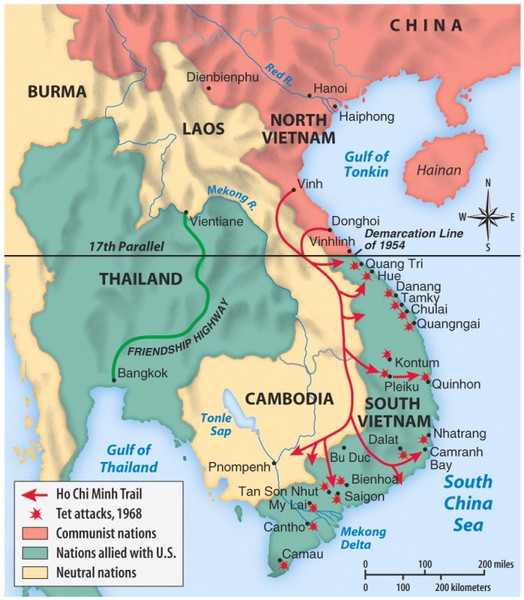
Vietnam divided at the 17th parallel
The U.S. stayed for several connected reasons:
- Containment meant stopping communism here.
- Domino theory said one communist victory could trigger others in Asia.
- Credibility meant allies might doubt U.S. promises if America quit.
- Decolonizing Asia had become a competition for influence between Cold War blocs.
South Vietnam made this harder by being weak from the start.
- Diem ruled harshly, favored Catholics in a mostly Buddhist country, and alienated many peasants.
- The Buddhist crisis exploded into global headlines when monks publicly self-immolated.
- A 1963 coup killed Diem, but instability got worse, not better.
- In the South, the National Liberation Front, often called the Viet Cong, fought the government.
- North Vietnam supplied that insurgency through the Ho Chi Minh Trail in Laos and Cambodia.
How the War Escalated Under Kennedy and Johnson
American entry into full war happened step by step. Kennedy expanded advisers. Johnson turned that commitment into a huge undeclared war.
Kennedy’s expanding commitment
- U.S. advisers grew from about 900 to more than 16,000.
- Kennedy backed counterinsurgency, using helicopters, intelligence, and Special Forces.
- The strategic hamlet program moved villagers into fortified settlements to isolate guerrillas, but it backfired because many peasants hated being displaced.
Gulf of Tonkin and presidential power
- On August 2, 1964, the USS Maddox clashed with North Vietnamese boats.
- A second attack on August 4 was later heavily disputed.
- Congress passed the Gulf of Tonkin Resolution, giving Johnson broad authority without a formal declaration of war.
- This became a huge constitutional issue because Congress had handed war-making discretion to the president.
Johnson’s escalation
- Operation Rolling Thunder began sustained bombing of North Vietnam.
- The first combat troops landed at Da Nang in 1965.
- Troop levels climbed past 500,000.
- Robert McNamara supported gradual escalation, trying to pressure North Vietnam without provoking China or the USSR.
- This was a limited war, which meant huge force but important limits.
- Napalm burned people and villages.
- Agent Orange stripped jungle cover and caused long-term environmental and health damage.
- Massive bombing still failed to break enemy resolve.
Why the United States Could Not Win Decisively
The U.S. usually won battles. It struggled to win the war’s political goal.
- General William Westmoreland used attrition, trying to kill enemy forces faster than they could be replaced.
- Search-and-destroy missions aimed to find and hit enemy units.
- Body counts became a fake sign of progress because killing more enemy soldiers did not equal controlling the countryside.
Stalemate developed because:
- guerrilla warfare let enemies move, hide, and choose when to fight
- the Viet Cong blended into the civilian population
- North Vietnam accepted enormous losses
- the Ho Chi Minh Trail kept working despite bombing
- South Vietnam lacked legitimacy and stability
- U.S. tactics often hurt civilians and damaged “hearts and minds”
- military victories did not create lasting political control
Tet Offensive in 1968
The Tet Offensive hit cities across South Vietnam, including Saigon and Hue.
- Militarily, it was a setback for the Viet Cong.
- Politically, it was a turning point in the U.S.
- It exposed the credibility gap between official optimism and battlefield reality.
- Walter Cronkite became a famous symbol of rising public doubt.
- Johnson then limited escalation and chose not to run again.
How the War Ended and What It Changed
Nixon’s Vietnamization
Nixon promised “peace with honor.”
- Vietnamization pulled out U.S. ground troops and shifted more fighting to South Vietnamese forces.
- Henry Kissinger helped run this strategy.
- The Nixon Doctrine said allies should provide most of their own ground troops.
Even during withdrawal, the war widened.
- Nixon secretly bombed Cambodia.
- The 1970 Cambodia incursion triggered the Kent State shootings.
- South Vietnamese forces, backed by the U.S., entered Laos in 1971.
Secrecy and trust
- The Pentagon Papers, leaked by Daniel Ellsberg, showed that multiple administrations had misled the public.
- In New York Times Co. v. United States (1971), the Supreme Court rejected prior restraint and allowed publication.
Peace and collapse
- The Paris Peace Accords in 1973 ended direct U.S. involvement.
- U.S. troops left and POWs returned.
- North Vietnamese troops remained in the South.
- In 1975, Saigon fell and Vietnam was reunified under communist rule.
- Laos also went communist, and Cambodia fell to the Khmer Rouge.
The rooftop helicopter evacuation from Saigon became one of the most recognizable images of the war’s final collapse.
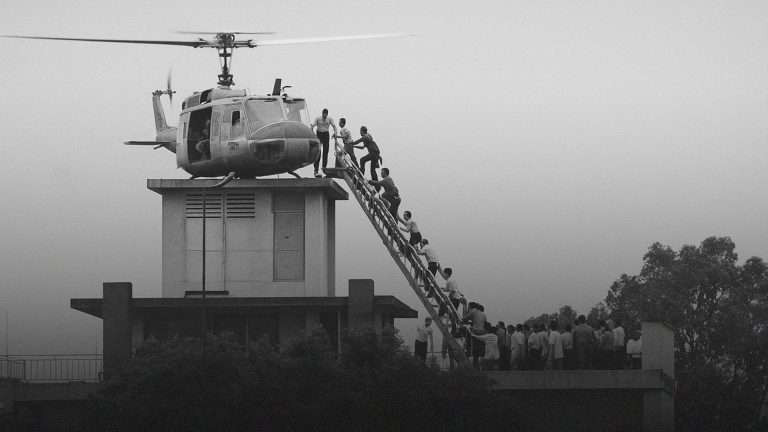
Evacuation during the fall of Saigon, 1975
Major effects of the war:
- over 58,000 Americans died, and millions of Vietnamese died
- Vietnam, Laos, and Cambodia were devastated
- war spending fueled inflation and strained Great Society programs
- the antiwar movement grew, and the draft ended in 1973
- Congress repealed the Gulf of Tonkin Resolution and passed the War Powers Resolution in 1973
- the war left lasting arguments about executive power, trust in government, and the Vietnam syndrome
Key Takeaways
Containment in Vietnam
Cold War policy of preventing communist expansion; led U.S. officials to support France and then anticommunist South Vietnam
Harry S. Truman
President who began financing and equipping France’s war against Ho Chi Minh as Vietnam became linked to Cold War containment
Ho Chi Minh
Vietnamese nationalist and communist who led the struggle against French rule and later headed communist North Vietnam
Viet Minh
Ho Chi Minh’s League for the Independence of Vietnam, which fought Japan and then France for Vietnamese independence
First Indochina War
War between France and the Viet Minh that ended with French defeat and the collapse of French colonial rule in Vietnam
Battle of Dien Bien Phu
The Viet Minh’s decisive 1954 defeat of French forces, which ended France’s effort to retain Vietnam
Geneva Conference of 1954
Settlement temporarily dividing Vietnam at the 17th parallel and calling for nationwide reunification elections in 1956
Dwight D. Eisenhower
President who supported a separate anticommunist South Vietnam, backed Ngo Dinh Diem, and justified aid through the domino theory
Domino Theory
Belief that a communist victory in South Vietnam would cause nearby Southeast Asian countries to fall to communism in succession
Ngo Dinh Diem
U.S.-backed anticommunist leader of South Vietnam whose repressive government lacked broad support; he was overthrown and killed in a 1963 coup
National Liberation Front and Viet Cong
The NLF organized the southern insurgency in 1960; Americans called its communist-led armed forces the Viet Cong
Ho Chi Minh Trail
Network through Laos and Cambodia that carried North Vietnamese troops and supplies into South Vietnam despite heavy bombing
Guerrilla Warfare
Use of ambushes, sabotage, local organization, and concealment among civilians to avoid conventional American firepower
John F. Kennedy
President who expanded counterinsurgency aid and increased U.S. military advisers in Vietnam from about 900 to over 16,000
Strategic Hamlet Program
U.S.-backed program that moved rural Vietnamese into fortified settlements to isolate the Viet Cong but often alienated displaced peasants
Gulf of Tonkin Incident
1964 naval incidents used by Johnson to claim North Vietnamese aggression, although the reported August 4 attack almost certainly did not occur as described
Gulf of Tonkin Resolution
1964 measure authorizing Johnson to take “all necessary measures” in Vietnam, enabling major escalation without a declaration of war
Lyndon B. Johnson
President who used the Gulf of Tonkin Resolution to begin sustained bombing and send large numbers of American combat troops
Robert McNamara
Johnson’s secretary of defense and an architect of gradual escalation intended to pressure North Vietnam without provoking China or the Soviet Union
Operation Rolling Thunder
Sustained 1965–1968 American bombing campaign intended to pressure North Vietnam into ending its support for the war
Limited War
Conflict fought for restricted objectives and with limits on targets and geography to avoid direct Chinese or Soviet intervention
Agent Orange
Chemical defoliant used to expose enemy forces and supply routes; later associated with severe environmental damage and long-term health problems
General William Westmoreland
Commander of U.S. forces who pursued attrition through search-and-destroy operations and measured progress largely through enemy body counts
Attrition Strategy
Strategy of killing enemy forces faster than North Vietnam and the Viet Cong could replace them
Search-and-Destroy Operations
American missions that located and attacked enemy units before withdrawing rather than permanently controlling territory
Selective Service System and the Draft
System that conscripted young men for military service; unequal deferments and combat burdens intensified opposition to the war
Antiwar Movement
Growing opposition driven by the draft, casualties, prolonged escalation, civilian harm, and doubts about official claims and legality
Tet Offensive
Coordinated communist attacks across South Vietnam in January 1968 that failed militarily but shattered claims that victory was near
Credibility Gap
Growing difference between government claims about progress in Vietnam and what journalists, soldiers, and the public believed the evidence showed
Richard Nixon
President who pursued “peace with honor” through Vietnamization, troop withdrawals, continued bombing, diplomacy, and expansion into Cambodia and Laos
Vietnamization
Nixon’s policy of withdrawing U.S. ground troops while expanding and equipping South Vietnamese forces to assume responsibility for the war
Nixon Doctrine
Policy of aiding allies with weapons, money, and air or naval power while expecting them to provide most ground troops
Henry Kissinger
Nixon’s national security adviser who directed diplomacy, bombing pressure, and negotiations leading to the Paris Peace Accords
Cambodian Incursion
1970 American–South Vietnamese attack on communist sanctuaries in Cambodia that widened the war and intensified U.S. antiwar protests
Pentagon Papers
Classified history leaked in 1971 showing that several administrations concealed doubts and misrepresented the expansion of U.S. involvement
Daniel Ellsberg
Former defense analyst who leaked the Pentagon Papers to the press in 1971
New York Times Co. v. United States
1971 Supreme Court decision rejecting the government’s attempt to use prior restraint to stop publication of the Pentagon Papers
Paris Peace Accords
1973 agreement providing a ceasefire, U.S. withdrawal, and prisoner return while leaving North Vietnamese forces in South Vietnam
Fall of Saigon
North Vietnam’s capture of Saigon on April 30, 1975, ending South Vietnam and reunifying Vietnam under communist rule
War Powers Resolution
1973 law requiring notice to Congress within 48 hours and generally limiting unauthorized deployments to 60 days plus 30 days for withdrawal
Vietnam Syndrome
Postwar reluctance to enter conflicts requiring large ground forces, prolonged nation-building, or unclear objectives and exit strategies
Decolonization
Postwar process by which colonies gained independence; in Vietnam, the nationalist struggle against France became entangled with the Cold War
Nonalignment
Position of remaining outside both the American-led and Soviet-led Cold War blocs, adopted by many newly independent nations
American Credibility
Belief that abandoning South Vietnam would weaken faith in U.S. commitments and encourage further communist expansion
Buddhist Crisis
1963 protests against Diem’s religious discrimination that exposed his government’s illegitimacy and helped lead to the U.S.-approved coup against him
Notes
Containment in Vietnam
Cold War policy of preventing communist expansion; led U.S. officials to support France and then anticommunist South Vietnam
Harry S. Truman
President who began financing and equipping France’s war against Ho Chi Minh as Vietnam became linked to Cold War containment
Ho Chi Minh
Vietnamese nationalist and communist who led the struggle against French rule and later headed communist North Vietnam
Viet Minh
Ho Chi Minh’s League for the Independence of Vietnam, which fought Japan and then France for Vietnamese independence
First Indochina War
War between France and the Viet Minh that ended with French defeat and the collapse of French colonial rule in Vietnam
Battle of Dien Bien Phu
The Viet Minh’s decisive 1954 defeat of French forces, which ended France’s effort to retain Vietnam
Geneva Conference of 1954
Settlement temporarily dividing Vietnam at the 17th parallel and calling for nationwide reunification elections in 1956
Dwight D. Eisenhower
President who supported a separate anticommunist South Vietnam, backed Ngo Dinh Diem, and justified aid through the domino theory
Domino Theory
Belief that a communist victory in South Vietnam would cause nearby Southeast Asian countries to fall to communism in succession
Ngo Dinh Diem
U.S.-backed anticommunist leader of South Vietnam whose repressive government lacked broad support; he was overthrown and killed in a 1963 coup
National Liberation Front and Viet Cong
The NLF organized the southern insurgency in 1960; Americans called its communist-led armed forces the Viet Cong
Ho Chi Minh Trail
Network through Laos and Cambodia that carried North Vietnamese troops and supplies into South Vietnam despite heavy bombing
Guerrilla Warfare
Use of ambushes, sabotage, local organization, and concealment among civilians to avoid conventional American firepower
John F. Kennedy
President who expanded counterinsurgency aid and increased U.S. military advisers in Vietnam from about 900 to over 16,000
Strategic Hamlet Program
U.S.-backed program that moved rural Vietnamese into fortified settlements to isolate the Viet Cong but often alienated displaced peasants
Gulf of Tonkin Incident
1964 naval incidents used by Johnson to claim North Vietnamese aggression, although the reported August 4 attack almost certainly did not occur as described
Gulf of Tonkin Resolution
1964 measure authorizing Johnson to take “all necessary measures” in Vietnam, enabling major escalation without a declaration of war
Lyndon B. Johnson
President who used the Gulf of Tonkin Resolution to begin sustained bombing and send large numbers of American combat troops
Robert McNamara
Johnson’s secretary of defense and an architect of gradual escalation intended to pressure North Vietnam without provoking China or the Soviet Union
Operation Rolling Thunder
Sustained 1965–1968 American bombing campaign intended to pressure North Vietnam into ending its support for the war
Limited War
Conflict fought for restricted objectives and with limits on targets and geography to avoid direct Chinese or Soviet intervention
Agent Orange
Chemical defoliant used to expose enemy forces and supply routes; later associated with severe environmental damage and long-term health problems
General William Westmoreland
Commander of U.S. forces who pursued attrition through search-and-destroy operations and measured progress largely through enemy body counts
Attrition Strategy
Strategy of killing enemy forces faster than North Vietnam and the Viet Cong could replace them
Search-and-Destroy Operations
American missions that located and attacked enemy units before withdrawing rather than permanently controlling territory
Selective Service System and the Draft
System that conscripted young men for military service; unequal deferments and combat burdens intensified opposition to the war
Antiwar Movement
Growing opposition driven by the draft, casualties, prolonged escalation, civilian harm, and doubts about official claims and legality
Tet Offensive
Coordinated communist attacks across South Vietnam in January 1968 that failed militarily but shattered claims that victory was near
Credibility Gap
Growing difference between government claims about progress in Vietnam and what journalists, soldiers, and the public believed the evidence showed
Richard Nixon
President who pursued “peace with honor” through Vietnamization, troop withdrawals, continued bombing, diplomacy, and expansion into Cambodia and Laos
Vietnamization
Nixon’s policy of withdrawing U.S. ground troops while expanding and equipping South Vietnamese forces to assume responsibility for the war
Nixon Doctrine
Policy of aiding allies with weapons, money, and air or naval power while expecting them to provide most ground troops
Henry Kissinger
Nixon’s national security adviser who directed diplomacy, bombing pressure, and negotiations leading to the Paris Peace Accords
Cambodian Incursion
1970 American–South Vietnamese attack on communist sanctuaries in Cambodia that widened the war and intensified U.S. antiwar protests
Pentagon Papers
Classified history leaked in 1971 showing that several administrations concealed doubts and misrepresented the expansion of U.S. involvement
Daniel Ellsberg
Former defense analyst who leaked the Pentagon Papers to the press in 1971
New York Times Co. v. United States
1971 Supreme Court decision rejecting the government’s attempt to use prior restraint to stop publication of the Pentagon Papers
Paris Peace Accords
1973 agreement providing a ceasefire, U.S. withdrawal, and prisoner return while leaving North Vietnamese forces in South Vietnam
Fall of Saigon
North Vietnam’s capture of Saigon on April 30, 1975, ending South Vietnam and reunifying Vietnam under communist rule
War Powers Resolution
1973 law requiring notice to Congress within 48 hours and generally limiting unauthorized deployments to 60 days plus 30 days for withdrawal
Vietnam Syndrome
Postwar reluctance to enter conflicts requiring large ground forces, prolonged nation-building, or unclear objectives and exit strategies
Decolonization
Postwar process by which colonies gained independence; in Vietnam, the nationalist struggle against France became entangled with the Cold War
Nonalignment
Position of remaining outside both the American-led and Soviet-led Cold War blocs, adopted by many newly independent nations
American Credibility
Belief that abandoning South Vietnam would weaken faith in U.S. commitments and encourage further communist expansion
Buddhist Crisis
1963 protests against Diem’s religious discrimination that exposed his government’s illegitimacy and helped lead to the U.S.-approved coup against him
