Topic 4.3 Notes – Politics and Regional Interests
How Regional Interests Shaped Politics in the Early Republic
The pattern to keep in your head is simple. Politicians talked about the Constitution and the national interest, but their positions often matched the needs of their region.
Three broad sections
- Northeast had shipping, commerce, and growing manufacturing. As factories expanded, many northeastern leaders wanted protective tariffs and a stable financial system because those helped industry compete.
- South depended on plantation agriculture, cotton exports, enslaved labor, and cheap imported goods. Southern leaders usually disliked tariffs because tariffs raised prices and could hurt export trade. They also defended slavery and later resisted federal interference with it.
- West wanted cheap land, easy credit, roads, canals, and access to markets. Westerners often liked federal help for transportation, but many distrusted national banking when it tightened credit.
National policy could help the whole country grow, but it never helped everyone equally. That is the core tension in this topic.
A detail teachers love to ask about is that positions could change when a region’s economy changed:
- Daniel Webster first opposed protection when New England cared more about trade, then supported tariffs when manufacturing mattered more.
- John C. Calhoun first backed nationalist policies like tariffs and internal improvements, then became a major spokesman for southern sectional interests.
Early Signs of Sectional Politics
The War of 1812 already showed the country splitting by region.
- South and West backed the war. The War Hawks wanted to defend national honor and push back against Britain.
- New England Federalists opposed it because war damaged Atlantic shipping and commerce.
Hartford Convention
This 1814 to 1815 New England Federalist meeting attacked Republican war policy and southern influence in national politics. The cartoon here mocks the convention as flirting with disunion, which is why it became such a political disaster for the Federalists. Delegates proposed amendments including:
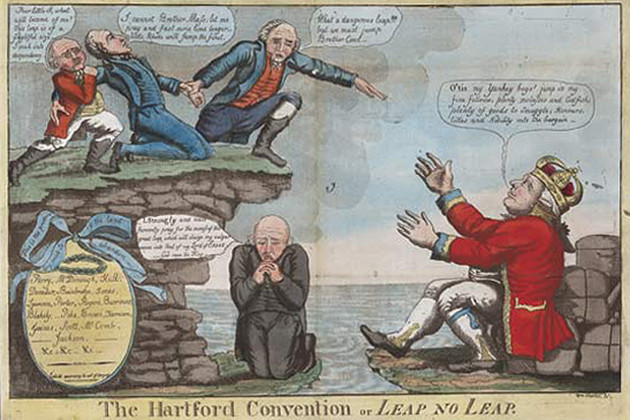
Political cartoon on the Hartford Convention
- two-thirds vote for war, admission of new states, and some commercial restrictions
- one-term presidency
- no successive presidents from the same state
- criticism of the Three-Fifths Clause advantage for the South
They did not officially call for secession, even though people connect them to Essex Junto extremism. Their timing wrecked them politically. News of the Treaty of Ghent and Andrew Jackson’s victory at New Orleans made them look disloyal and helped kill the Federalist Party.
Era of Good Feelings
Under James Monroe, one-party rule made the country look united. That unity was shallow. Sectional conflict kept growing inside the Democratic-Republican Party.
The American System and Sectional Debate
Henry Clay’s American System tried to tie the sections together economically through three linked parts:
- protective tariff
- Second Bank of the United States
- federally funded internal improvements
Tariff of 1816
This was the first tariff aimed mainly at protection, not just revenue. It helped northeastern manufacturers. Many southerners later opposed it because it raised prices and threatened export markets. Early on, support was broader than students usually expect, including support from Calhoun.
Second Bank of the United States
Chartered in 1816, the Bank held federal deposits, issued stable currency, and restrained risky state-bank lending. Supporters saw it as necessary for commerce. Critics saw it as favoring wealthy eastern interests, and western and southern debtors hated its credit tightening. McCulloch v. Maryland upheld its constitutionality.
Internal improvements
Roads and canals lowered transport costs and connected markets.
- National Road (Cumberland Road) was the big federal example.
- Erie Canal was the big state-funded example.
Even people who liked roads and canals argued over whether the Constitution let the federal government pay for them. Madison’s 1817 veto of the Bonus Bill shows that problem clearly.
Panic of 1819
The first major post-Constitution depression came from falling crop prices, speculation, easy credit, and Bank contraction. It hit the West and South hardest and deepened distrust of national economic institutions.
Slavery, Western Expansion, and the Missouri Compromise
Western expansion turned slavery into a national political issue because every new state changed the Senate balance.
Tallmadge Amendment
This proposal would stop further importation of enslaved people into Missouri and gradually free children born there. It passed the House and failed in the Senate. That split showed clear sectional division.
Missouri Compromise
The compromise tried to preserve the balance between free and slave states, and maps of the period usually highlight the dividing line that came out of it.
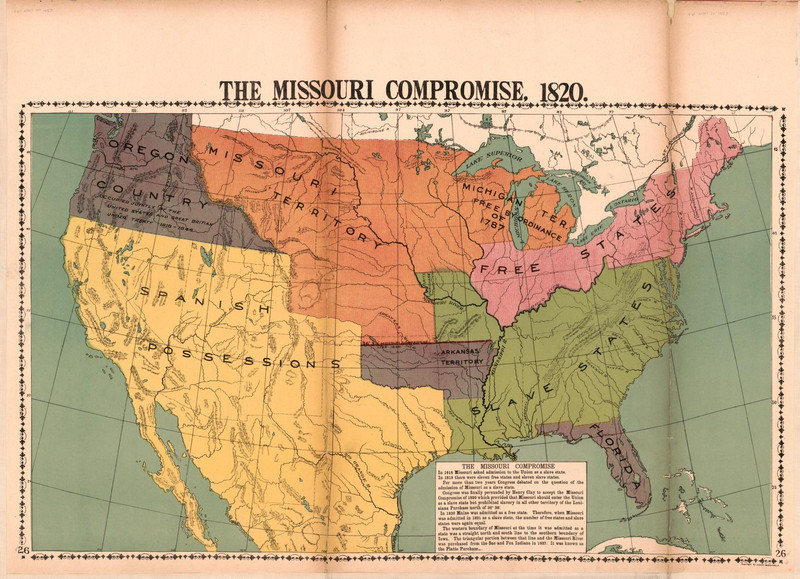
Map of the Missouri Compromise, 1820
- Maine entered as a free state.
- Missouri entered as a slave state.
- Slavery was banned in the rest of the Louisiana Purchase north of 36°30′, except Missouri.
- In 1821, Missouri’s constitution caused another fight over the rights of free Black people before final admission.
This compromise preserved balance for the moment. It also proved slavery’s expansion would keep coming back as a national crisis.
Why This Topic Matters
The American System and Missouri Compromise were both attempts to preserve national unity. Both showed that sections judged federal power by one question. Did it help us or threaten us? That is why sectionalism kept growing even during a period of nationalism.
Key Takeaways
Northeast–South–West Regional Interests
Northeast: manufacturing, commerce, tariffs, and stable finance; South: plantation slavery, exports, and low tariffs; West: cheap land, credit, transportation, and settlement
Hartford Convention
1814–1815 meeting where New England Federalists protested the War of 1812 and proposed constitutional limits; the nationalist backlash hastened the Federalist Party’s collapse
Era of Good Feelings
Monroe-era decline of national party competition after the Federalists collapsed; apparent unity concealed disputes over economic policy, federal power, and slavery
Henry Clay
Kentucky leader who championed the American System and helped negotiate the Missouri Compromise to preserve national unity
American System
Henry Clay’s plan to unify the economy through a protective tariff, the Second Bank, and federally supported roads and canals
Tariff of 1816
First federal tariff primarily intended to protect U.S. industry by raising selected import prices; support shifted toward the manufacturing Northeast and opposition toward the agricultural South
Second Bank of the United States
National bank chartered in 1816 to stabilize currency and credit; supporters valued financial order, while critics viewed it as serving wealthy eastern interests
Internal Improvements
Government-supported roads and canals intended to connect regional markets; western support met southern cost concerns and constitutional objections to broad federal funding
National Road / Cumberland Road
Major federally supported highway across the Appalachians that connected western settlement and agriculture with eastern markets
Panic of 1819
First major post-Constitution depression; credit contraction caused failures, foreclosures, and unemployment and intensified western hostility toward the Second Bank
Daniel Webster
New England leader who opposed the Tariff of 1816 when commerce dominated his region but later supported protection as northeastern manufacturing expanded
John C. Calhoun
South Carolina leader who initially supported tariffs and internal improvements as a nationalist but later defended southern sectional interests and limited federal power
Missouri Crisis
1819 sectional conflict over admitting Missouri as a slave state, which threatened the Senate balance and divided the northern House from the evenly balanced Senate
James Tallmadge Jr.
New York representative who proposed restricting slavery in Missouri through the Tallmadge Amendment
Tallmadge Amendment
1819 proposal to bar additional enslaved people from Missouri and gradually emancipate children born there; the House approved it, but the Senate rejected it
Missouri Compromise of 1820
Admitted Maine free and Missouri slave while banning slavery north of 36°30′ in the Louisiana Purchase except Missouri, temporarily preserving sectional balance
War Hawks
Southern and western nationalists who supported the War of 1812 to defend national honor, challenge Britain, and possibly acquire territory
Protective Tariff
Import tax intended to aid domestic manufacturers by making foreign goods more expensive; increasingly favored in the Northeast and opposed in the agricultural South
Notes
Northeast–South–West Regional Interests
Northeast: manufacturing, commerce, tariffs, and stable finance; South: plantation slavery, exports, and low tariffs; West: cheap land, credit, transportation, and settlement
Hartford Convention
1814–1815 meeting where New England Federalists protested the War of 1812 and proposed constitutional limits; the nationalist backlash hastened the Federalist Party’s collapse
Era of Good Feelings
Monroe-era decline of national party competition after the Federalists collapsed; apparent unity concealed disputes over economic policy, federal power, and slavery
Henry Clay
Kentucky leader who championed the American System and helped negotiate the Missouri Compromise to preserve national unity
American System
Henry Clay’s plan to unify the economy through a protective tariff, the Second Bank, and federally supported roads and canals
Tariff of 1816
First federal tariff primarily intended to protect U.S. industry by raising selected import prices; support shifted toward the manufacturing Northeast and opposition toward the agricultural South
Second Bank of the United States
National bank chartered in 1816 to stabilize currency and credit; supporters valued financial order, while critics viewed it as serving wealthy eastern interests
Internal Improvements
Government-supported roads and canals intended to connect regional markets; western support met southern cost concerns and constitutional objections to broad federal funding
National Road / Cumberland Road
Major federally supported highway across the Appalachians that connected western settlement and agriculture with eastern markets
Panic of 1819
First major post-Constitution depression; credit contraction caused failures, foreclosures, and unemployment and intensified western hostility toward the Second Bank
Daniel Webster
New England leader who opposed the Tariff of 1816 when commerce dominated his region but later supported protection as northeastern manufacturing expanded
John C. Calhoun
South Carolina leader who initially supported tariffs and internal improvements as a nationalist but later defended southern sectional interests and limited federal power
Missouri Crisis
1819 sectional conflict over admitting Missouri as a slave state, which threatened the Senate balance and divided the northern House from the evenly balanced Senate
James Tallmadge Jr.
New York representative who proposed restricting slavery in Missouri through the Tallmadge Amendment
Tallmadge Amendment
1819 proposal to bar additional enslaved people from Missouri and gradually emancipate children born there; the House approved it, but the Senate rejected it
Missouri Compromise of 1820
Admitted Maine free and Missouri slave while banning slavery north of 36°30′ in the Louisiana Purchase except Missouri, temporarily preserving sectional balance
War Hawks
Southern and western nationalists who supported the War of 1812 to defend national honor, challenge Britain, and possibly acquire territory
Protective Tariff
Import tax intended to aid domestic manufacturers by making foreign goods more expensive; increasingly favored in the Northeast and opposed in the agricultural South
