Topic 4.2 Notes – The Rise of Political Parties and the Era of Jefferson
What the First Party System Was
The First Party System was the first organized national competition between political parties in the United States. It grew out of arguments inside Washington’s own administration, especially between Hamilton and Jefferson, and those arguments were about the biggest question of the early republic. What kind of country should this be, and how strong should the federal government be?
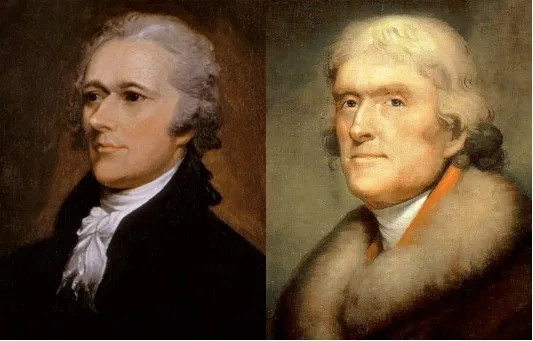
Alexander Hamilton and Thomas Jefferson
You can think of Hamilton and Jefferson as the clearest symbols of the split that produced the first party system.
| Party | Leaders | Constitution | Economy | Foreign leaning | Main support |
|---|---|---|---|---|---|
| Federalists | Alexander Hamilton, John Adams | broad or loose construction | national bank, public credit, commerce, manufacturing | friendlier to Britain | New England, merchants, creditors, commercial elites |
| Democratic-Republicans | Thomas Jefferson, James Madison | strict construction, limited federal power, states’ rights | agrarian republic, low taxes, distrust of concentrated power | more sympathetic to France | southern planters, small farmers, western settlers, immigrants, artisans |
These parties organized recurring debates:
- Tariffs and economic policy became a fight over whether the government should actively promote manufacturing and commerce.
- The national bank turned into a fight over implied powers. Hamilton said the Constitution allowed actions that were necessary and proper to carry out listed powers.
- Britain and France kept pulling the U.S. into conflict, so foreign policy became domestic politics.
- Liberty and order sat underneath everything. Federalists feared chaos. Republicans feared tyranny.
People had once feared parties as dangerous factions, but parties became normal tools of politics through newspapers, campaigns, and voter mobilization.
The Election of 1800 and Jefferson’s Presidency
By 1800, partisan conflict had gotten bitter. John Adams faced Thomas Jefferson, and the Federalists were weakened by several hits:
- Alien and Sedition Acts made Federalists look hostile to immigrants and free speech.
- Virginia and Kentucky Resolutions argued the federal government had overstepped.
- Unpopular taxes hurt support.
- Adams and Hamilton split the party.
The election ended in an electoral tie between Jefferson and Aaron Burr, so the House decided it. Hamilton helped block Burr, and Jefferson finally won on the 36th ballot. The Twelfth Amendment later required separate electoral votes for president and vice president.
Jefferson called this the Revolution of 1800 because it was a peaceful transfer of power between rival parties. That mattered a lot. It proved opposition parties could win without wrecking the Constitution.
Jefferson’s program included:
- cutting military spending and some federal expenses
- repealing internal taxes like the whiskey excise
- reducing the national debt
- pardoning people convicted under the Sedition Act
- letting the Alien and Sedition Acts expire
- keeping parts of Hamilton’s system, including the Bank
That last point gets tested a lot. Jefferson talked about limited government, but he did not tear federal power apart.
The Main Policy Debates in the Early Republic
These party fights kept going because governing forced both sides to adjust their principles.
- Constitutional interpretation stayed central. Federalists defended implied powers. Jefferson had opposed the Bank on strict-construction grounds, but both parties bent when in office.
- Economic policy divided them too. Federalists liked tariffs, commerce, manufacturing, and financial stability. Republicans started with low taxes and an agrarian vision, but after the War of 1812 they backed the Tariff of 1816 and the Second Bank of the United States.
- Relations with Europe turned into fights over federal power. Britain and France both attacked neutral shipping. British impressment and the Chesapeake-Leopard affair raised tensions.
Jefferson answered with the Embargo Act of 1807. He tried economic pressure instead of war, but it hurt American merchants, especially in New England, encouraged smuggling, and forced stronger federal enforcement. The Non-Intercourse Act replaced it in 1809.
The trade map below is a good reminder of why these disputes hit so hard. Atlantic commerce linked the United States, the Caribbean, Europe, and Africa, so disruptions to shipping had major economic consequences.
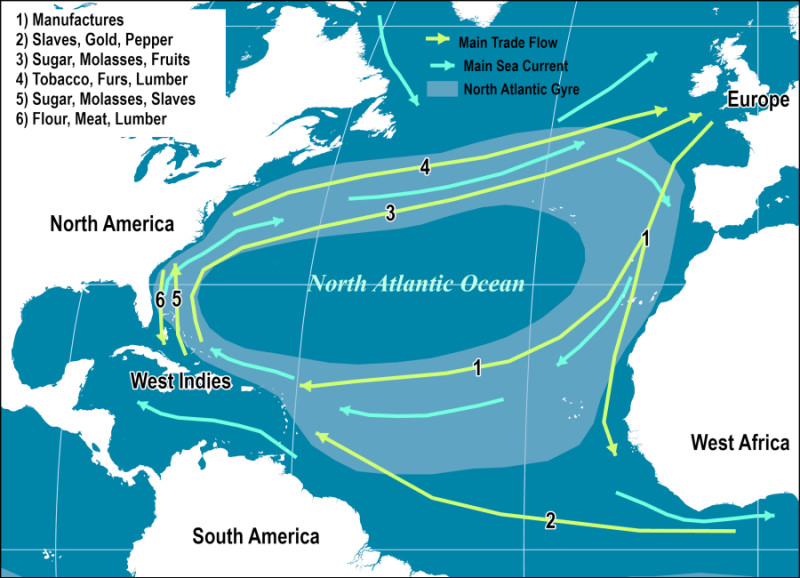
Atlantic trade routes
The Louisiana Purchase and Continental Expansion
In 1803, the U.S. bought Louisiana from France for about $15 million. The immediate fear was French control of New Orleans and the Mississippi River, which western farmers depended on.
Napoleon sold because:
- France failed in Saint-Domingue after the Haitian Revolution
- war with Britain resumed
- he needed money
Jefferson worried the Constitution did not explicitly allow a land purchase, but he used the treaty-making power anyway. This is the classic example of principle versus practice.
Effects of the purchase:
- doubled U.S. territory
- secured New Orleans and Mississippi access
- encouraged western settlement
- set up future conflict over slavery’s expansion
- strengthened presidential and federal power
Exploration helped turn the purchase into real influence. The map traces the major Jeffersonian expeditions tied to this expansion.
- Lewis and Clark with Sacagawea mapped territory, studied plants and animals, built diplomatic ties, and asserted U.S. presence.
- Zebulon Pike led other expeditions for geographic and military knowledge.
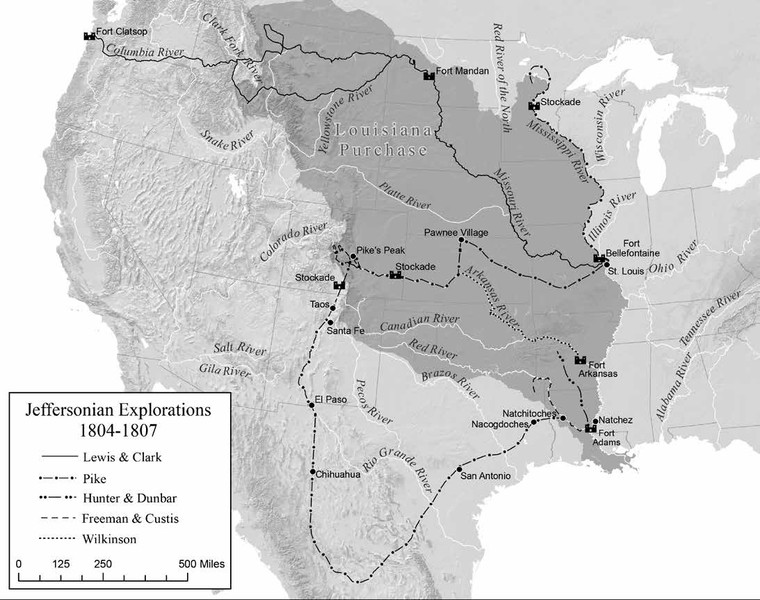
Jeffersonian explorations, 1804-1807
This was not empty land. Many Native nations already lived there.
How the Marshall Court Strengthened Federal Power
Even as Jeffersonians won elections, John Marshall made the Supreme Court a nationalist force.
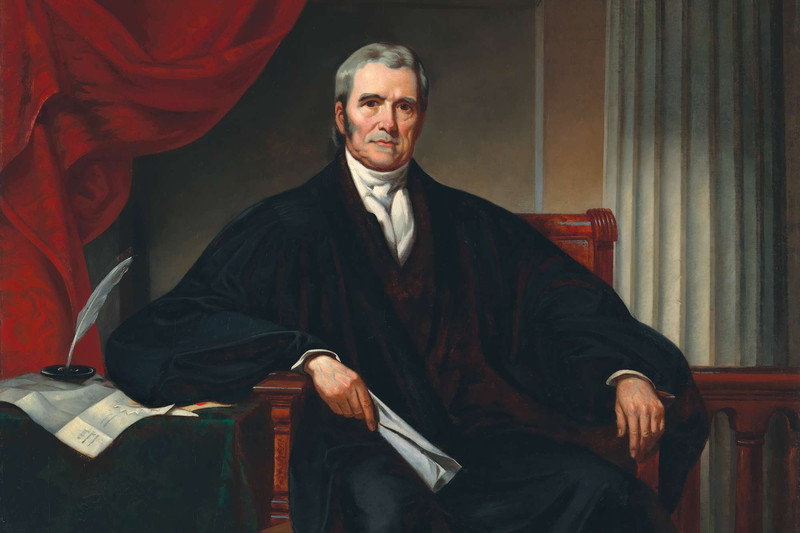
Chief Justice John Marshall
- Marbury v. Madison (1803) came out of Adams’s midnight judges and established judicial review.
- Fletcher v. Peck (1810) struck down a state law and protected contracts.
- Dartmouth College v. Woodward (1819) protected private charters under the Contract Clause.
- McCulloch v. Maryland (1819) upheld the Second Bank, confirmed implied powers, and said states cannot tax federal institutions.
- Cohens v. Virginia (1821) said the Supreme Court can review state-court decisions involving federal law.
- Gibbons v. Ogden (1824) gave a broad reading of interstate commerce and put federal power above conflicting state monopolies.
Key Takeaways
First Party System
Competition between the Federalists and Democratic-Republicans over federal power, economic policy, and relations with Britain and France
Federalist Party
Hamilton and Adams’s party, favoring broad federal power, commerce and manufacturing, a national bank, and friendly relations with Britain
Democratic-Republican Party / Jeffersonian Republican Party
Jefferson and Madison’s party, favoring strict construction, states’ rights, low taxes, an agrarian republic, and sympathy for France
Alexander Hamilton
Federalist leader whose financial program promoted federal assumption, a national bank, public credit, taxation, commerce, and manufacturing
Thomas Jefferson
Democratic-Republican leader and president who advocated limited government but used broad federal power for the Louisiana Purchase and embargo
James Madison
Jefferson’s Democratic-Republican ally who opposed Hamiltonian centralization and supported strict constitutional construction
John Adams
Federalist president defeated by Jefferson in 1800 after party division, unpopular taxes, and controversy over the Alien and Sedition Acts
Loose Construction vs. Strict Construction
Loose construction permits implied federal powers; strict construction limits the federal government to powers explicitly delegated by the Constitution
First Bank of the United States
Hamilton-backed national bank chartered in 1791 under implied powers; its charter expired in 1811 when Congress declined renewal
Tariff of 1816
Tariff enacted by a Democratic-Republican Congress partly to protect emerging American manufacturers from foreign competition
Second Bank of the United States
National bank chartered in 1816 after wartime financial difficulties and later upheld as constitutional in McCulloch v. Maryland
Alien and Sedition Acts
Federalist laws that restricted noncitizens and criminalized certain government criticism, provoking Republican charges of violated civil liberties
Virginia and Kentucky Resolutions
Republican responses to the Alien and Sedition Acts arguing that the federal government had exceeded its constitutional powers
Election of 1800 / Revolution of 1800
Jefferson’s victory over Adams, resolved after an electoral tie with Burr, produced a peaceful transfer of executive power between rival parties
Aaron Burr
Jefferson’s running mate whose equal 73 electoral votes created the 1800 tie that the House resolved in Jefferson’s favor
Twelfth Amendment
1804 amendment requiring electors to cast separate votes for president and vice president
Jefferson’s First Inaugural Address
Conciliatory 1801 address declaring “We are all Republicans, we are all Federalists” to reassure the country after a bitter election
Impressment
British seizure and forced service of sailors, which violated American neutrality and intensified pressure for a national response
Chesapeake–Leopard Affair
1807 attack by the British Leopard on the American Chesapeake that intensified anger over impressment and neutral rights
Embargo Act of 1807
Jefferson’s prohibition on American ships trading with foreign ports, intended to pressure Britain and France but instead harming Americans and requiring intrusive enforcement
Non-Intercourse Act
1809 law reopening trade with most nations while continuing restrictions against Britain and France
Louisiana Purchase
The 1803 acquisition from France of about 828,000 square miles for $15 million, doubling U.S. claims and broadening presidential power
Sacagawea
Lemhi Shoshone interpreter and intermediary who aided the Lewis and Clark expedition and helped it obtain horses for the mountain crossing
Zebulon Pike
Explorer who led federal expeditions from 1805 to 1807 that gathered geographic and military information in the upper Mississippi and Southwest
Judiciary Act of 1801
Federalist law reorganizing the courts and creating new judgeships that Adams filled shortly before leaving office
Midnight Judges
Federalist judicial appointees named near the end of Adams’s presidency to preserve Federalist influence in the courts
Marbury v. Madison
1803 decision denying Marbury’s requested writ while declaring part of a federal law unconstitutional and establishing judicial review
Judicial Review
The authority of courts, especially the Supreme Court, to invalidate laws or government actions that conflict with the Constitution
Fletcher v. Peck
1810 decision invalidating Georgia’s revocation of a land grant under the Contract Clause, the first voiding a state law as unconstitutional
Dartmouth College v. Woodward
1819 decision holding that New Hampshire could not alter Dartmouth’s private charter because the Contract Clause protected it
McCulloch v. Maryland
1819 decision upholding Congress’s implied power to charter a national bank and denying Maryland authority to tax the federal institution
Necessary and Proper Clause
Clause allowing Congress to choose appropriate means for carrying out its enumerated powers, providing the basis for implied powers in McCulloch
Implied Powers
Federal powers not expressly listed but reasonably connected to enumerated powers through the Necessary and Proper Clause
Supremacy Clause
Constitutional rule that valid federal law takes precedence over conflicting state law or state action
Cohens v. Virginia
1821 decision asserting Supreme Court authority to review state-court judgments involving federal law, including criminal cases
Gibbons v. Ogden
1824 decision broadly defining interstate commerce to include navigation and holding that federal regulation overrode a conflicting state monopoly
Era of Good Feelings
Period beginning under Monroe when Federalist decline reduced formal party competition, although disputes over banks, tariffs, slavery, and regional power continued
Lewis and Clark Expedition / Corps of Discovery
The 1804–1806 federal expedition led by Meriwether Lewis and William Clark that mapped western lands, studied resources, contacted Native nations, and reached the Pacific
John Marshall
Federalist chief justice and constitutional nationalist who led the Supreme Court in strengthening judicial authority and federal power
Marshall Court
The Supreme Court under John Marshall, whose decisions strengthened judicial review, implied federal powers, interstate commerce authority, and federal supremacy
Commerce Clause
Constitutional grant of congressional power over interstate commerce, interpreted in Gibbons v. Ogden to include navigation
Notes
First Party System
Competition between the Federalists and Democratic-Republicans over federal power, economic policy, and relations with Britain and France
Federalist Party
Hamilton and Adams’s party, favoring broad federal power, commerce and manufacturing, a national bank, and friendly relations with Britain
Democratic-Republican Party / Jeffersonian Republican Party
Jefferson and Madison’s party, favoring strict construction, states’ rights, low taxes, an agrarian republic, and sympathy for France
Alexander Hamilton
Federalist leader whose financial program promoted federal assumption, a national bank, public credit, taxation, commerce, and manufacturing
Thomas Jefferson
Democratic-Republican leader and president who advocated limited government but used broad federal power for the Louisiana Purchase and embargo
James Madison
Jefferson’s Democratic-Republican ally who opposed Hamiltonian centralization and supported strict constitutional construction
John Adams
Federalist president defeated by Jefferson in 1800 after party division, unpopular taxes, and controversy over the Alien and Sedition Acts
Loose Construction vs. Strict Construction
Loose construction permits implied federal powers; strict construction limits the federal government to powers explicitly delegated by the Constitution
First Bank of the United States
Hamilton-backed national bank chartered in 1791 under implied powers; its charter expired in 1811 when Congress declined renewal
Tariff of 1816
Tariff enacted by a Democratic-Republican Congress partly to protect emerging American manufacturers from foreign competition
Second Bank of the United States
National bank chartered in 1816 after wartime financial difficulties and later upheld as constitutional in McCulloch v. Maryland
Alien and Sedition Acts
Federalist laws that restricted noncitizens and criminalized certain government criticism, provoking Republican charges of violated civil liberties
Virginia and Kentucky Resolutions
Republican responses to the Alien and Sedition Acts arguing that the federal government had exceeded its constitutional powers
Election of 1800 / Revolution of 1800
Jefferson’s victory over Adams, resolved after an electoral tie with Burr, produced a peaceful transfer of executive power between rival parties
Aaron Burr
Jefferson’s running mate whose equal 73 electoral votes created the 1800 tie that the House resolved in Jefferson’s favor
Twelfth Amendment
1804 amendment requiring electors to cast separate votes for president and vice president
Jefferson’s First Inaugural Address
Conciliatory 1801 address declaring “We are all Republicans, we are all Federalists” to reassure the country after a bitter election
Impressment
British seizure and forced service of sailors, which violated American neutrality and intensified pressure for a national response
Chesapeake–Leopard Affair
1807 attack by the British Leopard on the American Chesapeake that intensified anger over impressment and neutral rights
Embargo Act of 1807
Jefferson’s prohibition on American ships trading with foreign ports, intended to pressure Britain and France but instead harming Americans and requiring intrusive enforcement
Non-Intercourse Act
1809 law reopening trade with most nations while continuing restrictions against Britain and France
Louisiana Purchase
The 1803 acquisition from France of about 828,000 square miles for $15 million, doubling U.S. claims and broadening presidential power
Sacagawea
Lemhi Shoshone interpreter and intermediary who aided the Lewis and Clark expedition and helped it obtain horses for the mountain crossing
Zebulon Pike
Explorer who led federal expeditions from 1805 to 1807 that gathered geographic and military information in the upper Mississippi and Southwest
Judiciary Act of 1801
Federalist law reorganizing the courts and creating new judgeships that Adams filled shortly before leaving office
Midnight Judges
Federalist judicial appointees named near the end of Adams’s presidency to preserve Federalist influence in the courts
Marbury v. Madison
1803 decision denying Marbury’s requested writ while declaring part of a federal law unconstitutional and establishing judicial review
Judicial Review
The authority of courts, especially the Supreme Court, to invalidate laws or government actions that conflict with the Constitution
Fletcher v. Peck
1810 decision invalidating Georgia’s revocation of a land grant under the Contract Clause, the first voiding a state law as unconstitutional
Dartmouth College v. Woodward
1819 decision holding that New Hampshire could not alter Dartmouth’s private charter because the Contract Clause protected it
McCulloch v. Maryland
1819 decision upholding Congress’s implied power to charter a national bank and denying Maryland authority to tax the federal institution
Necessary and Proper Clause
Clause allowing Congress to choose appropriate means for carrying out its enumerated powers, providing the basis for implied powers in McCulloch
Implied Powers
Federal powers not expressly listed but reasonably connected to enumerated powers through the Necessary and Proper Clause
Supremacy Clause
Constitutional rule that valid federal law takes precedence over conflicting state law or state action
Cohens v. Virginia
1821 decision asserting Supreme Court authority to review state-court judgments involving federal law, including criminal cases
Gibbons v. Ogden
1824 decision broadly defining interstate commerce to include navigation and holding that federal regulation overrode a conflicting state monopoly
Era of Good Feelings
Period beginning under Monroe when Federalist decline reduced formal party competition, although disputes over banks, tariffs, slavery, and regional power continued
Lewis and Clark Expedition / Corps of Discovery
The 1804–1806 federal expedition led by Meriwether Lewis and William Clark that mapped western lands, studied resources, contacted Native nations, and reached the Pacific
John Marshall
Federalist chief justice and constitutional nationalist who led the Supreme Court in strengthening judicial authority and federal power
Marshall Court
The Supreme Court under John Marshall, whose decisions strengthened judicial review, implied federal powers, interstate commerce authority, and federal supremacy
Commerce Clause
Constitutional grant of congressional power over interstate commerce, interpreted in Gibbons v. Ogden to include navigation
