Topic 8.9 Notes – The Great Society
What the Great Society Was
The Great Society was Johnson’s broad reform program, mostly from 1964 to 1966. Think of it as an umbrella. The War on Poverty sat underneath it, but it was only one part.
This grew out of older reform traditions. Progressives had used government to regulate business. The New Deal expanded federal responsibility during the Depression. Truman’s Fair Deal and Kennedy’s New Frontier pushed for more action too. The difference was timing. The Great Society came during affluence, not crisis, so it aimed to use prosperity to improve life.
Core goals included:
- ending poverty
- expanding education and health care
- enforcing civil rights
- improving cities
- reforming immigration
- protecting consumers
- supporting culture
- addressing environmental quality
Political conditions made this possible:
- Johnson became president after Kennedy’s assassination in 1963.
- He used the Johnson treatment, meaning intense, personal pressure on Congress.
- In the 1964 State of the Union, he declared an “unconditional war on poverty.”
- At the University of Michigan commencement in 1964, he announced the Great Society vision.
- In 1964, he crushed Barry Goldwater and Democrats won huge congressional majorities in the 89th Congress.
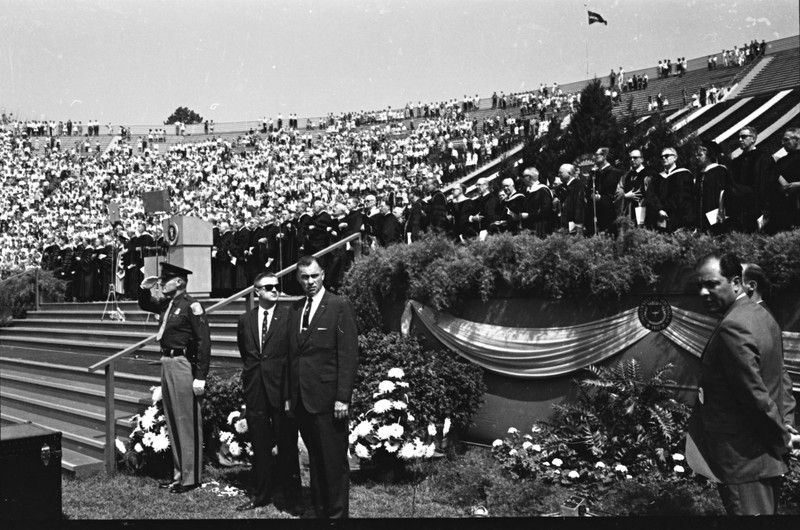
Johnson at the 1964 University of Michigan commencement
The Major Great Society Programs
Johnson’s ideas turned into a flood of laws because liberals believed opportunity could be widened through federal action.
War on Poverty
The Economic Opportunity Act of 1964 created the Office of Economic Opportunity.
Major programs:
- Job Corps: job training for disadvantaged youth
- VISTA: domestic volunteer service
- Head Start: preschool, nutrition, and health help for low-income children
- Community Action Programs: poor residents helped shape local programs
- Legal Services: lawyers for people who could not afford them
- work-study and job training: tied education to employment
- Food Stamp Act of 1964 and expanded school nutrition
A big reason poverty got national attention was Michael Harrington’s The Other America, which exposed poverty hidden inside a wealthy country.
Health care
The Social Security Amendments of 1965 created:
- Medicare: age-based federal health insurance for the elderly
- Medicaid: means-tested health assistance for low-income Americans, funded by both federal and state governments
Johnson signed Medicare at the Truman Library to connect it to Truman’s earlier push for national health insurance.
Education
- Elementary and Secondary Education Act of 1965: especially Title I aid for low-income schools
- Higher Education Act of 1965: scholarships, grants, work-study, and loans
Civil rights and equality
- Civil Rights Act of 1964: attacked segregation and employment discrimination
- Voting Rights Act of 1965: protected Black voting rights, especially in the South
- Civil Rights Act of 1968: fair housing protections
Johnson’s Howard University speech, “To Fulfill These Rights,” argued that legal equality alone could not erase generations of discrimination.
Other key reforms
- Immigration and Nationality Act of 1965 or Hart-Celler Act: ended national-origins quotas
- Department of Housing and Urban Development in 1965; Robert C. Weaver became the first Black cabinet member
- Model Cities program
- National Endowment for the Arts, National Endowment for the Humanities, Public Broadcasting Act of 1967
- consumer laws: Truth in Lending Act, Fair Packaging and Labeling Act, Highway Safety Act, National Traffic and Motor Vehicle Safety Act
- environmental laws: Wilderness Act, Land and Water Conservation Fund, Water Quality Act of 1965
How the Great Society Expanded Federal Power
This program made the federal government more responsible for people’s social and economic welfare. Washington usually supplied the money and rules, while states and cities often ran the programs.
| Policy form | Example | What it did |
|---|---|---|
| Social insurance | Medicare | benefits based on age/status |
| Means-tested aid | Medicaid, food stamps | aid for low-income people |
| Federal grants | education, urban aid | federal money for local programs |
| Regulation | civil rights, consumer laws | national rules and standards |
| Community action | CAPs | poor residents involved directly |
That changed federalism. The main debate was whether equal opportunity required national action or whether federal power created too much bureaucracy, spending, dependency, and loss of local control.
Effects, Limits, and Legacy
The Great Society had real results, but it did not solve everything.
- The poverty rate dropped sharply in the 1960s, helped by both economic growth and federal programs.
- It created durable institutions like Medicare, Medicaid, Head Start, food assistance, federal school aid, legal services, and public broadcasting.
- It strengthened federal protection of civil rights.
- Hart-Celler reshaped later U.S. immigration and demographics.
The poverty-rate graph helps show the big pattern you should remember. The steepest decline came in the years after the Great Society began, then the rate leveled off and fluctuated more in later decades.
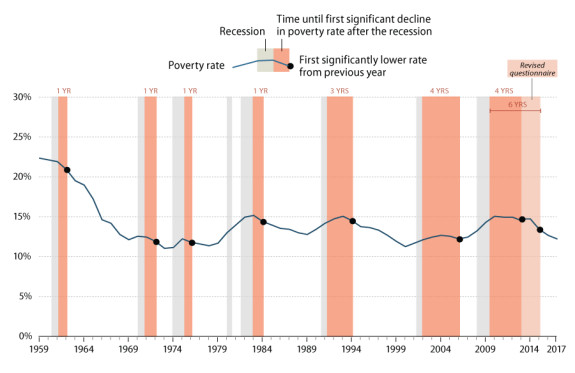
U.S. poverty rate, 1959-2017
Limits mattered too:
- poverty and racial inequality continued in cities, rural areas, Appalachia, and the Mississippi Delta
- Community Action often clashed with mayors and local political machines
- urban unrest showed legal equality did not fix deeper economic inequality
- the Vietnam War created the “guns and butter” problem by straining money and attention
The backlash came from both sides. Conservatives attacked spending, bureaucracy, dependency, and federal intrusion. Critics on the left said the reforms were too moderate and did not redistribute wealth enough. That is why the Great Society became both the high-water mark of liberalism and a major cause of the later conservative resurgence.
Key Takeaways
Lyndon B. Johnson
President who used his legislative skill and 1964 electoral mandate to enact the Great Society
Great Society
Johnson’s broad domestic reform program to reduce poverty, protect civil rights, expand opportunity, and improve quality of life through federal action
Postwar Liberalism
Belief in civil rights, social welfare, regulation, economic management, and federal power to achieve social goals, combined with anti-communism abroad
Michael Harrington
Author whose 1962 book The Other America publicized persistent poverty amid postwar affluence
The Other America
Michael Harrington’s 1962 book exposing the largely invisible poverty that persisted amid national prosperity
Johnson Treatment
Johnson’s intense personal persuasion of legislators to obtain political support and congressional votes
Election of 1964
Johnson’s landslide defeat of Barry Goldwater gave him a strong mandate and large Democratic congressional majorities
War on Poverty
Great Society campaign using education, training, health, food, legal aid, and community programs to reduce poverty and expand opportunity
Economic Opportunity Act of 1964
Law that launched major War on Poverty programs and created the Office of Economic Opportunity
Office of Economic Opportunity (OEO)
Federal agency created by the Economic Opportunity Act to coordinate the War on Poverty
Job Corps
War on Poverty program providing education and vocational training, especially to disadvantaged young people
Volunteers in Service to America (VISTA)
Domestic volunteer program that placed participants in low-income communities, often described as a home-front Peace Corps
Head Start
Program providing preschool education, nutrition, health screening, and related services to children from low-income families
Community Action Programs
Federally funded local antipoverty programs seeking the “maximum feasible participation” of poor residents in decision-making
Legal Services
War on Poverty initiative providing legal assistance to people unable to afford representation
Food Stamp Act of 1964
Law that made the federal food stamp program permanent to provide food assistance to eligible low-income Americans
Medicare
Federally administered social insurance providing health coverage primarily to Americans age 65 and older
Medicaid
Means-tested medical assistance for eligible low-income Americans, jointly financed by federal and state governments and administered by states
Elementary and Secondary Education Act of 1965
Law providing continuing federal aid to public schools, especially those serving large numbers of low-income children
Higher Education Act of 1965
Law expanding scholarships, grants, work-study opportunities, and federally supported student loans
Civil Rights Act of 1964
Law prohibiting discrimination in public accommodations and employment and strengthening federal power against segregation
Voting Rights Act of 1965
Law attacking state and local barriers that had disfranchised African Americans, especially in the South
Civil Rights Act of 1968
Law whose fair housing provisions prohibited many forms of racial discrimination in housing sales and rentals
To Fulfill These Rights
Johnson’s 1965 Howard University address arguing that removing legal barriers was insufficient to overcome accumulated racial inequality
Immigration and Nationality Act of 1965 (Hart–Celler Act)
Law abolishing national-origins quotas and emphasizing family reunification and occupational skills in immigration admissions
Department of Housing and Urban Development (HUD)
Cabinet department created in 1965 to oversee federal housing and urban policy
Model Cities Program
Program that attempted to coordinate housing, transportation, education, employment, and social services in selected urban neighborhoods
National Endowment for the Arts (NEA)
Federal agency created in 1965 to support artistic and cultural projects
National Endowment for the Humanities (NEH)
Federal agency created in 1965 to support historical, scholarly, educational, and humanities projects
Public Broadcasting Act of 1967
Law creating the Corporation for Public Broadcasting to support noncommercial public television and radio
Wilderness Act of 1964
Law protecting designated federal lands as wilderness and extending Great Society reform into conservation
Guns and Butter
Johnson’s attempt to fund the Vietnam War and Great Society programs simultaneously, producing budgetary and political strain
Social Security Amendments of 1965
Law that created Medicare and Medicaid, greatly expanding the federal role in health care
Notes
Lyndon B. Johnson
President who used his legislative skill and 1964 electoral mandate to enact the Great Society
Great Society
Johnson’s broad domestic reform program to reduce poverty, protect civil rights, expand opportunity, and improve quality of life through federal action
Postwar Liberalism
Belief in civil rights, social welfare, regulation, economic management, and federal power to achieve social goals, combined with anti-communism abroad
Michael Harrington
Author whose 1962 book The Other America publicized persistent poverty amid postwar affluence
The Other America
Michael Harrington’s 1962 book exposing the largely invisible poverty that persisted amid national prosperity
Johnson Treatment
Johnson’s intense personal persuasion of legislators to obtain political support and congressional votes
Election of 1964
Johnson’s landslide defeat of Barry Goldwater gave him a strong mandate and large Democratic congressional majorities
War on Poverty
Great Society campaign using education, training, health, food, legal aid, and community programs to reduce poverty and expand opportunity
Economic Opportunity Act of 1964
Law that launched major War on Poverty programs and created the Office of Economic Opportunity
Office of Economic Opportunity (OEO)
Federal agency created by the Economic Opportunity Act to coordinate the War on Poverty
Job Corps
War on Poverty program providing education and vocational training, especially to disadvantaged young people
Volunteers in Service to America (VISTA)
Domestic volunteer program that placed participants in low-income communities, often described as a home-front Peace Corps
Head Start
Program providing preschool education, nutrition, health screening, and related services to children from low-income families
Community Action Programs
Federally funded local antipoverty programs seeking the “maximum feasible participation” of poor residents in decision-making
Legal Services
War on Poverty initiative providing legal assistance to people unable to afford representation
Food Stamp Act of 1964
Law that made the federal food stamp program permanent to provide food assistance to eligible low-income Americans
Medicare
Federally administered social insurance providing health coverage primarily to Americans age 65 and older
Medicaid
Means-tested medical assistance for eligible low-income Americans, jointly financed by federal and state governments and administered by states
Elementary and Secondary Education Act of 1965
Law providing continuing federal aid to public schools, especially those serving large numbers of low-income children
Higher Education Act of 1965
Law expanding scholarships, grants, work-study opportunities, and federally supported student loans
Civil Rights Act of 1964
Law prohibiting discrimination in public accommodations and employment and strengthening federal power against segregation
Voting Rights Act of 1965
Law attacking state and local barriers that had disfranchised African Americans, especially in the South
Civil Rights Act of 1968
Law whose fair housing provisions prohibited many forms of racial discrimination in housing sales and rentals
To Fulfill These Rights
Johnson’s 1965 Howard University address arguing that removing legal barriers was insufficient to overcome accumulated racial inequality
Immigration and Nationality Act of 1965 (Hart–Celler Act)
Law abolishing national-origins quotas and emphasizing family reunification and occupational skills in immigration admissions
Department of Housing and Urban Development (HUD)
Cabinet department created in 1965 to oversee federal housing and urban policy
Model Cities Program
Program that attempted to coordinate housing, transportation, education, employment, and social services in selected urban neighborhoods
National Endowment for the Arts (NEA)
Federal agency created in 1965 to support artistic and cultural projects
National Endowment for the Humanities (NEH)
Federal agency created in 1965 to support historical, scholarly, educational, and humanities projects
Public Broadcasting Act of 1967
Law creating the Corporation for Public Broadcasting to support noncommercial public television and radio
Wilderness Act of 1964
Law protecting designated federal lands as wilderness and extending Great Society reform into conservation
Guns and Butter
Johnson’s attempt to fund the Vietnam War and Great Society programs simultaneously, producing budgetary and political strain
Social Security Amendments of 1965
Law that created Medicare and Medicaid, greatly expanding the federal role in health care
