Topic 1.5 Notes – Labor, Slavery, and Caste in the Spanish Colonial System
How the Spanish Colonial System Organized Labor and Status
Spanish conquest created the basic problem the empire had to solve. A few Europeans wanted gold, silver, crops, and power over huge Indigenous populations. That led to one connected pattern: extract wealth, secure labor, justify domination.
Three structures fit together:
- Encomienda forced Native communities to provide tribute and labor to Spaniards.
- African slavery expanded through the Atlantic slave trade and supplied labor where colonists wanted more workers.
- Caste hierarchy ranked Europeans, Native Americans, Africans, and mixed-ancestry peoples by status.
The economy depended on plantation agriculture, silver and gold mining, and other resource extraction. The causation chain matters here because APUSH loves asking for it in one sentence: conquest created labor demand, labor demand created coercive systems, those systems produced a mixed colonial population, and that population was sorted into an ancestry-based hierarchy.
Spanish colonizers did not invent tribute or slavery from nothing. They built on existing Indigenous tribute systems and preexisting African slavery, then plugged both into a much larger imperial and Atlantic economy. Over time, labor systems and social rank reinforced each other.
The Encomienda and Other Forms of Native Labor
Encomienda
An encomienda was a grant of Indigenous tribute and labor. It was not a grant of land, and technically it was not ownership of people. In theory, the encomendero owed protection, Christian instruction, order, and loyalty and taxes to the Crown. In practice, it often meant coercion, violence, exhausting labor, and heavy tribute.
Native tribute and labor included:
- farm and plantation work
- mining labor and transport
- maize, textiles, and manufactured goods
- precious metals and other resources
Spain adapted tribute networks already used by empires like the Aztec Empire, which made conquest more profitable faster. Economically, encomienda supported agriculture and especially mining. A key example is Zacatecas, where silver was discovered in 1546.
North American examples and reforms
On Spain’s northern frontier, the same pattern appeared in St. Augustine, Florida (1565) and New Mexico (1598). Colonists tried to extract labor and tribute while missionaries pushed conversion. Native resistance limited Spanish control.
Disease, warfare, famine, and harsh labor caused massive Native population decline. Bartolomé de las Casas criticized the abuses, and the New Laws of 1542 tried to limit encomienda abuse and inheritance.
Other labor systems followed or coexisted:
- repartimiento: government labor draft, temporary and paid in theory, still compulsory in practice
- mita: related labor draft in the Andes
- hacienda: large estate using dependent labor
That last distinction shows up on tests a lot. Hacienda = estate. Encomienda = claim to labor/tribute.
The Forced Migration and Labor of Enslaved Africans
As Spain expanded, its empire became part of the Atlantic slave trade. European traders worked with some West and West Central African groups who captured and sold enslaved people. Preexisting African slavery matters for context, but it does not reduce European responsibility for massively expanding the trade.
Spain often depended on Portuguese and other foreign merchants. The asiento system let the Crown license contracts to supply enslaved Africans and profit from the trade.
The routes on the map help you see the larger pattern. Most forced migration across the Atlantic went from West and West Central Africa to Brazil and the Caribbean, with smaller flows to mainland Spanish America and North America.
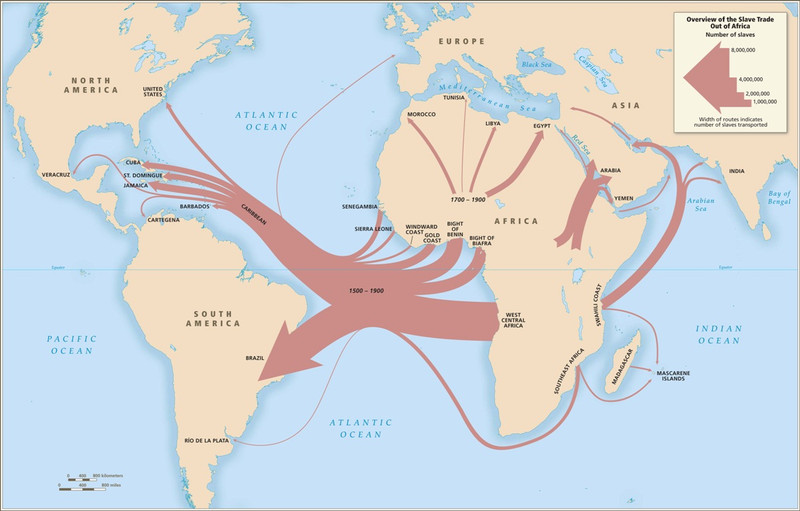
Major slave-trade routes out of Africa
The Middle Passage meant overcrowding, disease, hunger, violence, family separation, and high death rates.
Enslaved Africans worked in:
- sugar plantations and commercial agriculture
- gold and silver mining
- construction, transport, and ranching
- domestic service, skilled crafts, and urban labor
Spanish slavery was chattel slavery. People could be bought, sold, and inherited, and status usually followed the mother. Some legal complexity existed, including manumission, marriage, court petitions, and free Black populations, but the system stayed coercive. Africans were added to colonial labor systems, not simply substituted for Native labor.
The Spanish Caste System
The casta system classified people by ancestry and tied ancestry to power, labor, and privilege.
| Group | Usual place in society |
|---|---|
| Peninsulares | Spain-born elites, usually held top imperial offices |
| Criollos/Creoles | American-born Spaniards, wealthy elites but below peninsulares |
| Mestizos | Mixed European and Indigenous ancestry |
| Mulattoes | Mixed European and African ancestry |
| Zambos | Mixed Indigenous and African ancestry |
| Indigenous people | Crown subjects, tribute burdens, subordinate status |
| Africans | Enslaved and free people, with enslaved Africans facing the harshest coercion |
Status affected political office, tribute, legal standing, access to wealth, land, and honor. Records in churches, marriages, taxes, and courts helped enforce the system, along with ideas about purity of blood. Mixed ancestry grew through unequal family formation, and status also depended on gender, legitimacy, wealth, and reputation. Casta paintings are worth recognizing, but they come later than 1607 and show the mature form of the hierarchy.
Why Labor, Slavery, and Caste Worked Together
Spanish demand for wealth drove everything. Encomienda and labor drafts extracted Native labor for farming and mining. Demographic collapse increased pressure on surviving Native communities and encouraged more African slave imports. The caste hierarchy then explained and defended why non-Europeans did the hardest labor and had the fewest rights.
The best synthesis is this: the Spanish North American empire developed social and economic structures in which coerced labor and ancestry-based inequality supported imperial extraction and Spanish elite power over time.
Key Takeaways
Encomienda System
Crown grants allowing encomenderos to compel tribute or labor from designated Indigenous communities in return for supposed protection and Christian instruction
Bartolomé de las Casas
Dominican friar and former encomendero who condemned the brutal exploitation of Indigenous people and encouraged royal labor reforms
New Laws of 1542
Spanish laws intended to curb abuses of Indigenous people and restrict inheritance of encomiendas; colonial resistance weakened enforcement
Repartimiento
Government-supervised labor draft requiring Native communities to provide supposedly paid workers for limited periods, though the labor remained compulsory and abusive
Hacienda
Large landed estate worked by wage, tenant, or debt-bound laborers; unlike an encomienda, it was land rather than a claim to Native tribute
Transatlantic Slave Trade
Forced Atlantic transportation of enslaved Africans, expanded by European demand and cooperation with some West and West Central African traders and rulers
Asiento System
Crown contracts granting a person or company the right and obligation to supply a specified number of enslaved Africans to Spanish America
Middle Passage
Brutal forced voyage of enslaved Africans across the Atlantic under crowded, violent, and deadly shipboard conditions
Caste System / Casta System
Spanish ancestry-based hierarchy that favored Europeans and assigned unequal legal, economic, and social status to Europeans, Native Americans, Africans, and mixed-ancestry people
Peninsulares
Spain-born residents of the Americas who generally held the colony's highest political, ecclesiastical, and commercial positions
Criollos / Creoles
American-born people of Spanish ancestry who belonged to colonial elites, although peninsulares often received preference for the highest imperial offices
Mestizos
People of mixed European and Indigenous ancestry in the Spanish colonial caste system
Mulattoes
People of mixed European and African ancestry in the Spanish colonial caste system
Zambos
People of mixed Indigenous and African ancestry in the Spanish colonial caste system
Chattel Slavery in Spanish America
Hereditary system in which enslaved Africans were treated as property and forced to labor especially in plantation agriculture and mining
Native Demographic Collapse
Catastrophic population decline caused by disease, warfare, forced relocation, famine, and harsh labor, weakening Native societies and encouraging greater importation of enslaved Africans
Notes
Encomienda System
Crown grants allowing encomenderos to compel tribute or labor from designated Indigenous communities in return for supposed protection and Christian instruction
Bartolomé de las Casas
Dominican friar and former encomendero who condemned the brutal exploitation of Indigenous people and encouraged royal labor reforms
New Laws of 1542
Spanish laws intended to curb abuses of Indigenous people and restrict inheritance of encomiendas; colonial resistance weakened enforcement
Repartimiento
Government-supervised labor draft requiring Native communities to provide supposedly paid workers for limited periods, though the labor remained compulsory and abusive
Hacienda
Large landed estate worked by wage, tenant, or debt-bound laborers; unlike an encomienda, it was land rather than a claim to Native tribute
Transatlantic Slave Trade
Forced Atlantic transportation of enslaved Africans, expanded by European demand and cooperation with some West and West Central African traders and rulers
Asiento System
Crown contracts granting a person or company the right and obligation to supply a specified number of enslaved Africans to Spanish America
Middle Passage
Brutal forced voyage of enslaved Africans across the Atlantic under crowded, violent, and deadly shipboard conditions
Caste System / Casta System
Spanish ancestry-based hierarchy that favored Europeans and assigned unequal legal, economic, and social status to Europeans, Native Americans, Africans, and mixed-ancestry people
Peninsulares
Spain-born residents of the Americas who generally held the colony's highest political, ecclesiastical, and commercial positions
Criollos / Creoles
American-born people of Spanish ancestry who belonged to colonial elites, although peninsulares often received preference for the highest imperial offices
Mestizos
People of mixed European and Indigenous ancestry in the Spanish colonial caste system
Mulattoes
People of mixed European and African ancestry in the Spanish colonial caste system
Zambos
People of mixed Indigenous and African ancestry in the Spanish colonial caste system
Chattel Slavery in Spanish America
Hereditary system in which enslaved Africans were treated as property and forced to labor especially in plantation agriculture and mining
Native Demographic Collapse
Catastrophic population decline caused by disease, warfare, forced relocation, famine, and harsh labor, weakening Native societies and encouraging greater importation of enslaved Africans
