Topic 4.9 Notes – The Development of an American Culture
What the New National Culture Was
After the Revolution, and even more after the War of 1812, many Americans wanted more than political independence. They wanted their own literature, art, architecture, and language too. That did not mean cutting off Europe. It meant taking European styles and making them fit American life.
This new culture mixed three ingredients:
- American elements included the Revolution, republican government, frontier life, westward expansion, and American exceptionalism, the belief that the U.S. had a unique democratic mission.
- European influences included Romanticism, liberal social thought, classical architecture, and German idealism.
- Regional sensibilities mattered because people lived very differently in different places.
- Northeast had reform movements, schools, publishing, and intellectual life.
- South was shaped by plantation hierarchy and slavery.
- West emphasized mobility, frontier hardship, and self-reliance.
This culture grew because nationalism rose after the War of 1812, the market revolution created larger audiences through roads, canals, steamboats, newspapers, and cheap print, and western land gave artists and writers distinctly American subjects. A map like this helps show why culture could spread so quickly in the 1840s, with transportation and migration routes linking regions that still kept their own identities.
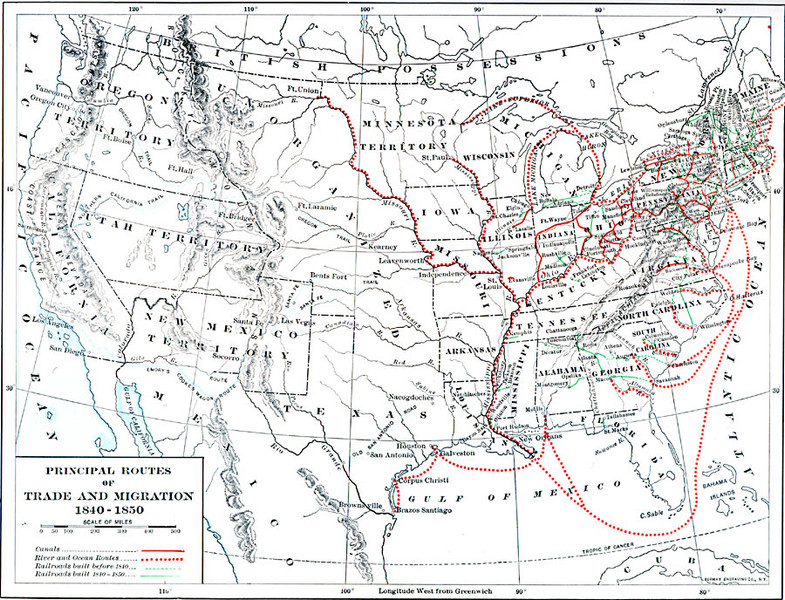
Trade and migration routes, 1840-1850
Immigration, especially by Irish Catholics and Germans, made culture more diverse and also triggered nativism and anti-Catholicism.
The Big Ideas Behind the Culture
Two European currents shaped almost everything here.
Romanticism
Romanticism valued emotion, imagination, intuition, and individual experience. It loved nature, especially the sublime, meaning nature as huge, beautiful, and awe-inspiring. It also liked folklore, the past, mystery, and Gothic themes. The U.S. fit Romanticism well because its forests, rivers, and mountains could serve as national symbols.
Liberal social thought and perfectibility
Liberal social thought emphasized individual rights, representative government, and opposition to inherited privilege. That fit a republic that celebrated the ordinary white male citizen and distrusted aristocracy.
Human perfectibility meant people and society could improve through education, morality, and better institutions. That idea helps explain why this period produced reform movements, utopian experiments, and early women’s rights arguments.
These same ideas could celebrate America’s uniqueness and criticize its materialism, conformity, and inequality.
Literature and Philosophy That Made America Distinctive
American writers took European forms and filled them with American places and problems.
- Washington Irving wrote The Sketch Book, including “Rip Van Winkle” and “The Legend of Sleepy Hollow.” He used European-style folklore in the Hudson River Valley to create an American legendary past.
- James Fenimore Cooper wrote the Leatherstocking Tales, including The Last of the Mohicans. His hero Natty Bumppo became the self-reliant frontiersman. His work made the frontier central, but it also pushed the “vanishing Indian” idea, which romanticized Native peoples while treating their removal as inevitable.
- William Cullen Bryant, especially in “Thanatopsis,” used Romantic nature themes.
- Edgar Allan Poe showed the Gothic side of Romanticism through mystery, terror, and intense emotion.
- Noah Webster published American Dictionary of the English Language in 1828, helping standardize American English and separate it from British usage.
Transcendentalism
In New England, Transcendentalism argued that truth came through intuition, conscience, self-reliance, and the spiritual power of nature.
- Ralph Waldo Emerson wrote Nature (1836) and Self-Reliance (1841).
- Henry David Thoreau lived at Walden Pond from 1845 to 1847 and protested slavery and the Mexican-American War. Civil Disobedience was published in 1849, just outside the period, but the ideas grew out of the 1840s.
- Margaret Fuller wrote Woman in the Nineteenth Century (1845), applying self-development and perfectibility to women’s status.
Art and Architecture That Expressed National Identity
Visual culture made the nation look grand and historic.
Hudson River School
The Hudson River School was the first major American school of landscape painting.
- Thomas Cole founded it.
- The Oxbow (1836) contrasts wild nature with cultivated land.
- The Course of Empire warns that expansion and power can end in decline.
- Asher B. Durand was another key artist.
Cole’s The Oxbow is a good example of that contrast.
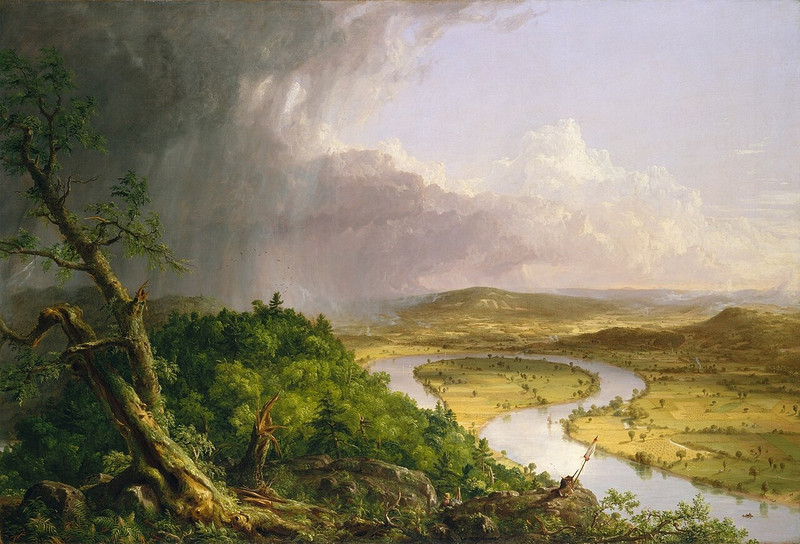
Thomas Cole, The Oxbow (1836)
These paintings made nature feel spiritual and national, but they often erased Native peoples and made occupied land look empty.
Other scenes mattered too:
- John Trumbull painted Revolutionary scenes in the U.S. Capitol.
- George Caleb Bingham painted western politics and river life.
Architecture
Neoclassical and Greek Revival styles used columns, symmetry, domes, and pediments to symbolize republican order and permanence.
- Second Bank of the United States in Philadelphia
- Thomas Jefferson’s University of Virginia Rotunda
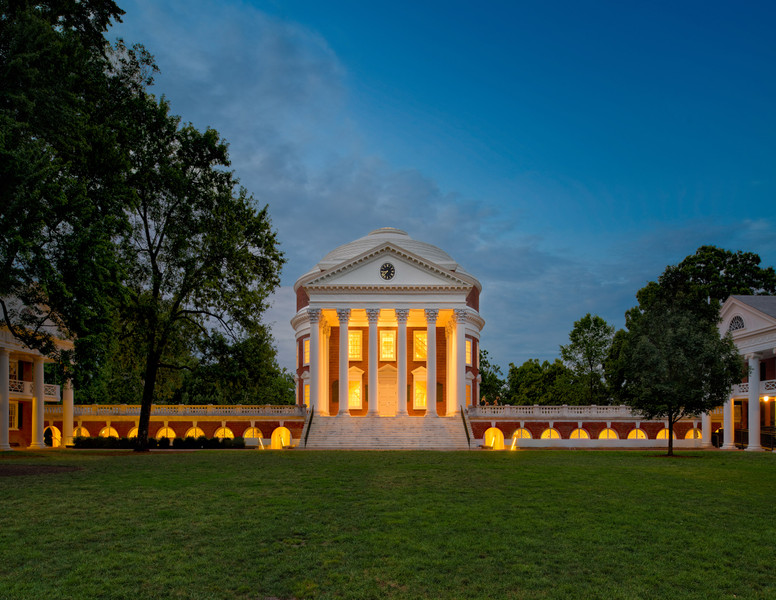
University of Virginia Rotunda
Gothic Revival reflected Romantic spirituality and medieval influence.
- Richard Upjohn’s Trinity Church in New York City
National Unity and Who Got Left Out
This culture gave Americans shared stories, landscapes, and symbols. It also excluded a lot of people.
- Blackface minstrelsy became national entertainment. Thomas D. Rice and “Jim Crow” turned racist caricature into mass culture.
- Native Americans were often romanticized in art and literature at the same time they were being dispossessed by removal and expansion.
- Immigrants, especially Irish Catholics and Germans, added traditions to American life, but anti-immigrant and anti-Catholic reactions showed the limits of who counted as “American.”
The bottom line is that this culture was national, but never uniform. It was shaped by race, gender, religion, class, and legal status.
Key Takeaways
American Exceptionalism
Belief that the United States differed fundamentally from Europe and possessed a distinctive democratic destiny
Romanticism
Movement emphasizing emotion, imagination, intuition, individual experience, the past, and nature’s spiritual power
The Sublime
Romantic experience of nature as beautiful, immense, awe-inspiring, and sometimes frightening
Liberal Social Thought
Ideas opposing inherited privilege and supporting individual rights, representative government, and freedom of conscience
Human Perfectibility
Belief that people and societies could improve through education, moral development, and better institutions
Washington Irving
Early internationally successful American author who adapted European folklore to American settings in “Rip Van Winkle” and “The Legend of Sleepy Hollow.”
James Fenimore Cooper
Author of the Leatherstocking Tales who made the frontier, Natty Bumppo, American Indians, and wilderness major American literary subjects
The Vanishing Indian
White American idea romanticizing Indigenous people as noble figures supposedly destined to disappear before white settlement
William Cullen Bryant
Romantic poet whose “Thanatopsis” used American nature to explore mortality, spirituality, and humanity’s connection to the natural world
Edgar Allan Poe
American writer who developed Gothic Romantic themes of intense emotion, psychological disturbance, mystery, and terror
Noah Webster
Compiler of the 1828 “American Dictionary of the English Language,” which promoted standardized American spelling and usage distinct from British conventions
Hudson River School
First major American school of landscape painting, using Romantic conventions to present American scenery as sublime and nationally meaningful
Thomas Cole
Founder of the Hudson River School whose dramatic landscapes explored nature, settlement, progress, and the possible decline of civilizations
The Oxbow
Thomas Cole’s 1836 painting contrasting sublime wilderness with a sunlit cultivated landscape and the uncertain meaning of progress
The Course of Empire
Thomas Cole’s five-painting series showing civilization’s rise and destruction as a warning about commerce, empire, and republican decline
Transcendentalism
New England movement teaching that intuition and direct experience of nature reveal spiritual truth and support conscience, self-reliance, and nonconformity
Ralph Waldo Emerson
Leading Transcendentalist who taught that individuals should find spiritual truth in nature and trust conscience over conformity
Self-Reliance
Emerson’s 1841 essay urging intellectual and moral independence through trust in one’s own conscience and intuition
Henry David Thoreau
Transcendentalist who practiced simple living at Walden Pond and resisted government policies supporting slavery and the Mexican–American War
Margaret Fuller
Transcendentalist writer who argued that social conventions prevented women from freely developing their abilities
Woman in the Nineteenth Century
Margaret Fuller’s 1845 work applying individual development and human perfectibility to women’s restricted social condition
Neoclassical Architecture
Architecture using Greek and Roman symmetry, columns, pediments, and domes to express order, civic dignity, and republican virtue
Greek Revival Architecture
Popular 1820s–1840s style using temple-like façades and large columns to associate American institutions with ancient democracy and republicanism
Thomas Jefferson
Designed the University of Virginia’s Rotunda and academic buildings to connect classical architecture with learning, reason, and republican self-government
Gothic Revival Architecture
Romantic style using pointed arches, steep roofs, towers, and medieval decoration to evoke spirituality and historical tradition
Blackface Minstrelsy
Popular entertainment in which white performers used blackface to appropriate Black culture and spread racist stereotypes to national audiences
Nature
Emerson’s 1836 essay presenting nature as a route to spiritual understanding and individual independence
Notes
American Exceptionalism
Belief that the United States differed fundamentally from Europe and possessed a distinctive democratic destiny
Romanticism
Movement emphasizing emotion, imagination, intuition, individual experience, the past, and nature’s spiritual power
The Sublime
Romantic experience of nature as beautiful, immense, awe-inspiring, and sometimes frightening
Liberal Social Thought
Ideas opposing inherited privilege and supporting individual rights, representative government, and freedom of conscience
Human Perfectibility
Belief that people and societies could improve through education, moral development, and better institutions
Washington Irving
Early internationally successful American author who adapted European folklore to American settings in “Rip Van Winkle” and “The Legend of Sleepy Hollow.”
James Fenimore Cooper
Author of the Leatherstocking Tales who made the frontier, Natty Bumppo, American Indians, and wilderness major American literary subjects
The Vanishing Indian
White American idea romanticizing Indigenous people as noble figures supposedly destined to disappear before white settlement
William Cullen Bryant
Romantic poet whose “Thanatopsis” used American nature to explore mortality, spirituality, and humanity’s connection to the natural world
Edgar Allan Poe
American writer who developed Gothic Romantic themes of intense emotion, psychological disturbance, mystery, and terror
Noah Webster
Compiler of the 1828 “American Dictionary of the English Language,” which promoted standardized American spelling and usage distinct from British conventions
Hudson River School
First major American school of landscape painting, using Romantic conventions to present American scenery as sublime and nationally meaningful
Thomas Cole
Founder of the Hudson River School whose dramatic landscapes explored nature, settlement, progress, and the possible decline of civilizations
The Oxbow
Thomas Cole’s 1836 painting contrasting sublime wilderness with a sunlit cultivated landscape and the uncertain meaning of progress
The Course of Empire
Thomas Cole’s five-painting series showing civilization’s rise and destruction as a warning about commerce, empire, and republican decline
Transcendentalism
New England movement teaching that intuition and direct experience of nature reveal spiritual truth and support conscience, self-reliance, and nonconformity
Ralph Waldo Emerson
Leading Transcendentalist who taught that individuals should find spiritual truth in nature and trust conscience over conformity
Self-Reliance
Emerson’s 1841 essay urging intellectual and moral independence through trust in one’s own conscience and intuition
Henry David Thoreau
Transcendentalist who practiced simple living at Walden Pond and resisted government policies supporting slavery and the Mexican–American War
Margaret Fuller
Transcendentalist writer who argued that social conventions prevented women from freely developing their abilities
Woman in the Nineteenth Century
Margaret Fuller’s 1845 work applying individual development and human perfectibility to women’s restricted social condition
Neoclassical Architecture
Architecture using Greek and Roman symmetry, columns, pediments, and domes to express order, civic dignity, and republican virtue
Greek Revival Architecture
Popular 1820s–1840s style using temple-like façades and large columns to associate American institutions with ancient democracy and republicanism
Thomas Jefferson
Designed the University of Virginia’s Rotunda and academic buildings to connect classical architecture with learning, reason, and republican self-government
Gothic Revival Architecture
Romantic style using pointed arches, steep roofs, towers, and medieval decoration to evoke spirituality and historical tradition
Blackface Minstrelsy
Popular entertainment in which white performers used blackface to appropriate Black culture and spread racist stereotypes to national audiences
Nature
Emerson’s 1836 essay presenting nature as a route to spiritual understanding and individual independence
