Topic 3.9 Notes – The Constitution
What the Constitution Created
The Constitution was written in 1787 and took effect in 1789. It replaced the Articles of Confederation, which had created a weak central government that mostly had to ask states for cooperation.
The new system was a federal republic. That means power was shared between national and state governments, and people ruled through elected representatives.
The core idea was a limited but dynamic central government.
- Limited meant power was divided and restrained.
- Government had to follow a written Constitution.
- Power was split across levels and branches.
- Leaders were checked by other leaders.
- Dynamic meant the national government could actually do things the Articles could not.
- It could tax, regulate commerce, enforce laws, conduct foreign policy, and maintain armed forces.
The Constitution rested on popular sovereignty and republican government. “We the People” mattered because it claimed authority came from the people, not just from the states.
This still was not a direct democracy.
- Only the House of Representatives was directly elected by voters.
- Senators were originally chosen by state legislatures.
- The president was chosen by the Electoral College.
- Federal judges were appointed.
A lot stayed the same from the Revolution. Americans still believed in republicanism, written constitutions, and distrusted concentrated power. States still mattered a lot. The big change was that the new national government could act directly on individuals, not just make requests to states.
Political participation also stayed narrow. Women, enslaved people, many poor men, and American Indians were still excluded from full political rights.
How Power Was Divided
The Constitution tried to prevent tyranny in two ways at once. It split power between governments and within the national government.
This chart puts those two ideas together by showing federalism across levels of government and the separation of powers within each level.
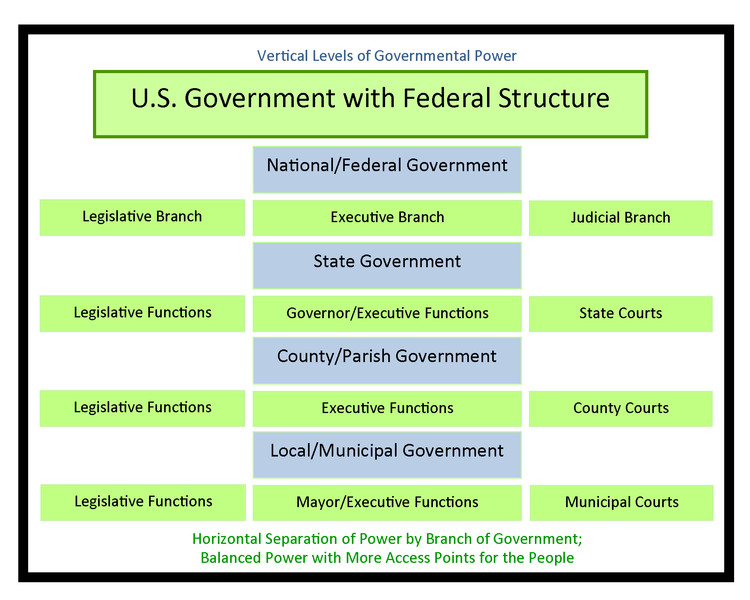
Federalism and separation of powers
Federalism
Federalism divided power between the national and state governments.
- Enumerated powers of the national government included the power to tax, borrow money, regulate interstate and foreign commerce, coin money, declare war, raise armies, and create lower courts.
- Concurrent powers were shared. Both states and the national government could tax.
- States were denied some powers, including making treaties and coining money.
- The supremacy clause made the Constitution and valid federal laws the highest law in the land.
- The Tenth Amendment later reinforced that powers not given to the national government were reserved to the states or the people.
Separation of powers
National power was also split into legislative, executive, and judicial branches. Each branch had its own job so no single part of government could control everything.
Checks and balances
- Congress passes a bill in both houses.
- The president signs it or vetoes it.
- Congress can override a veto with a two-thirds vote in both houses.
- The courts can later rule on whether the law is constitutional.
Shared power also showed up in appointments and treaties. The president nominated officials and judges, but the Senate had to approve them.
The Three Branches
Legislative branch
Article I created a bicameral Congress.
| Part | Structure | Main role |
|---|---|---|
| House | based on population, 2-year terms | closest to voters |
| Senate | 2 per state, 6-year staggered terms, originally chosen by state legislatures | represents states equally |
Congress had major powers over taxation, commerce, war, and spending. The necessary and proper clause, or elastic clause, gave Congress flexibility to carry out its listed powers.
Congress also checked others through impeachment, veto overrides, and Senate confirmation of appointments and treaties.
Executive branch
Article II created a single president, chosen through the Electoral College.
The president could enforce laws, act as commander in chief, veto bills, negotiate treaties, nominate officials and judges, and grant pardons. This office was much stronger than anything under the Articles, but it was still limited by impeachment, Senate approval, and Congress’s control of funding.
Judicial branch
Article III created the Supreme Court and allowed lower federal courts. Judges served for life during “good behavior,” which helped keep them independent.
Federal courts heard cases involving the Constitution, federal laws, treaties, and disputes between states. Judicial review was not clearly written out in 1787, but it became established in Marbury v. Madison (1803). That date matters because students often mix up what the Constitution created with what later practice confirmed.
Why the New Government Was Both Limited and Flexible
The Constitution limited government by giving it enumerated powers, not unlimited authority. It banned bills of attainder and ex post facto laws, protected habeas corpus except in extreme cases, and banned religious tests for federal office.
The Bill of Rights was added in 1791 and protected speech, religion, press, assembly, due process, jury rights, and protections against unreasonable searches and seizures.
It was also flexible. The necessary and proper clause let Congress adapt. Broad powers over taxation, spending, and commerce could grow in practice. Article V created an amendment process that was hard, but still much easier than the Articles’ rule of unanimity. The Bill of Rights itself proved the system could change without being replaced.
Continuity and Change from the Articles
The Constitution kept some old ideas alive.
- Republican government stayed.
- There was still no king.
- States kept their own governments and major authority.
- The national government still handled diplomacy, war, and western lands.
- Americans still feared tyranny.
The changes were huge.
- Confederation → federal system
- Unicameral Congress → bicameral Congress
- No direct taxing power → direct federal taxation
- Weak commerce power → regulation of interstate and foreign trade
- No executive → president
- No national judiciary → Supreme Court and lower federal courts
- Dependence on state compliance → federal supremacy
The Constitution also built in compromises over slavery.
- The three-fifths clause increased Southern representation.
- The slave trade could not be banned before 1808.
- The fugitive slave clause required the return of escaped enslaved people.
Those clauses are a major APUSH point. The Constitution strengthened the national government, but it also protected slavery and pushed that conflict into the future.
Key Takeaways
United States Constitution
The 1787 framework, operating in 1789, that replaced the loose confederation with a federal republic whose stronger national government could act directly on individuals
Limited but Dynamic Central Government
A national government restrained by federalism, separated powers, checks, and a written constitution but empowered to tax, regulate commerce, enforce laws, and address national problems
Popular Sovereignty
The principle that legitimate political authority comes from the people, expressed by the Constitution’s opening words, “We the People.”
Republican Government (Representative Government)
A system in which citizens choose representatives to govern for them rather than deciding national policy through direct democracy
Federalism
The constitutional division of sovereignty between the national government and state governments, with each exercising authority over the same people
Enumerated Powers (Delegated Powers)
Powers specifically granted to the national government, including taxation, borrowing, regulating commerce, coining money, declaring war, and maintaining armed forces
Concurrent Powers
Powers exercised by both the national and state governments, such as the power to levy taxes
Reserved Powers
Powers not delegated to the United States or prohibited to the states and therefore retained by the states or the people
Tenth Amendment
The amendment reserving powers not delegated to the United States or prohibited to the states to the states or the people
Supremacy Clause
The rule that the Constitution, valid federal laws, and treaties are the supreme law, prevailing over conflicting state laws
Commerce Power (Commerce Clause)
Congress’s authority to regulate commerce with foreign nations, among the states, and with American Indian tribes
Necessary and Proper Clause (Elastic Clause)
The clause allowing Congress to use reasonable means not expressly listed when carrying out its enumerated powers
Separation of Powers
The horizontal division of national authority among legislative, executive, and judicial branches to prevent concentrated power
Checks and Balances
The system in which each branch can limit the others through powers such as vetoes, overrides, confirmation, impeachment, and judicial review
Bicameral Congress
The two-house legislature created by Article I, consisting of the population-based House and the equal-state Senate
House of Representatives
The directly elected chamber of Congress whose members serve two-year terms and whose state delegations are apportioned by population
Senate
The chamber giving every state two senators serving staggered six-year terms, originally selected by state legislatures
Impeachment
The House approves formal charges against a civil officer, and the Senate tries the case and may convict by a two-thirds vote of those present
Presidential Veto and Congressional Override
The president may reject legislation, but two-thirds of each house of Congress can enact it over the veto
Senate Advice and Consent
The Senate confirms major presidential appointments and approves treaties, with treaties requiring two-thirds of senators present
President
The Article II executive, chosen for a four-year term, who enforces federal laws, commands the armed forces, vetoes bills, and conducts diplomacy subject to checks
Electoral College
The indirect presidential selection system in which each state receives electors equal to its total representation in the House and Senate
Federal Judiciary
The Article III court system headed by the Supreme Court, with life-tenured judges and authority over cases arising under federal law
Formal Amendment Process
Amendments are proposed by two-thirds of both houses or a convention requested by two-thirds of the states and ratified by three-fourths of the states
Bill of Rights
The first ten amendments, ratified in 1791, that added explicit protections for individual liberties and reserved powers
Bill of Attainder
A legislative act declaring a person guilty without a judicial trial, prohibited by the Constitution
Ex Post Facto Law
A law that criminalizes conduct retroactively, prohibited by the Constitution
Writ of Habeas Corpus
The right of a detained person to challenge the legality of imprisonment, suspendable only during rebellion or invasion when public safety requires it
Three-Fifths Clause
The provision counting enslaved people as three-fifths of a person for representation and direct taxation, increasing slaveholding states’ political power
Slave Trade Clause (1808 Compromise)
The provision preventing Congress from prohibiting the international slave trade before 1808
Fugitive Slave Clause
The constitutional provision requiring the return of people held to service or labor who escaped into another state
Articles of Confederation versus Constitution
Both preserved republicanism and state governments, but the Constitution added federal supremacy, direct taxation, commerce power, bicameralism, and separate executive and judicial branches
Judicial Review
The power to declare laws or executive actions unconstitutional; not explicitly stated in the Constitution and firmly established through Marbury v. Madison in 1803
Notes
United States Constitution
The 1787 framework, operating in 1789, that replaced the loose confederation with a federal republic whose stronger national government could act directly on individuals
Limited but Dynamic Central Government
A national government restrained by federalism, separated powers, checks, and a written constitution but empowered to tax, regulate commerce, enforce laws, and address national problems
Popular Sovereignty
The principle that legitimate political authority comes from the people, expressed by the Constitution’s opening words, “We the People.”
Republican Government (Representative Government)
A system in which citizens choose representatives to govern for them rather than deciding national policy through direct democracy
Federalism
The constitutional division of sovereignty between the national government and state governments, with each exercising authority over the same people
Enumerated Powers (Delegated Powers)
Powers specifically granted to the national government, including taxation, borrowing, regulating commerce, coining money, declaring war, and maintaining armed forces
Concurrent Powers
Powers exercised by both the national and state governments, such as the power to levy taxes
Reserved Powers
Powers not delegated to the United States or prohibited to the states and therefore retained by the states or the people
Tenth Amendment
The amendment reserving powers not delegated to the United States or prohibited to the states to the states or the people
Supremacy Clause
The rule that the Constitution, valid federal laws, and treaties are the supreme law, prevailing over conflicting state laws
Commerce Power (Commerce Clause)
Congress’s authority to regulate commerce with foreign nations, among the states, and with American Indian tribes
Necessary and Proper Clause (Elastic Clause)
The clause allowing Congress to use reasonable means not expressly listed when carrying out its enumerated powers
Separation of Powers
The horizontal division of national authority among legislative, executive, and judicial branches to prevent concentrated power
Checks and Balances
The system in which each branch can limit the others through powers such as vetoes, overrides, confirmation, impeachment, and judicial review
Bicameral Congress
The two-house legislature created by Article I, consisting of the population-based House and the equal-state Senate
House of Representatives
The directly elected chamber of Congress whose members serve two-year terms and whose state delegations are apportioned by population
Senate
The chamber giving every state two senators serving staggered six-year terms, originally selected by state legislatures
Impeachment
The House approves formal charges against a civil officer, and the Senate tries the case and may convict by a two-thirds vote of those present
Presidential Veto and Congressional Override
The president may reject legislation, but two-thirds of each house of Congress can enact it over the veto
Senate Advice and Consent
The Senate confirms major presidential appointments and approves treaties, with treaties requiring two-thirds of senators present
President
The Article II executive, chosen for a four-year term, who enforces federal laws, commands the armed forces, vetoes bills, and conducts diplomacy subject to checks
Electoral College
The indirect presidential selection system in which each state receives electors equal to its total representation in the House and Senate
Federal Judiciary
The Article III court system headed by the Supreme Court, with life-tenured judges and authority over cases arising under federal law
Formal Amendment Process
Amendments are proposed by two-thirds of both houses or a convention requested by two-thirds of the states and ratified by three-fourths of the states
Bill of Rights
The first ten amendments, ratified in 1791, that added explicit protections for individual liberties and reserved powers
Bill of Attainder
A legislative act declaring a person guilty without a judicial trial, prohibited by the Constitution
Ex Post Facto Law
A law that criminalizes conduct retroactively, prohibited by the Constitution
Writ of Habeas Corpus
The right of a detained person to challenge the legality of imprisonment, suspendable only during rebellion or invasion when public safety requires it
Three-Fifths Clause
The provision counting enslaved people as three-fifths of a person for representation and direct taxation, increasing slaveholding states’ political power
Slave Trade Clause (1808 Compromise)
The provision preventing Congress from prohibiting the international slave trade before 1808
Fugitive Slave Clause
The constitutional provision requiring the return of people held to service or labor who escaped into another state
Articles of Confederation versus Constitution
Both preserved republicanism and state governments, but the Constitution added federal supremacy, direct taxation, commerce power, bicameralism, and separate executive and judicial branches
Judicial Review
The power to declare laws or executive actions unconstitutional; not explicitly stated in the Constitution and firmly established through Marbury v. Madison in 1803
