Topic 6.4 Notes – The “New South”
What the New South Was
The New South was a post-Reconstruction program that promised the South could modernize after slavery and the turmoil of Reconstruction. Southern boosters said the region would build industry, expand railroads, grow cities, and attract northern money.
That sounded new, but the plan never meant giving up white elite control. After the Compromise of 1877, federal enforcement of Reconstruction faded, and Redeemer Democrats regained southern state governments. They wanted growth, but on their terms.
Henry W. Grady
Henry W. Grady, editor of the Atlanta Constitution, was the best-known spokesman. He sold the South to northern investors and audiences by talking about opportunity, reconciliation, and growth. His purpose matters on the exam. He was pitching the region, so he downplayed poverty, labor coercion, and racial violence.
The key AP idea is that the New South was more of a sales pitch and aspiration than a full transformation.
How the Southern Economy Changed and Stayed the Same
Industrialization did happen, but only in certain places and industries. Cotton still anchored much of the region's economy, especially across the Black Belt counties shown here.
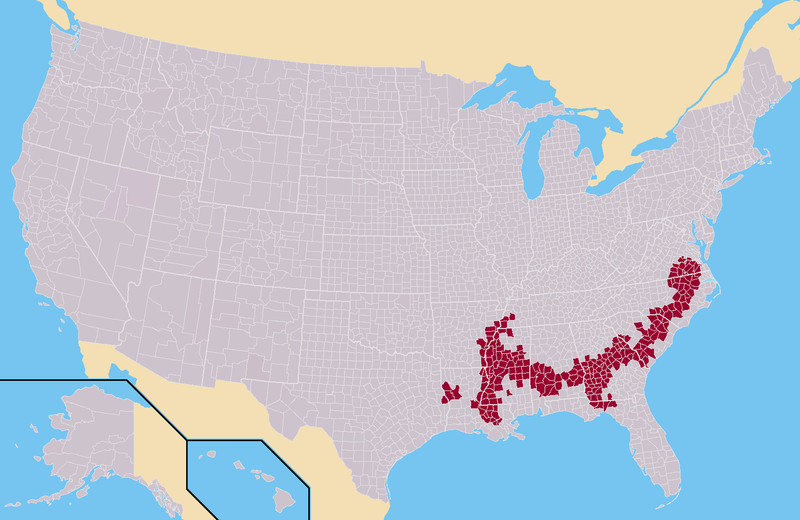
Black Belt counties in the South
- Textiles grew in the Carolinas and Georgia, so more cotton was processed in the South.
- Tobacco processing expanded in Virginia and North Carolina.
- Lumber and naval stores developed in forested areas.
- Coal, iron, and steel grew around Birmingham, Alabama.
- Atlanta became the symbolic New South city because of railroads, commerce, and rebuilding.
Railroads tied the South more closely to national markets, but they also increased dependence on northern capital. A lot of investment came from outside the region, so profits often flowed outward too.
Why growth stayed limited
- The South lacked local investment capital.
- Rural poverty meant weak demand for goods.
- Public education stayed weak.
- Elites still favored cotton and land.
- Racial discrimination kept wages low and blocked broader development.
Agriculture still dominated
Cotton stayed the main cash crop, and most southerners still lived in an agricultural economy.
- Sharecropping meant the landowner supplied land and tools, and the crop was divided at harvest.
- Tenant farming meant the farmer rented land and usually had a bit more independence.
- Crop-lien system trapped farmers in debt:
- Farmers bought supplies on credit.
- A merchant took a lien on the future crop.
- That pushed farmers to plant cotton, the easiest crop to sell.
- If prices fell or harvests failed, debt rolled into the next year.
Convict leasing connected industry to coerced labor. Southern governments leased prisoners, often Black men arrested under discriminatory laws, to private employers.
The South had new railroads and factories, but they sat inside an old, unequal farm economy.
How White Supremacy Was Rebuilt Under Jim Crow
Jim Crow was the legal, social, and violent system that enforced segregation and Black subordination.
Its parts worked together:
- Segregation in railcars, schools, public spaces, and bans on interracial marriage
- Disfranchisement through poll taxes, literacy or understanding tests, grandfather clauses, white primaries, intimidation, and fraud
- Violence through lynching and mob terror
- Pseudoscientific racism and Social Darwinism used to justify inequality
Key court cases and laws
- Civil Rights Cases (1883) struck down much of the Civil Rights Act of 1875 and limited federal protection against private discrimination.
- Plessy v. Ferguson (1896) upheld “separate but equal.” Homer Plessy challenged Louisiana’s Separate Car Act. Justice John Marshall Harlan dissented and argued for a “color-blind” Constitution.
- The Mississippi Constitution of 1890 became a model for disfranchisement.
- The Wilmington coup of 1898 showed how white supremacists used violence to destroy biracial politics.
This was a continuation of the backlash against Reconstruction. Black political gains were narrowed or overturned by law and terror.
How African Americans Resisted
Black resistance did not end with Reconstruction. African Americans kept building institutions and fighting back.
- Black churches became centers of leadership, mutual aid, and independence.
- Schools and colleges such as Howard, Fisk, Hampton, and Tuskegee trained teachers and leaders.
- Black newspapers, women’s clubs, and the National Association of Colored Women (1896) organized communities and activism.
- Some places still saw voting and biracial politics, including the Readjusters in Virginia and Fusion politics in North Carolina.
Booker T. Washington
Booker T. Washington founded Tuskegee Institute and gave the Atlanta Compromise speech in 1895. He stressed vocational education, economic self-help, and limited open challenge to segregation. His conciliatory tone reflected both strategy and danger. He was speaking to a white audience in a violent time.
Ida B. Wells and W. E. B. Du Bois
Ida B. Wells was an anti-lynching journalist and activist. In Southern Horrors (1892) and A Red Record (1895), she showed that lynching often had economic and political motives, not just the excuses white mobs gave.
W. E. B. Du Bois emerged in the 1890s as a voice for full civil and political equality.
Key Takeaways
The “New South”
Post-Reconstruction program for southern industrialization and investment; modernization remained limited by agricultural dependence, rural poverty, and white supremacy
Henry W. Grady
Atlanta Constitution editor and leading New South spokesman who promoted industrialization, northern investment, sectional reconciliation, and continued white rule
Redeemers
Conservative white southern Democrats who regained state governments and dismantled Reconstruction-era Black political gains
Sharecropping
System in which a family farmed an owner’s land and paid with a share of the crop, often becoming trapped in debt
Tenant Farming
System in which farmers rented land and supplied more of their own equipment or capital than sharecroppers, giving them greater but limited independence
Crop-Lien System
Credit system in which merchants claimed a farmer’s future crop as security, encouraging cotton production and recurring debt
Convict Leasing
Practice of leasing disproportionately Black prisoners to private employers for brutal labor, linking industrial growth to racial coercion
Jim Crow
Southern system of laws, customs, inequality, and violence that enforced racial segregation and Black subordination after Reconstruction
The Civil Rights Cases
1883 Supreme Court decisions striking down major parts of the Civil Rights Act of 1875 because the Fourteenth Amendment restricted state, not private, discrimination
Disfranchisement
Removal of voting power through poll taxes, tests, registration barriers, white primaries, fraud, intimidation, and violence aimed chiefly at Black citizens
Poll Taxes
Fees required before voting that disfranchised many Black citizens and poor whites
Literacy Tests / Understanding Tests
Voting requirements selectively administered by white registrars to exclude African Americans
Grandfather Clauses
Voting exemptions for men whose ancestors had voted before the Civil War, protecting many whites while excluding most Black citizens
White Primaries
Democratic primary elections that barred Black voters from the decisive stage of politics in the one-party South
Lynching
Mob killing without trial used to terrorize African Americans and punish political activity, economic success, or resistance to white authority
Scientific Racism
Pseudoscientific theories that ranked races biologically and supplied a modern-sounding justification for segregation and inequality
Booker T. Washington
Tuskegee Institute leader who promoted vocational education, property ownership, economic self-help, and cautious accommodation to segregation
Atlanta Compromise
Washington’s 1895 position emphasizing Black economic and vocational progress while deferring demands for immediate social and political equality
Ida B. Wells
Black journalist who investigated lynching, exposed its economic and political motives, and campaigned for protest and federal action
W. E. B. Du Bois
Black scholar who argued that vocational advancement could not replace voting rights, equal education, and full constitutional equality
Plessy v. Ferguson
1896 Supreme Court decision upholding Louisiana’s state-mandated railroad segregation and giving constitutional protection to Jim Crow
Separate but Equal Doctrine
Principle that racial segregation was constitutional if the separate facilities provided were supposedly equal
Tuskegee Institute
Black educational institution led by Booker T. Washington that emphasized industrial and agricultural training, teacher preparation, and economic advancement
Notes
The “New South”
Post-Reconstruction program for southern industrialization and investment; modernization remained limited by agricultural dependence, rural poverty, and white supremacy
Henry W. Grady
Atlanta Constitution editor and leading New South spokesman who promoted industrialization, northern investment, sectional reconciliation, and continued white rule
Redeemers
Conservative white southern Democrats who regained state governments and dismantled Reconstruction-era Black political gains
Sharecropping
System in which a family farmed an owner’s land and paid with a share of the crop, often becoming trapped in debt
Tenant Farming
System in which farmers rented land and supplied more of their own equipment or capital than sharecroppers, giving them greater but limited independence
Crop-Lien System
Credit system in which merchants claimed a farmer’s future crop as security, encouraging cotton production and recurring debt
Convict Leasing
Practice of leasing disproportionately Black prisoners to private employers for brutal labor, linking industrial growth to racial coercion
Jim Crow
Southern system of laws, customs, inequality, and violence that enforced racial segregation and Black subordination after Reconstruction
The Civil Rights Cases
1883 Supreme Court decisions striking down major parts of the Civil Rights Act of 1875 because the Fourteenth Amendment restricted state, not private, discrimination
Disfranchisement
Removal of voting power through poll taxes, tests, registration barriers, white primaries, fraud, intimidation, and violence aimed chiefly at Black citizens
Poll Taxes
Fees required before voting that disfranchised many Black citizens and poor whites
Literacy Tests / Understanding Tests
Voting requirements selectively administered by white registrars to exclude African Americans
Grandfather Clauses
Voting exemptions for men whose ancestors had voted before the Civil War, protecting many whites while excluding most Black citizens
White Primaries
Democratic primary elections that barred Black voters from the decisive stage of politics in the one-party South
Lynching
Mob killing without trial used to terrorize African Americans and punish political activity, economic success, or resistance to white authority
Scientific Racism
Pseudoscientific theories that ranked races biologically and supplied a modern-sounding justification for segregation and inequality
Booker T. Washington
Tuskegee Institute leader who promoted vocational education, property ownership, economic self-help, and cautious accommodation to segregation
Atlanta Compromise
Washington’s 1895 position emphasizing Black economic and vocational progress while deferring demands for immediate social and political equality
Ida B. Wells
Black journalist who investigated lynching, exposed its economic and political motives, and campaigned for protest and federal action
W. E. B. Du Bois
Black scholar who argued that vocational advancement could not replace voting rights, equal education, and full constitutional equality
Plessy v. Ferguson
1896 Supreme Court decision upholding Louisiana’s state-mandated railroad segregation and giving constitutional protection to Jim Crow
Separate but Equal Doctrine
Principle that racial segregation was constitutional if the separate facilities provided were supposedly equal
Tuskegee Institute
Black educational institution led by Booker T. Washington that emphasized industrial and agricultural training, teacher preparation, and economic advancement
