Topic 4.6 Notes – Market Revolution: Society and Culture
How the Market Revolution Changed Everyday Life
Topic 4.5 covered the roads, canals, steamboats, and other innovations. Here, you’re looking at what those changes did to people’s lives.
Early in the 1800s, many families lived in semi-subsistence households. They grew food and made many daily goods themselves, then sold only a small surplus. The market revolution pushed Americans toward a market society, where people produced goods for distant buyers and depended more on buying things with cash.
- Households became more dependent on wages, credit, cash, and market prices.
- Work moved out of the home and into factories, shops, docks, and offices.
- The old artisan system weakened. Apprentices no longer had the same clear path to become independent masters. The economy created sharper lines between employers and employees.
- Factory labor brought time discipline. Bells, clocks, fixed hours, and close supervision replaced the older rhythm of seasons and task-based work.
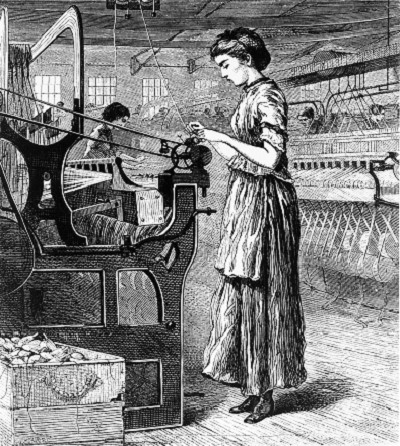
Textile mill labor during the market revolution
This change created both gains and risks. Productivity rose, goods became easier to buy, and some people found new chances to move up. At the same time, dependence on markets made families vulnerable during downturns like the Panic of 1819 and Panic of 1837.
Migration, Immigration, and the Growth of Cities
The new economy pulled people across the map in two big ways. Native-born Americans moved west of the Appalachians, and immigrants moved mostly into Northern cities.
Westward settlement and commercial towns
White settlers built communities along the Ohio and Mississippi river systems. Places like Cincinnati, Louisville, and St. Louis grew because they sat on trade routes and became centers for processing, storage, and distribution.
A period railroad map of the Ohio Valley helps show how these commercial centers were linked to one another and to newer western settlements.
- Western farmers sold grain and livestock into national markets.
- They bought eastern manufactured goods, tying West and Northeast together.
- Transportation access shaped settlement. Rivers, canals, roads, and later rail lines determined where towns grew.
- This expansion depended on Native dispossession, removal, and unequal treaties.
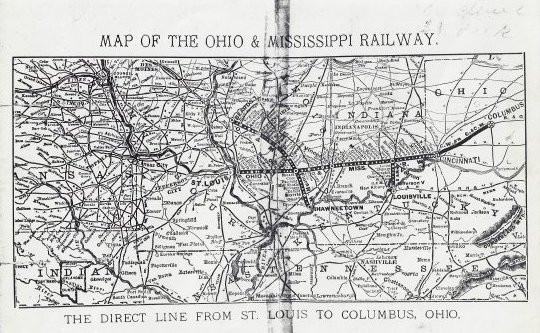
Ohio and Mississippi Railway map
International immigration
The biggest immigrant groups were Irish and Germans.
- Irish immigrants surged after the Great Famine began in 1845. Many stayed in New York and Boston and worked in low-wage jobs such as construction, dock work, factory labor, and domestic service.
- German immigrants were more diverse economically. Many moved inland to farms and businesses in Pennsylvania and the Old Northwest.
Immigrants built ethnic neighborhoods, churches, and mutual-aid societies. Their growing presence also fueled nativism, especially anti-immigrant and anti-Catholic prejudice that later fed the Know-Nothing movement.
Urbanization
Cities like New York City, Boston, Philadelphia, and Baltimore expanded rapidly. The Erie Canal helped make New York the nation’s leading commercial city.
Urban growth also brought problems:
- crowded housing
- weak sanitation
- disease
- poverty
- fire danger
A standard example is the cholera epidemic of 1832, which exposed how unhealthy crowded cities could be. Lowell, Massachusetts became the classic model of an industrial town.
New Work and the New Class Structure
Manufacturing expanded wage labor and reduced reliance on family-based production. As production got broken into smaller repetitive tasks, many workers became more replaceable.
Common wage workers included:
- factory operatives
- dockworkers
- construction laborers
- domestic servants
- seamstresses
- miners
- transport workers
Conditions were often harsh. Long hours, low or unstable pay, dangerous machines, child labor, and almost no protection from injury or firing were common.
Americans argued over free labor. In theory, wage work could lead to independence and upward mobility. In practice, many workers stayed wage-dependent for life.
| Group | Who they were | Main pattern |
|---|---|---|
| Business elite | merchants, bankers, manufacturers, investors | great wealth and influence |
| Middle class | clerks, managers, professionals, shopkeepers, prosperous farmers, skilled artisans | valued thrift, discipline, education, respectability |
| Laboring poor | casual laborers, poor immigrants, widows, servants, low-paid workers | vulnerable to unemployment and illness |
The self-made man ideal celebrated hard work and talent, but it also blamed poor people for problems caused by low wages, discrimination, and panics. At the same time, an expanding consumer culture made goods like clocks, books, furniture, and clothing more available, and consumption became a status marker.
Gender, Family, and Worker Resistance
As work left the household, Americans increasingly described life in separate spheres. Men belonged in business and politics. Women belonged in the home, religion, morality, and childrearing.
The cult of domesticity or true womanhood emphasized:
- piety
- purity
- submissiveness
- domesticity
Catherine Beecher expressed this ideal in A Treatise on Domestic Economy.
This fit mainly white middle-class families. Working-class women, immigrant women, rural women, enslaved women, and free Black women often had to work for wages or do heavy productive labor.
Lowell mill girls
The best case is the Lowell mill girls, young unmarried New England women recruited into textile mills.
- They earned cash wages and gained some independence.
- They lived in company boardinghouses with curfews and moral supervision.
- Some wrote for the Lowell Offering.
- They faced long hours, noise, dust, and strict discipline.
- They staged turnouts in 1834 and 1836.
- The Lowell Female Labor Reform Association demanded a ten-hour day.
- Later, mills relied more on Irish immigrant labor.
Labor protest and family change
Workers also organized beyond Lowell.
- Workingmen’s parties appeared in the late 1820s and 1830s.
- The National Trades’ Union formed in 1834.
- Commonwealth v. Hunt in 1842 ruled that unions were not automatically criminal conspiracies.
Family life changed too. The family became less of a shared productive unit and more tied to consumption, schooling, and childrearing, though poor families still depended on pooled wages from multiple members.
Key Takeaways
Market Revolution
The shift from household production and semi-subsistence farming toward commercial agriculture, manufacturing, wage labor, and long-distance markets, producing migration, urbanization, new classes, and changing gender roles
Semi-Subsistence Agriculture
Farming in which a household produced most of its own necessities and sold or exchanged only a limited surplus
Old Northwest
The region north of the Ohio River that attracted western settlers and developed commercial farms and market towns linked to Northeastern manufacturing
Irish Immigration
Migration intensified by the Great Famine; many poor Irish settled in Northern port cities and entered low-wage construction, domestic, transportation, and factory work
Great Famine
The Irish famine beginning in 1845 when potato blight destroyed a staple crop, driving mass emigration to the United States
German Immigration
Migration by Germans of varied backgrounds; some settled in Northern cities, while others with sufficient resources established farms or businesses in Pennsylvania and the Old Northwest
Nativism
The belief that native-born Americans deserved preference over immigrants, often expressed through anti-immigrant and anti-Catholic prejudice
Urbanization
The rapid growth of cities as manufacturing, commerce, transportation, and immigration concentrated people and jobs in urban centers
Wage Labor
Work performed for cash wages rather than through ownership of a farm, shop, or tools, leaving workers dependent on employers and market conditions
Deskilling
The division of production into simple repetitive tasks that reduced the training workers needed and made them easier for employers to replace
Time Discipline
Factory regulation of labor through clocks, bells, fixed hours, punctuality, attendance rules, and measured output
Free Labor
The ideal that wage earners freely chose employers and could save, acquire property, and become independent, unlike enslaved laborers
Lowell System
A textile-production system that combined spinning and weaving in mechanized factories and employed young unmarried women housed in supervised company boardinghouses
Lowell Mill Girls
Young unmarried New England women who earned wages in Lowell textile mills, gaining limited independence while facing long hours and strict company discipline
Lowell Female Labor Reform Association
An organization of female textile workers that campaigned during the 1840s for a ten-hour workday
Workingmen's Political Parties
Urban labor parties of the late 1820s and early 1830s that opposed concentrated wealth, imprisonment for debt, long hours, and unequal education
National Trades' Union
An organization founded in 1834 to unite local labor groups; it declined during the Panic of 1837
Commonwealth v. Hunt
An 1842 Massachusetts ruling that unions were not inherently criminal conspiracies and could peacefully pursue lawful goals
Business Elite
A small wealthy class of merchants, manufacturers, bankers, and investors whose economic power brought disproportionate social and political influence
Middle Class
Merchants, managers, clerks, professionals, prosperous farmers, and some skilled artisans who emphasized thrift, education, respectability, self-discipline, and consumption
Self-Made Man
The ideal that an ordinary white man could gain success through talent, discipline, hard work, sobriety, and risk-taking rather than inherited privilege
Consumer Culture
A culture in which expanding production and advertising encouraged purchases of manufactured goods that increasingly expressed status and respectability
Separate Spheres / Cult of Domesticity / Cult of True Womanhood
The middle-class ideal assigning men to the public world of work and politics and women to the private home, where they were expected to embody piety, purity, submissiveness, and domesticity
Catherine Beecher
Author of A Treatise on Domestic Economy (1841), which presented homemaking and childrearing as women's specialized social responsibilities
Working Class
The expanding class of factory, transportation, construction, domestic, and workshop employees who depended primarily on wages
Laboring Poor
Low-paid and insecure workers whose families were especially vulnerable to unemployment, illness, overcrowding, and economic downturns
Commercial Agriculture
Farming specialized in crops or livestock for cash sale to distant markets, increasing dependence on transportation, credit, and market prices
Traditional Artisan System
A craft system in which apprentices learned under master craftsmen, became journeymen, and could hope to establish independent shops
Notes
Market Revolution
The shift from household production and semi-subsistence farming toward commercial agriculture, manufacturing, wage labor, and long-distance markets, producing migration, urbanization, new classes, and changing gender roles
Semi-Subsistence Agriculture
Farming in which a household produced most of its own necessities and sold or exchanged only a limited surplus
Old Northwest
The region north of the Ohio River that attracted western settlers and developed commercial farms and market towns linked to Northeastern manufacturing
Irish Immigration
Migration intensified by the Great Famine; many poor Irish settled in Northern port cities and entered low-wage construction, domestic, transportation, and factory work
Great Famine
The Irish famine beginning in 1845 when potato blight destroyed a staple crop, driving mass emigration to the United States
German Immigration
Migration by Germans of varied backgrounds; some settled in Northern cities, while others with sufficient resources established farms or businesses in Pennsylvania and the Old Northwest
Nativism
The belief that native-born Americans deserved preference over immigrants, often expressed through anti-immigrant and anti-Catholic prejudice
Urbanization
The rapid growth of cities as manufacturing, commerce, transportation, and immigration concentrated people and jobs in urban centers
Wage Labor
Work performed for cash wages rather than through ownership of a farm, shop, or tools, leaving workers dependent on employers and market conditions
Deskilling
The division of production into simple repetitive tasks that reduced the training workers needed and made them easier for employers to replace
Time Discipline
Factory regulation of labor through clocks, bells, fixed hours, punctuality, attendance rules, and measured output
Free Labor
The ideal that wage earners freely chose employers and could save, acquire property, and become independent, unlike enslaved laborers
Lowell System
A textile-production system that combined spinning and weaving in mechanized factories and employed young unmarried women housed in supervised company boardinghouses
Lowell Mill Girls
Young unmarried New England women who earned wages in Lowell textile mills, gaining limited independence while facing long hours and strict company discipline
Lowell Female Labor Reform Association
An organization of female textile workers that campaigned during the 1840s for a ten-hour workday
Workingmen's Political Parties
Urban labor parties of the late 1820s and early 1830s that opposed concentrated wealth, imprisonment for debt, long hours, and unequal education
National Trades' Union
An organization founded in 1834 to unite local labor groups; it declined during the Panic of 1837
Commonwealth v. Hunt
An 1842 Massachusetts ruling that unions were not inherently criminal conspiracies and could peacefully pursue lawful goals
Business Elite
A small wealthy class of merchants, manufacturers, bankers, and investors whose economic power brought disproportionate social and political influence
Middle Class
Merchants, managers, clerks, professionals, prosperous farmers, and some skilled artisans who emphasized thrift, education, respectability, self-discipline, and consumption
Self-Made Man
The ideal that an ordinary white man could gain success through talent, discipline, hard work, sobriety, and risk-taking rather than inherited privilege
Consumer Culture
A culture in which expanding production and advertising encouraged purchases of manufactured goods that increasingly expressed status and respectability
Separate Spheres / Cult of Domesticity / Cult of True Womanhood
The middle-class ideal assigning men to the public world of work and politics and women to the private home, where they were expected to embody piety, purity, submissiveness, and domesticity
Catherine Beecher
Author of A Treatise on Domestic Economy (1841), which presented homemaking and childrearing as women's specialized social responsibilities
Working Class
The expanding class of factory, transportation, construction, domestic, and workshop employees who depended primarily on wages
Laboring Poor
Low-paid and insecure workers whose families were especially vulnerable to unemployment, illness, overcrowding, and economic downturns
Commercial Agriculture
Farming specialized in crops or livestock for cash sale to distant markets, increasing dependence on transportation, credit, and market prices
Traditional Artisan System
A craft system in which apprentices learned under master craftsmen, became journeymen, and could hope to establish independent shops
