Topic 3.5 Notes – The American Revolution
Why the Patriots Won the Revolution
American victory came from a chain of causes, not one miracle battle. The Patriots kept fighting long enough for the war to change.
- Patriot commitment and military survival kept the Revolution alive even after defeats.
- Washington preserved the army, which mattered more than holding every city.
- Saratoga convinced France to openly join the war.
- The French alliance turned the conflict into a global war and stretched Britain thin.
- Yorktown destroyed British hopes of finishing the war and helped collapse support in Parliament.
Britain started with huge advantages:
- Professional army with experienced officers
- Royal Navy that controlled the sea
- Stronger finances and credit
- Hessians, German hired soldiers who added manpower
Britain’s real problem was harder than winning battles. It had to conquer a huge territory, protect supply lines across the Atlantic, restore civil government, and turn Loyalist sympathy into actual control. That was much harder than capturing cities.
This was also a civil war among colonists.
- Patriots backed independence.
- Loyalists or Tories stayed loyal to Britain, especially in New York, New Jersey, Georgia, and the southern backcountry.
- Many people stayed neutral or changed sides.
- American Indians often favored Britain because they hoped Britain would slow settler expansion.
- African Americans served on both sides. Lord Dunmore’s Proclamation promised freedom to enslaved people who fled Patriot masters and joined the British.
American Strengths That Kept the Revolution Alive
The Patriots fought with both militias and the Continental Army, and APUSH loves this distinction.
Militias
Militias were local and short-term. They could gather fast, defend home areas, spy on British movements, and attack detachments and supply lines.
- Lexington and Concord showed this clearly. British troops could march out, but militia could rapidly assemble and make that march back deadly.
Continental Army
The Second Continental Congress created the Continental Army in 1775. This was the long-term national force that could survive across campaigns.
It had constant problems:
- shortages of food, clothing, weapons, and pay
- inflation and weak financing by Congress
- desertion and short enlistments
- the phrase “not worth a Continental” came from the collapse of paper money’s value
Civilian support mattered just as much as soldiers.
- belief in liberty, self-government, and natural rights helped people keep going
- women provided food, clothing, nursing, labor, and ran farms and businesses
- Valley Forge became the symbol of sacrifice and endurance
That idea shows up in many later images of the war, including scenes of Washington at Valley Forge.
Baron von Steuben helped turn the army into a more disciplined fighting force through drill and training.
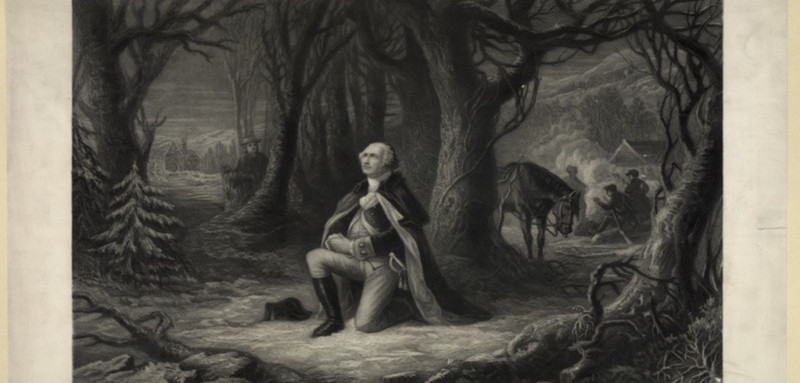
Washington at Valley Forge
Washington’s Leadership and the War’s Turning Points
Washington’s biggest strength was persistence. He used a Fabian-style strategy. He avoided letting the British destroy his army, retreated when needed, and attacked when the odds improved. His being a Virginian leading a mostly New England force also helped colonial unity.
The major turning points and campaigns below trace that strategy from New England to the Middle Colonies and finally to Virginia.
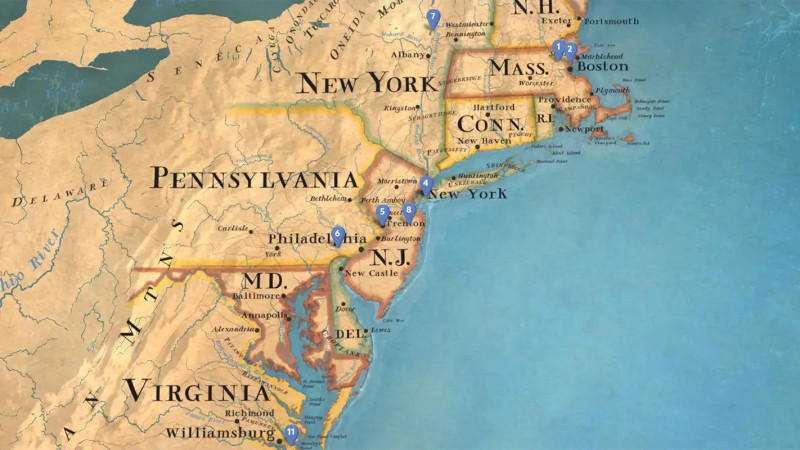
Major Revolutionary War campaigns in the Northeast
- Bunker Hill and Boston: Britain won at Breed’s Hill but took heavy losses. Then Henry Knox brought artillery from Fort Ticonderoga, and Britain evacuated Boston in 1776.
- New York campaign: Britain captured New York City in 1776, but Washington’s nighttime escape saved the army.
- Trenton and Princeton: Washington crossed the Delaware, won surprise victories, and revived morale and reenlistments.
- Saratoga: Burgoyne surrendered after Freeman’s Farm and Bemis Heights. Benedict Arnold fought bravely there, though Horatio Gates commanded. This victory brought the French alliance.
- Yorktown: Washington and Rochambeau trapped Cornwallis, and the French fleet under de Grasse won the Battle of the Chesapeake, blocking escape.
Why Britain Could Win Battles but Still Lose the War
British strategy kept failing politically. Capturing cities did not end resistance.
Common British problems:
- long Atlantic supply lines
- slow communication with London
- too much faith in Loyalist support
- rural resistance continued after cities fell
- Britain also had to defend Canada, Caribbean sugar islands, Atlantic trade, and later a wider empire
Saratoga showed failed coordination. Burgoyne expected help from Howe and St. Leger, but rough terrain, militia pressure, and isolation ruined the campaign.
The southern strategy showed the same problem. Britain took Savannah, Charleston, and won at Camden, but Patriot resistance came back through Kings Mountain, Cowpens, and Nathanael Greene’s war of attrition. Guilford Courthouse was a British tactical win that weakened Cornwallis badly.
European Aid and the Peace Settlement
Foreign help turned resistance into victory. French aid was the decisive outside factor.
- before 1778, France sent covert supplies
- after Saratoga, France recognized the U.S. and formed an alliance
- France gave loans, weapons, troops, officers, and crucial naval power
- Marquis de Lafayette became a key symbol of French-American cooperation
That support mattered most at Yorktown, where French troops and naval power helped trap Cornwallis.
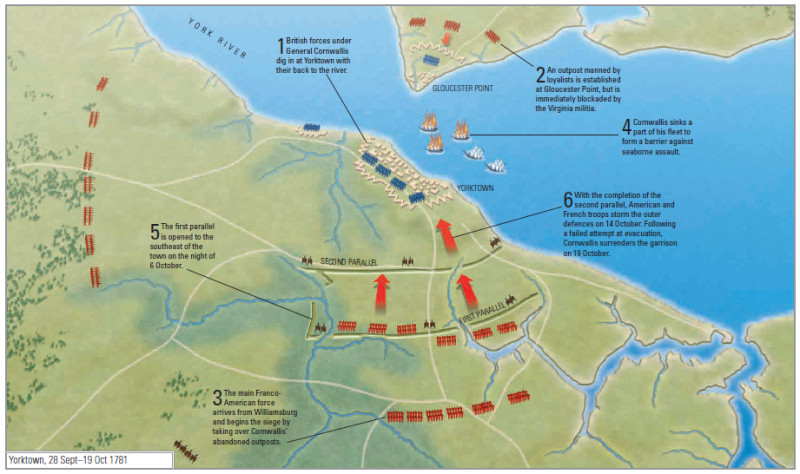
Siege of Yorktown, 1781
Other support widened the war:
- Spain entered in 1779. Bernardo de Gálvez captured Baton Rouge, Mobile, and Pensacola.
- The Dutch Republic provided credit and later fought Britain.
- Volunteers included Tadeusz Kościuszko and Casimir Pulaski.
After Saratoga and especially Yorktown, British political support for the war fell apart.
The Treaty of Paris 1783 did four big things:
| Term | What it did |
|---|---|
| Independence | Britain recognized the United States |
| Boundaries | U.S. land reached the Mississippi River |
| Fishing rights | Americans kept rights off Newfoundland and in the Gulf of Saint Lawrence |
| Unresolved issues | Loyalist property and prewar debts remained disputed |
Key Takeaways
Lord Dunmore’s Proclamation
1775 proclamation offering freedom to some enslaved people who escaped Patriot owners and entered British service
Hessians (German Auxiliaries)
About 30,000 soldiers hired by Britain from German states, especially Hesse-Cassel, to supplement British forces
Colonial and State Militias
Local, short-term citizen forces that mobilized quickly, gathered intelligence, harassed British forces, reinforced the army, and made occupation difficult
Continental Army
National army created by the Second Continental Congress in June 1775 whose soldiers enlisted for longer service and sustained conventional resistance
George Washington
Continental Army commander who preserved the army through defeats, maintained political unity, restored morale, and coordinated the allied victory at Yorktown
Fabian Strategy
Strategy of avoiding decisive battle on a stronger enemy’s terms, wearing the enemy down, and preserving one’s army for continued resistance
Lexington and Concord
April 19, 1775 opening battles in which rapidly mobilized Massachusetts militia made a British expedition to seize supplies costly
Battle of Bunker Hill
June 1775 British capture of American fortifications on Breed’s Hill at the cost of more than 1,000 British casualties
General William Howe
British commander who captured New York and later campaigned against Philadelphia instead of supporting Burgoyne’s advance toward Albany
General John Burgoyne
British general whose poorly supplied 1777 advance from Canada became isolated and ended with his surrender at Saratoga
Battle of Saratoga
1777 American victory and surrender of Burgoyne’s army that convinced France to recognize and ally with the United States
General Horatio Gates
American general who held overall command of the Patriot forces that defeated Burgoyne at Saratoga
Benedict Arnold at Saratoga
American officer whose aggressive battlefield leadership, especially at Bemis Heights, helped force Burgoyne’s defeat
Treaties of Amity and Alliance
1778 agreements by which France recognized the United States and entered the war, providing loans, weapons, troops, officers, and naval power
Valley Forge
Continental Army’s winter 1777–1778 encampment, where it endured severe shortages and disease while becoming more disciplined and cohesive
Baron Friedrich Wilhelm von Steuben
Prussian officer who standardized drill and improved the Continental Army’s discipline and battlefield coordination at Valley Forge
Marquis de Lafayette
French nobleman who served with Washington and helped strengthen military and political cooperation between France and the United States
Dutch Republic’s Support
Dutch credit and goods aided the Americans, and open war with Britain beginning in 1780 further stretched British military and naval resources
British Southern Strategy
British plan beginning in 1778 to conquer Georgia and the Carolinas by capturing key positions and mobilizing presumed southern Loyalist support
Siege of Charleston
May 1780 British capture of Charleston and more than 5,000 American troops, one of the Patriots’ worst defeats
Battle of Camden
August 1780 British victory over an American army that strengthened British control temporarily but failed to end southern resistance
Battle of Kings Mountain
October 1780 Patriot militia victory over Loyalist forces that weakened Britain’s southern campaign
Battle of Cowpens
January 1781 American victory in which Daniel Morgan used layered militia and Continental lines and a planned withdrawal to defeat a British force
General Nathanael Greene
Southern commander who used mobility and attrition to preserve American forces while exhausting British troops and supply lines
Battle of Guilford Courthouse
March 1781 battle in which Britain held the field but suffered heavy casualties it could not readily replace, weakening Cornwallis despite his tactical victory
General Charles Cornwallis
British southern commander whose costly campaign ended when his army became trapped and surrendered at Yorktown
General Jean-Baptiste de Rochambeau
French commander who led French troops south with Washington and helped coordinate the allied siege of Yorktown
Admiral François Joseph Paul de Grasse
French admiral whose fleet controlled the Chesapeake and prevented the Royal Navy from rescuing Cornwallis at Yorktown
Battle of the Chesapeake
September 1781 French naval victory that blocked British relief of Cornwallis and allowed allied forces to trap him at Yorktown
Battle of Yorktown
1781 combined American-French siege, supported by French naval control, that forced Cornwallis to surrender about 8,000 troops and broke British support for the war
Treaty of Paris of 1783
Peace treaty in which Britain recognized an independent United States with territory extending west to the Mississippi River
Patriots (Revolutionaries)
Colonists who supported resistance and independence, sustained by beliefs in liberty, natural rights, and self-government
Loyalists (Tories)
Colonists who remained loyal to the British Crown and provided Britain with civilian support, intelligence, and military service
Siege of Boston
Patriot encirclement of British-held Boston that ended with the British evacuation in March 1776
Dorchester Heights
Heights where artillery transported from Fort Ticonderoga threatened British forces and compelled their evacuation of Boston
New York Campaign
1776 British campaign that captured New York City and drove Washington into retreat, though his army survived to continue the war
Battle of Long Island
August 1776 British victory in which Washington’s defeated army escaped capture through a nighttime evacuation across the East River
Battle of Trenton
December 1776 surprise attack after Washington crossed the Delaware that captured nearly 900 German soldiers and revived Patriot morale
Battle of Princeton
January 1777 American victory following Trenton that further restored confidence and encouraged continuation of the war
Bernardo de Gálvez
Spanish governor whose Gulf Coast campaigns captured British positions at Baton Rouge, Mobile, and Pensacola
Spanish Intervention
Spain’s war against Britain widened the conflict, weakened British power along the Gulf Coast, and divided British resources
Patriot Ideology and Resilience
Commitment to liberty, natural rights, and self-government encouraged soldiers and civilians to continue the war through defeats and shortages
Civilian Mobilization
Civilian production, transportation, labor, money, and management of farms and businesses helped sustain the army through eight years of war
Notes
Lord Dunmore’s Proclamation
1775 proclamation offering freedom to some enslaved people who escaped Patriot owners and entered British service
Hessians (German Auxiliaries)
About 30,000 soldiers hired by Britain from German states, especially Hesse-Cassel, to supplement British forces
Colonial and State Militias
Local, short-term citizen forces that mobilized quickly, gathered intelligence, harassed British forces, reinforced the army, and made occupation difficult
Continental Army
National army created by the Second Continental Congress in June 1775 whose soldiers enlisted for longer service and sustained conventional resistance
George Washington
Continental Army commander who preserved the army through defeats, maintained political unity, restored morale, and coordinated the allied victory at Yorktown
Fabian Strategy
Strategy of avoiding decisive battle on a stronger enemy’s terms, wearing the enemy down, and preserving one’s army for continued resistance
Lexington and Concord
April 19, 1775 opening battles in which rapidly mobilized Massachusetts militia made a British expedition to seize supplies costly
Battle of Bunker Hill
June 1775 British capture of American fortifications on Breed’s Hill at the cost of more than 1,000 British casualties
General William Howe
British commander who captured New York and later campaigned against Philadelphia instead of supporting Burgoyne’s advance toward Albany
General John Burgoyne
British general whose poorly supplied 1777 advance from Canada became isolated and ended with his surrender at Saratoga
Battle of Saratoga
1777 American victory and surrender of Burgoyne’s army that convinced France to recognize and ally with the United States
General Horatio Gates
American general who held overall command of the Patriot forces that defeated Burgoyne at Saratoga
Benedict Arnold at Saratoga
American officer whose aggressive battlefield leadership, especially at Bemis Heights, helped force Burgoyne’s defeat
Treaties of Amity and Alliance
1778 agreements by which France recognized the United States and entered the war, providing loans, weapons, troops, officers, and naval power
Valley Forge
Continental Army’s winter 1777–1778 encampment, where it endured severe shortages and disease while becoming more disciplined and cohesive
Baron Friedrich Wilhelm von Steuben
Prussian officer who standardized drill and improved the Continental Army’s discipline and battlefield coordination at Valley Forge
Marquis de Lafayette
French nobleman who served with Washington and helped strengthen military and political cooperation between France and the United States
Dutch Republic’s Support
Dutch credit and goods aided the Americans, and open war with Britain beginning in 1780 further stretched British military and naval resources
British Southern Strategy
British plan beginning in 1778 to conquer Georgia and the Carolinas by capturing key positions and mobilizing presumed southern Loyalist support
Siege of Charleston
May 1780 British capture of Charleston and more than 5,000 American troops, one of the Patriots’ worst defeats
Battle of Camden
August 1780 British victory over an American army that strengthened British control temporarily but failed to end southern resistance
Battle of Kings Mountain
October 1780 Patriot militia victory over Loyalist forces that weakened Britain’s southern campaign
Battle of Cowpens
January 1781 American victory in which Daniel Morgan used layered militia and Continental lines and a planned withdrawal to defeat a British force
General Nathanael Greene
Southern commander who used mobility and attrition to preserve American forces while exhausting British troops and supply lines
Battle of Guilford Courthouse
March 1781 battle in which Britain held the field but suffered heavy casualties it could not readily replace, weakening Cornwallis despite his tactical victory
General Charles Cornwallis
British southern commander whose costly campaign ended when his army became trapped and surrendered at Yorktown
General Jean-Baptiste de Rochambeau
French commander who led French troops south with Washington and helped coordinate the allied siege of Yorktown
Admiral François Joseph Paul de Grasse
French admiral whose fleet controlled the Chesapeake and prevented the Royal Navy from rescuing Cornwallis at Yorktown
Battle of the Chesapeake
September 1781 French naval victory that blocked British relief of Cornwallis and allowed allied forces to trap him at Yorktown
Battle of Yorktown
1781 combined American-French siege, supported by French naval control, that forced Cornwallis to surrender about 8,000 troops and broke British support for the war
Treaty of Paris of 1783
Peace treaty in which Britain recognized an independent United States with territory extending west to the Mississippi River
Patriots (Revolutionaries)
Colonists who supported resistance and independence, sustained by beliefs in liberty, natural rights, and self-government
Loyalists (Tories)
Colonists who remained loyal to the British Crown and provided Britain with civilian support, intelligence, and military service
Siege of Boston
Patriot encirclement of British-held Boston that ended with the British evacuation in March 1776
Dorchester Heights
Heights where artillery transported from Fort Ticonderoga threatened British forces and compelled their evacuation of Boston
New York Campaign
1776 British campaign that captured New York City and drove Washington into retreat, though his army survived to continue the war
Battle of Long Island
August 1776 British victory in which Washington’s defeated army escaped capture through a nighttime evacuation across the East River
Battle of Trenton
December 1776 surprise attack after Washington crossed the Delaware that captured nearly 900 German soldiers and revived Patriot morale
Battle of Princeton
January 1777 American victory following Trenton that further restored confidence and encouraged continuation of the war
Bernardo de Gálvez
Spanish governor whose Gulf Coast campaigns captured British positions at Baton Rouge, Mobile, and Pensacola
Spanish Intervention
Spain’s war against Britain widened the conflict, weakened British power along the Gulf Coast, and divided British resources
Patriot Ideology and Resilience
Commitment to liberty, natural rights, and self-government encouraged soldiers and civilians to continue the war through defeats and shortages
Civilian Mobilization
Civilian production, transportation, labor, money, and management of farms and businesses helped sustain the army through eight years of war
