Topic 3.3 Notes – Taxation Without Representation
What Taxation Without Representation Meant
The phrase sounds like a money complaint, but the deeper issue was sovereignty. Britain wanted revenue and tighter control after the Seven Years’ War. Colonists asked who actually had the right to govern them.
Before this, salutary neglect had given the colonies a long habit of self-rule:
- colonial assemblies voted on local taxes
- town meetings handled local affairs
- Navigation Acts existed, but enforcement was uneven
- colonists got used to making many decisions themselves
That is why new British policies felt like a major change, not normal empire.
Colonists built their case from several ideas:
- rights of British subjects included property rights, trial by jury, and taxation by consent
- actual representation meant elected assemblies whose members lived among the people they taxed
- Parliament answered with virtual representation, claiming it represented all British subjects everywhere
- Enlightenment ideas added natural rights and government by consent
Early on, many colonists said Parliament could regulate trade through external taxes, but could not impose internal taxes meant to raise revenue inside the colonies. That line got blurry once Britain used customs duties to raise money too. The fight widened from taxes to who ruled the empire.
How British Policies Escalated the Imperial Crisis
Britain kept pressing, and each law pulled more colonists into resistance.
- Sugar Act (1764) lowered the molasses duty but enforced it harder. Vice-admiralty courts used no juries, so people saw a threat to rights as much as a tax issue.
- Currency Act (1764) restricted paper money, making debts harder to pay.
- Stamp Act (1765) taxed printed materials like newspapers, legal documents, licenses, almanacs, and playing cards. Because it touched daily life, resistance spread fast.
- Patrick Henry pushed the Virginia Resolves
- the Stamp Act Congress issued the Declaration of Rights and Grievances
- Benjamin Franklin defended the colonial position before Parliament in 1766
- Parliament repealed it, then passed the Declaratory Act, saying it could legislate for the colonies “in all cases whatsoever”
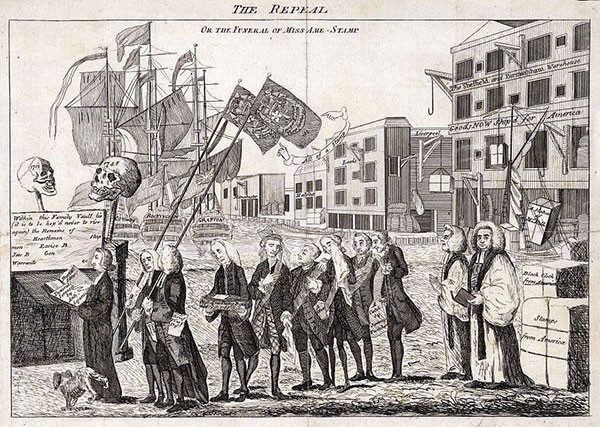
Political cartoon on the repeal of the Stamp Act
- Quartering Act (1765) required colonies to house and supply troops. New York’s assembly was suspended for resisting. A standing army in peacetime scared many colonists.
- Townshend Acts (1767) taxed glass, lead, paint, paper, and tea. Revenue would pay royal governors and judges, weakening assembly power. Boston got an American Board of Customs Commissioners, stronger customs enforcement, and writs of assistance. John Dickinson’s Letters from a Farmer in Pennsylvania attacked these policies. Most duties were repealed in 1770, but the tea tax stayed.
- Tea Act (1773) helped the British East India Company and made tea cheaper, but kept the tax. Colonists resisted the principle of accepting Parliament’s authority.
- Coercive Acts (1774) punished Massachusetts through the Boston Port Act, Massachusetts Government Act, Administration of Justice Act, and revised Quartering Act. Colonists also linked the Quebec Act to these measures.
How Colonists Organized Resistance
Resistance became both formal and popular, which is why it grew so powerful.
Formal political resistance
- petitions, pamphlets, and resolutions turned local complaints into constitutional arguments
- Stamp Act Congress was the first major intercolonial response
- committees of correspondence, led by Samuel Adams after 1772, spread news quickly across colonies
- the Gaspee affair increased fears that colonists might be shipped to Britain for trial
- the First Continental Congress in 1774 issued the Declaration and Resolves, petitioned King George III, and created the Continental Association for nonimportation, nonconsumption, and nonexportation
Popular resistance
- Sons of Liberty used protests, effigies, intimidation, and sometimes tar and feathering
- artisans and laborers backed boycotts and crowd actions, especially in port cities
- women and the Daughters of Liberty promoted homespun cloth, spinning bees, tea boycotts, and substitutes for British goods
- merchants often supported boycotts, though profit sometimes pulled them the other way
This matters on the exam because resistance was not just elite leadership. It expanded political participation far beyond wealthy men in assemblies.
From Protest to Revolution
British troops arrived in Boston in 1768, and occupation made conflict more personal.
The Boston Massacre in 1770 left five dead, including Crispus Attucks, outside the Boston Custom House. Paul Revere’s engraving, shown here, turned the event into Patriot propaganda. John Adams defended the soldiers, and most were acquitted. That mix of propaganda and legal defense is a classic sourcing question about point of view, audience, purpose, and historical situation.
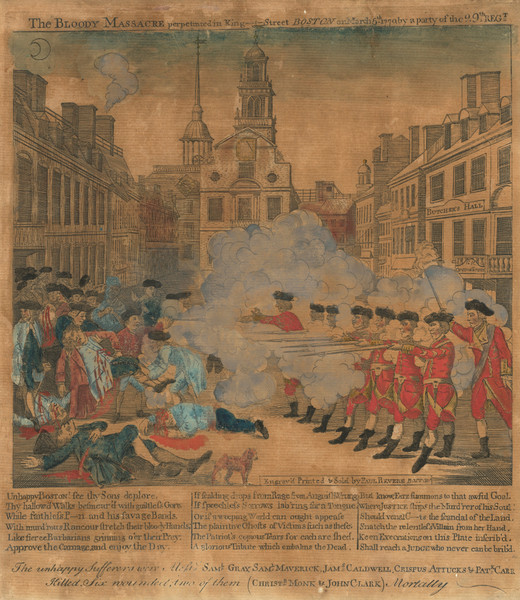
Paul Revere’s engraving of the Boston Massacre
The Boston Tea Party in 1773 destroyed 342 chests of East India Company tea. Protesters disguised themselves as American Indians and targeted taxable property, not random violence.
Britain meant to isolate Massachusetts, but punishment backfired. Other colonies sent aid to Boston. The First Continental Congress created ongoing colonial cooperation. Militias formed, and weapons were stored in Massachusetts. In 1775, General Thomas Gage tried to seize those supplies at Lexington and Concord, starting the Revolutionary War.
Key Takeaways
Taxation Without Representation / No Taxation Without Representation
Colonial claim that Parliament could not tax colonists who elected no members of Parliament and had not consented through their assemblies
Salutary Neglect
Pre-1763 pattern of uneven British enforcement that allowed colonial assemblies and merchants substantial practical autonomy
Rights of British Subjects / Rights of Englishmen
Claimed protections including property rights, jury trials, and taxation only with consent
Colonial Assemblies
Elected colonial legislatures that controlled local taxation and spending and provided colonists with actual representation
Virtual Representation vs. Actual Representation
Britain said Parliament represented all subjects virtually; colonists said only elected, locally accountable assemblies actually represented them
Internal vs. External Taxes
Internal taxes were imposed directly within the colonies; external taxes regulated trade, a distinction strained when import duties were used to raise revenue
Parliamentary Sovereignty
British doctrine that Parliament was the empire’s supreme legislature and could make binding laws for the colonies
Sugar Act of 1764
Lowered the foreign-molasses duty but strengthened collection, expanded import duties, and used juryless vice-admiralty courts to raise revenue
Vice-Admiralty Courts
Juryless imperial courts used to try customs violations, which colonists attacked as violations of British subjects’ rights
Currency Act of 1764
Restricted colonial paper money as legal tender, worsening shortages of specie and making debts harder to pay
Stamp Act of 1765
Direct tax requiring paid stamps on printed and legal materials, provoking broad intercolonial resistance and boycotts
Patrick Henry
Virginia legislator who promoted the Virginia Resolves declaring that only Virginia’s elected assembly could tax Virginians
Virginia Resolves
Patrick Henry’s 1765 resolutions asserting Virginians’ British rights and the Virginia assembly’s exclusive authority to tax them
Stamp Act Congress
1765 meeting of nine colonies that affirmed British rights, demanded taxation through colonial representatives, and petitioned for repeal
Sons of Liberty
Resistance organization that led demonstrations, intimidated stamp distributors, enforced boycotts, and later helped carry out the Boston Tea Party
Nonimportation Agreements
Merchant pledges not to import British goods, using commercial pressure to make British businesses lobby Parliament
Benjamin Franklin
Colonial agent who explained Stamp Act opposition to Parliament in 1766 and gradually moved from imperial reconciliation toward independence
Declaratory Act of 1766
Law accompanying Stamp Act repeal that claimed Parliament could bind the colonies in all cases whatsoever
Townshend Acts
1767 measures imposing revenue duties on glass, lead, paint, paper, and tea while strengthening customs enforcement
Writs of Assistance
Broad search warrants allowing customs officials to search for smuggled goods without naming a specific place or shipment
Nonconsumption
Consumer refusal to buy British imports, broadening boycotts beyond merchants to households and ordinary colonists
Daughters of Liberty
Women activists who promoted homespun, organized spinning gatherings, and substituted colonial products for British imports
Boston Massacre
March 5, 1770 confrontation in which British soldiers killed five colonists, becoming Patriot evidence of military tyranny
Crispus Attucks
Sailor of African and American Indian ancestry killed in the Boston Massacre and remembered as its best-known victim
Paul Revere
Patriot artisan whose widely circulated engraving portrayed the Boston Massacre as a deliberate British attack on defenseless colonists
Committees of Correspondence
Networks beginning in Massachusetts in 1772 that circulated grievances and coordinated resistance among towns and colonies
Samuel Adams
Boston Patriot leader who helped establish Boston’s committee of correspondence and organize resistance to British policies
Gaspee Affair
1772 burning of a British customs schooner in Rhode Island, followed by fears that suspects would be tried in Britain without a local jury
Tea Act of 1773
Allowed the East India Company to sell cheaper tea directly in the colonies while retaining the Townshend tea duty
Boston Tea Party
December 16, 1773 protest in which Sons of Liberty associates dumped 342 chests of taxed East India Company tea into Boston Harbor
Coercive Acts / Intolerable Acts
1774 punitive laws that closed Boston’s port, restricted Massachusetts government, altered official trials, and broadened troop quartering
Quebec Act of 1774
Extended Quebec into the Ohio Valley and protected Catholic practice, alarming colonists seeking western land and fearing arbitrary rule
First Continental Congress
1774 meeting of twelve colonies that condemned the Coercive Acts, petitioned the king, asserted colonial rights, and organized collective resistance
Continental Association
First Continental Congress program of nonimportation, nonconsumption, and eventual nonexportation enforced by local committees
General Thomas Gage
Massachusetts royal governor and military commander who sent troops to seize colonial supplies at Concord in April 1775
Battles of Lexington and Concord
April 19, 1775 clashes begun during Britain’s attempt to seize colonial military supplies, marking the start of the Revolutionary War
John Dickinson
Colonial writer who argued that Parliament could regulate trade but could not impose duties primarily to raise colonial revenue
Letters from a Farmer in Pennsylvania
Widely circulated essays arguing that Parliament could regulate trade but could not impose duties primarily to raise colonial revenue
Quartering Act of 1765
Required colonial governments to provide supplies and accommodations for British troops stationed in North America
Homespun
Colonially produced cloth promoted during boycotts as a substitute for British imports and a public symbol of resistance
Notes
Taxation Without Representation / No Taxation Without Representation
Colonial claim that Parliament could not tax colonists who elected no members of Parliament and had not consented through their assemblies
Salutary Neglect
Pre-1763 pattern of uneven British enforcement that allowed colonial assemblies and merchants substantial practical autonomy
Rights of British Subjects / Rights of Englishmen
Claimed protections including property rights, jury trials, and taxation only with consent
Colonial Assemblies
Elected colonial legislatures that controlled local taxation and spending and provided colonists with actual representation
Virtual Representation vs. Actual Representation
Britain said Parliament represented all subjects virtually; colonists said only elected, locally accountable assemblies actually represented them
Internal vs. External Taxes
Internal taxes were imposed directly within the colonies; external taxes regulated trade, a distinction strained when import duties were used to raise revenue
Parliamentary Sovereignty
British doctrine that Parliament was the empire’s supreme legislature and could make binding laws for the colonies
Sugar Act of 1764
Lowered the foreign-molasses duty but strengthened collection, expanded import duties, and used juryless vice-admiralty courts to raise revenue
Vice-Admiralty Courts
Juryless imperial courts used to try customs violations, which colonists attacked as violations of British subjects’ rights
Currency Act of 1764
Restricted colonial paper money as legal tender, worsening shortages of specie and making debts harder to pay
Stamp Act of 1765
Direct tax requiring paid stamps on printed and legal materials, provoking broad intercolonial resistance and boycotts
Patrick Henry
Virginia legislator who promoted the Virginia Resolves declaring that only Virginia’s elected assembly could tax Virginians
Virginia Resolves
Patrick Henry’s 1765 resolutions asserting Virginians’ British rights and the Virginia assembly’s exclusive authority to tax them
Stamp Act Congress
1765 meeting of nine colonies that affirmed British rights, demanded taxation through colonial representatives, and petitioned for repeal
Sons of Liberty
Resistance organization that led demonstrations, intimidated stamp distributors, enforced boycotts, and later helped carry out the Boston Tea Party
Nonimportation Agreements
Merchant pledges not to import British goods, using commercial pressure to make British businesses lobby Parliament
Benjamin Franklin
Colonial agent who explained Stamp Act opposition to Parliament in 1766 and gradually moved from imperial reconciliation toward independence
Declaratory Act of 1766
Law accompanying Stamp Act repeal that claimed Parliament could bind the colonies in all cases whatsoever
Townshend Acts
1767 measures imposing revenue duties on glass, lead, paint, paper, and tea while strengthening customs enforcement
Writs of Assistance
Broad search warrants allowing customs officials to search for smuggled goods without naming a specific place or shipment
Nonconsumption
Consumer refusal to buy British imports, broadening boycotts beyond merchants to households and ordinary colonists
Daughters of Liberty
Women activists who promoted homespun, organized spinning gatherings, and substituted colonial products for British imports
Boston Massacre
March 5, 1770 confrontation in which British soldiers killed five colonists, becoming Patriot evidence of military tyranny
Crispus Attucks
Sailor of African and American Indian ancestry killed in the Boston Massacre and remembered as its best-known victim
Paul Revere
Patriot artisan whose widely circulated engraving portrayed the Boston Massacre as a deliberate British attack on defenseless colonists
Committees of Correspondence
Networks beginning in Massachusetts in 1772 that circulated grievances and coordinated resistance among towns and colonies
Samuel Adams
Boston Patriot leader who helped establish Boston’s committee of correspondence and organize resistance to British policies
Gaspee Affair
1772 burning of a British customs schooner in Rhode Island, followed by fears that suspects would be tried in Britain without a local jury
Tea Act of 1773
Allowed the East India Company to sell cheaper tea directly in the colonies while retaining the Townshend tea duty
Boston Tea Party
December 16, 1773 protest in which Sons of Liberty associates dumped 342 chests of taxed East India Company tea into Boston Harbor
Coercive Acts / Intolerable Acts
1774 punitive laws that closed Boston’s port, restricted Massachusetts government, altered official trials, and broadened troop quartering
Quebec Act of 1774
Extended Quebec into the Ohio Valley and protected Catholic practice, alarming colonists seeking western land and fearing arbitrary rule
First Continental Congress
1774 meeting of twelve colonies that condemned the Coercive Acts, petitioned the king, asserted colonial rights, and organized collective resistance
Continental Association
First Continental Congress program of nonimportation, nonconsumption, and eventual nonexportation enforced by local committees
General Thomas Gage
Massachusetts royal governor and military commander who sent troops to seize colonial supplies at Concord in April 1775
Battles of Lexington and Concord
April 19, 1775 clashes begun during Britain’s attempt to seize colonial military supplies, marking the start of the Revolutionary War
John Dickinson
Colonial writer who argued that Parliament could regulate trade but could not impose duties primarily to raise colonial revenue
Letters from a Farmer in Pennsylvania
Widely circulated essays arguing that Parliament could regulate trade but could not impose duties primarily to raise colonial revenue
Quartering Act of 1765
Required colonial governments to provide supplies and accommodations for British troops stationed in North America
Homespun
Colonially produced cloth promoted during boycotts as a substitute for British imports and a public symbol of resistance
