Topic 4.4 Notes – America on the World Stage
How U.S. Foreign Policy Expanded in the Early 1800s
The goals stayed pretty steady. The U.S. wanted to protect independence from Europe, defend national sovereignty, and gain access to land and trade. After Washington’s neutrality tradition, the country still wanted commerce with Europe, just without permanent alliances.
What changed was the method. Early leaders tried neutrality and commercial pressure first. By the 1810s and 1820s, they were also using war, diplomacy backed by force, and broad claims about the Western Hemisphere.
One pattern ties the whole topic together. Foreign policy and westward expansion were linked. Pushing back against European influence often meant pushing Native nations off their land. The U.S. was still not a world great power, but it was becoming a more assertive regional power in North America.
Neutral Trade, Maritime Rights, and the War of 1812
Europe’s wars pulled the U.S. into conflict even when it tried to stay neutral. Britain’s Orders in Council restricted trade with France. Napoleon’s Continental System restricted trade with Britain. American ships got caught in the middle.
Britain’s impressment was especially explosive. British ships seized sailors from American vessels, claiming they were British deserters. To Americans, this was more than a trade problem. It meant Britain was ignoring U.S. sovereignty and dishonoring the American flag.
The U.S. also showed it would use force to protect trade in the First Barbary War from 1801 to 1805.
The crisis got worse with the Chesapeake-Leopard affair in 1807, when a British warship attacked an American one and took sailors off it.
Failed economic coercion
- Embargo Act of 1807 banned U.S. exports to pressure Britain and France.
- It hurt American merchants, farmers, and especially New England shippers more than Europe.
- It encouraged smuggling and helped some domestic manufacturing grow.
- It was replaced by the Non-Intercourse Act.
- Then came Macon’s Bill No. 2, which reopened trade but tried to punish whichever power kept violating U.S. rights.
The War of 1812 came from several causes working together:
- Impressment
- Violations of neutral trade
- British support for Native resistance
- Defense of national honor
- Some hopes of taking Canada
Major people and events
- Henry Clay and John C. Calhoun were War Hawks pushing for war.
- U.S. invasions of Canada mostly failed.
- Oliver Hazard Perry won on Lake Erie.
- The British burned Washington, D.C.
- Fort McHenry inspired Francis Scott Key.
- The Treaty of Ghent ended the war.
- Andrew Jackson won the Battle of New Orleans after the treaty was signed, which made the war feel like a U.S. victory.
The map highlights the main theaters of the war, especially the Great Lakes border, the Mid-Atlantic, and New Orleans.
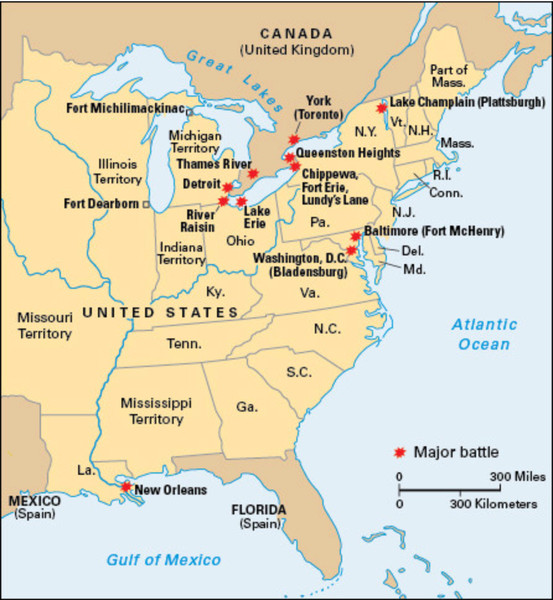
Major battles of the War of 1812
The war changed politics and identity. Many called it the Second War of Independence. Nationalism rose, the Federalist Party was damaged by the Hartford Convention, manufacturing got a boost, and Native resistance weakened.
Native Resistance, Borderlands Conflict, and Continental Control
Control of the continent depended on breaking Indigenous power, so Native resistance was a central foreign-policy issue. Tecumseh and Tenskwatawa tried to unite Native peoples in a pan-Indian movement.
The Battle of Tippecanoe in 1811 increased U.S. fears that Britain and Native groups were working together. Tecumseh later allied with Britain and died at the Battle of the Thames.
In the South, Jackson defeated the Red Stick Creeks at Horseshoe Bend. The Treaty of Fort Jackson forced the Creek to give up huge amounts of land.
Indian Removal
- Indian Removal Act of 1830 authorized removal west of the Mississippi.
- The Five Civilized Tribes were the Cherokee, Creek, Choctaw, Chickasaw, and Seminole.
- Gold in Cherokee land in Georgia increased removal pressure.
- Cherokee Nation v. Georgia called tribes domestic dependent nations.
- Worcester v. Georgia said states had no authority in Cherokee territory.
- Jackson’s administration did not effectively enforce Worcester.
- The Treaty of New Echota led to removal.
- The Trail of Tears happened under Van Buren.
- The Second Seminole War showed some Native groups kept resisting.
The map shows how removal targeted the southeastern tribes and pushed them along routes to Indian Territory in present-day Oklahoma.
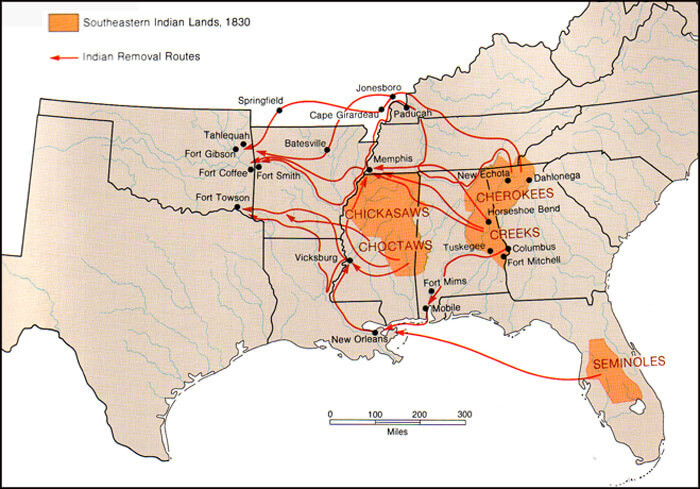
Indian removal routes from the Southeast
This is the contradiction you want to remember. The U.S. claimed to resist European colonialism while practicing settler colonialism against Native peoples.
Florida, Borders, and Diplomacy with Britain and Spain
After 1812, the U.S. often gained territory through negotiation backed by military pressure.
With Britain:
- Rush-Bagot Agreement in 1817 demilitarized the Great Lakes.
- Convention of 1818 set the 49th parallel to the Rockies.
- Oregon Country would be jointly occupied.
With Spain, conflict centered on Florida. In the First Seminole War, Jackson invaded Spanish Florida and seized St. Marks and Pensacola. John Quincy Adams defended him by arguing Spain could not control the region.
The Adams-Onís Treaty of 1819 did three big things, all of which appear on this map:
- Spain ceded Florida
- The U.S. gave up claims to Texas
- A transcontinental boundary to the Pacific was drawn
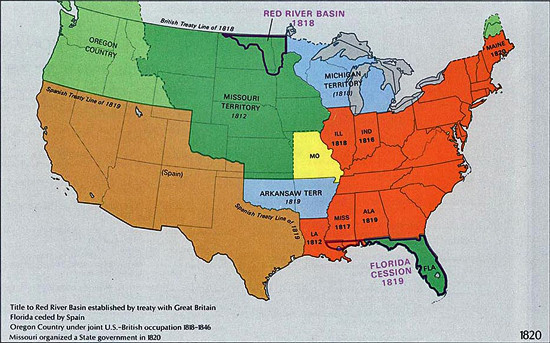
U.S. boundary settlements around 1820
The Monroe Doctrine and America’s Claim to the Western Hemisphere
Latin American independence weakened Spain and opened trade opportunities. The U.S. recognized new republics in 1822. At the same time, leaders feared the Holy Alliance might help Spain recover its colonies, and Russia was making Pacific claims.
Britain wanted open trade too and proposed a joint statement, but John Quincy Adams wanted an independent U.S. declaration. That became the Monroe Doctrine in 1823.
- No new European colonization in the Americas
- European interference in independent American nations would be seen as unfriendly
- The U.S. would stay out of existing European colonies
- The U.S. would stay out of European wars and internal affairs
For sourcing, remember Monroe is the speaker, but the ideas were heavily shaped by Adams. The audience was Congress, the U.S. public, and European powers. The purpose was to warn Europe, show independence from Britain, and claim a U.S. sphere of influence.
It mattered more in the long run than right away. The U.S. could not enforce it alone without British naval power, but it became the foundation for later U.S. dominance in the hemisphere.
Key Takeaways
Thomas Jefferson
President who used naval force in the First Barbary War and economic coercion through the Embargo Act to defend American commerce
Impressment
British removal of sailors from American ships for Royal Navy service, violating American maritime rights and helping cause the War of 1812
First Barbary War
1801–1805 conflict in which Jefferson sent the Navy and Marines against Tripoli to protect shipping and resist tribute demands
Chesapeake-Leopard Affair
The 1807 British attack on USS Chesapeake and removal of four sailors, provoking outrage over impressment and American sovereignty
Embargo Act of 1807
Jefferson’s ban on American ships sailing to foreign ports; it failed to change British or French policy and badly harmed the American economy
Non-Intercourse Act
The 1809 law that reopened most foreign trade after the embargo but continued prohibiting commerce with Britain and France
Macon’s Bill No. 2
The 1810 law reopening trade with Britain and France and promising restrictions against one if the other stopped violating American neutral rights
Tecumseh
Shawnee leader who organized a Native confederacy against American expansion and later allied with Britain during the War of 1812
Tenskwatawa (The Prophet)
Tecumseh’s brother, whose religious movement rejected American cultural influence and promoted Native unity and resistance
William Henry Harrison
American commander whose forces fought Tenskwatawa’s followers at Tippecanoe, intensifying suspicions that Britain supported Native resistance
Battle of Tippecanoe
The 1811 battle between Harrison’s forces and Tenskwatawa’s followers that failed to destroy Tecumseh’s confederacy but intensified American suspicions of Britain
War Hawks
Mostly young southern and western Democratic-Republicans, including Henry Clay and John C. Calhoun, who demanded war with Britain for honor, rights, and expansion
James Madison
President who restored trade restrictions against Britain and led the United States into the War of 1812
War of 1812
Inconclusive U.S.-British war over impressment, neutral trade, British-Native ties, sovereignty, and expansion; it strengthened nationalism and weakened Native resistance
Battle of the Thames
The 1813 American victory in Upper Canada where Tecumseh was killed, severely weakening organized Native resistance in the Old Northwest
Battle of Horseshoe Bend
Andrew Jackson’s 1814 defeat of the Red Stick Creeks, followed by a treaty requiring the Creek nation to surrender over 20 million acres
Treaty of Fort Jackson
The 1814 agreement forcing the Creek nation to cede over 20 million acres after Horseshoe Bend, including land held by U.S.-allied Creeks
Treaty of Ghent
The December 1814 treaty ending the War of 1812 and restoring prewar boundaries without resolving impressment or neutral shipping rights
Battle of New Orleans
Andrew Jackson’s January 1815 victory after Ghent was signed; it created an impression of decisive American victory and made Jackson a hero
Hartford Convention
The 1814 Federalist meeting that protested the war and proposed constitutional amendments; its timing made the party appear disloyal and hastened its decline
Rush-Bagot Agreement
The 1817 U.S.-British agreement limiting naval armaments on the Great Lakes and beginning demilitarization of the Canadian border
Convention of 1818
Agreement setting the U.S.-British boundary at the 49th parallel to the Rocky Mountains and establishing joint occupation of Oregon Country
Andrew Jackson
General who defeated the Red Stick Creeks and invaded Spanish Florida; as president, he pursued the coercive removal of southeastern Native nations
First Seminole War
The 1817–1818 conflict in which Andrew Jackson invaded Spanish Florida, attacked Seminoles, and seized Spanish posts, pressuring Spain to negotiate
John Quincy Adams
Secretary of state who defended Jackson’s Florida invasion, negotiated the Adams-Onís Treaty, and urged Monroe to issue an independent hemispheric declaration
Adams-Onís Treaty (Transcontinental Treaty)
The 1819 treaty giving Florida to the United States, renouncing the U.S. claim to Texas, and drawing a boundary to the Pacific
James Monroe
President who acquired Florida through treaty and announced the Monroe Doctrine asserting a special U.S. interest in the Western Hemisphere
Monroe Doctrine
The 1823 declaration opposing new European colonization or intervention in the Americas while promising U.S. noninterference in Europe and existing colonies
American Indian Removal
The coerced displacement of eastern Native nations westward through treaties, legislation, warfare, and military force, opening land to settlement, cotton, and slavery
Indian Removal Act
The 1830 law authorizing negotiated exchanges of Native lands east of the Mississippi for western territory, enabling widespread coerced removal
Cherokee Nation v. Georgia
The 1831 case calling tribes “domestic dependent nations” but ruling that the Cherokee could not sue as a foreign nation
Worcester v. Georgia
The 1832 decision holding that Georgia law had no force in Cherokee territory and that tribal relations belonged to federal authority
Treaty of New Echota
The disputed 1835 treaty in which a small Cherokee minority accepted removal despite opposition from most Cherokee people and their government
Trail of Tears
The 1838 forced removal of about 16,000 Cherokee to Indian Territory; roughly 4,000 died during roundup, confinement, and migration
Second Seminole War
The 1835–1842 war caused by Seminole resistance to removal; many Seminoles were forced west, although some remained in Florida
British Orders in Council
British restrictions on neutral commerce with France and Napoleon-controlled territories that led to seizures of American ships
Napoleon’s Continental System
French policy excluding British goods from European ports and leading France to seize neutral ships that violated its restrictions
Notes
Thomas Jefferson
President who used naval force in the First Barbary War and economic coercion through the Embargo Act to defend American commerce
Impressment
British removal of sailors from American ships for Royal Navy service, violating American maritime rights and helping cause the War of 1812
First Barbary War
1801–1805 conflict in which Jefferson sent the Navy and Marines against Tripoli to protect shipping and resist tribute demands
Chesapeake-Leopard Affair
The 1807 British attack on USS Chesapeake and removal of four sailors, provoking outrage over impressment and American sovereignty
Embargo Act of 1807
Jefferson’s ban on American ships sailing to foreign ports; it failed to change British or French policy and badly harmed the American economy
Non-Intercourse Act
The 1809 law that reopened most foreign trade after the embargo but continued prohibiting commerce with Britain and France
Macon’s Bill No. 2
The 1810 law reopening trade with Britain and France and promising restrictions against one if the other stopped violating American neutral rights
Tecumseh
Shawnee leader who organized a Native confederacy against American expansion and later allied with Britain during the War of 1812
Tenskwatawa (The Prophet)
Tecumseh’s brother, whose religious movement rejected American cultural influence and promoted Native unity and resistance
William Henry Harrison
American commander whose forces fought Tenskwatawa’s followers at Tippecanoe, intensifying suspicions that Britain supported Native resistance
Battle of Tippecanoe
The 1811 battle between Harrison’s forces and Tenskwatawa’s followers that failed to destroy Tecumseh’s confederacy but intensified American suspicions of Britain
War Hawks
Mostly young southern and western Democratic-Republicans, including Henry Clay and John C. Calhoun, who demanded war with Britain for honor, rights, and expansion
James Madison
President who restored trade restrictions against Britain and led the United States into the War of 1812
War of 1812
Inconclusive U.S.-British war over impressment, neutral trade, British-Native ties, sovereignty, and expansion; it strengthened nationalism and weakened Native resistance
Battle of the Thames
The 1813 American victory in Upper Canada where Tecumseh was killed, severely weakening organized Native resistance in the Old Northwest
Battle of Horseshoe Bend
Andrew Jackson’s 1814 defeat of the Red Stick Creeks, followed by a treaty requiring the Creek nation to surrender over 20 million acres
Treaty of Fort Jackson
The 1814 agreement forcing the Creek nation to cede over 20 million acres after Horseshoe Bend, including land held by U.S.-allied Creeks
Treaty of Ghent
The December 1814 treaty ending the War of 1812 and restoring prewar boundaries without resolving impressment or neutral shipping rights
Battle of New Orleans
Andrew Jackson’s January 1815 victory after Ghent was signed; it created an impression of decisive American victory and made Jackson a hero
Hartford Convention
The 1814 Federalist meeting that protested the war and proposed constitutional amendments; its timing made the party appear disloyal and hastened its decline
Rush-Bagot Agreement
The 1817 U.S.-British agreement limiting naval armaments on the Great Lakes and beginning demilitarization of the Canadian border
Convention of 1818
Agreement setting the U.S.-British boundary at the 49th parallel to the Rocky Mountains and establishing joint occupation of Oregon Country
Andrew Jackson
General who defeated the Red Stick Creeks and invaded Spanish Florida; as president, he pursued the coercive removal of southeastern Native nations
First Seminole War
The 1817–1818 conflict in which Andrew Jackson invaded Spanish Florida, attacked Seminoles, and seized Spanish posts, pressuring Spain to negotiate
John Quincy Adams
Secretary of state who defended Jackson’s Florida invasion, negotiated the Adams-Onís Treaty, and urged Monroe to issue an independent hemispheric declaration
Adams-Onís Treaty (Transcontinental Treaty)
The 1819 treaty giving Florida to the United States, renouncing the U.S. claim to Texas, and drawing a boundary to the Pacific
James Monroe
President who acquired Florida through treaty and announced the Monroe Doctrine asserting a special U.S. interest in the Western Hemisphere
Monroe Doctrine
The 1823 declaration opposing new European colonization or intervention in the Americas while promising U.S. noninterference in Europe and existing colonies
American Indian Removal
The coerced displacement of eastern Native nations westward through treaties, legislation, warfare, and military force, opening land to settlement, cotton, and slavery
Indian Removal Act
The 1830 law authorizing negotiated exchanges of Native lands east of the Mississippi for western territory, enabling widespread coerced removal
Cherokee Nation v. Georgia
The 1831 case calling tribes “domestic dependent nations” but ruling that the Cherokee could not sue as a foreign nation
Worcester v. Georgia
The 1832 decision holding that Georgia law had no force in Cherokee territory and that tribal relations belonged to federal authority
Treaty of New Echota
The disputed 1835 treaty in which a small Cherokee minority accepted removal despite opposition from most Cherokee people and their government
Trail of Tears
The 1838 forced removal of about 16,000 Cherokee to Indian Territory; roughly 4,000 died during roundup, confinement, and migration
Second Seminole War
The 1835–1842 war caused by Seminole resistance to removal; many Seminoles were forced west, although some remained in Florida
British Orders in Council
British restrictions on neutral commerce with France and Napoleon-controlled territories that led to seizures of American ships
Napoleon’s Continental System
French policy excluding British goods from European ports and leading France to seize neutral ships that violated its restrictions
