Topic 5.7 Notes – Election of 1860 and Secession
How Lincoln’s Election Changed the Political Balance
Lincoln’s win mattered because it showed a sectional candidate could become president without Southern electoral votes. That had not happened before, and many white Southerners saw it as proof they were becoming a permanent minority.
The deeper cause had been building for years. After the Mexican-American War, every new territory raised the same question. Would slavery expand? The Compromise of 1850, Kansas-Nebraska Act, Bleeding Kansas, Dred Scott decision, and John Brown’s raid all made that fight sharper and more violent.
The Republican position was narrower than many students remember. Republicans believed in free-soil and free-labor ideas. Western land should go to free farmers and workers, not slave plantations. Lincoln opposed slavery’s expansion into territories, but he did not call for immediate abolition where slavery already existed.
Southern leaders still saw this as a long-term threat. If slavery stopped expanding, the South would lose power in Congress and the Electoral College. To them, nonextension meant slavery was being placed on a path to “ultimate extinction.”
The Election of 1860
By 1860, one election contained four different answers to the slavery crisis.
The candidates
| Candidate | Party | Main position |
|---|---|---|
| Abraham Lincoln | Republican | No expansion of slavery; also backed protective tariff, homesteads, transcontinental railroad |
| Stephen A. Douglas | Northern Democrat | Popular sovereignty |
| John C. Breckinridge | Southern Democrat | Federal protection of slavery in the territories |
| John Bell | Constitutional Union | Save the Union, avoid clear stand on expansion |
Why Democrats split
At Charleston, Democrats broke apart over slavery in the territories. Northern Democrats backed Douglas and popular sovereignty. Southern Democrats backed Breckinridge and federal protection for slavery. This wrecked one of the last national parties.
Lincoln’s rise
Lincoln became nationally known in the Lincoln-Douglas debates of 1858. His House Divided speech said the nation could not stay half slave and half free forever. Douglas hurt himself with Southern Democrats through the Freeport Doctrine, which said territories could still block slavery by refusing to protect it.
Results
The electoral map makes the sectional split easy to see.
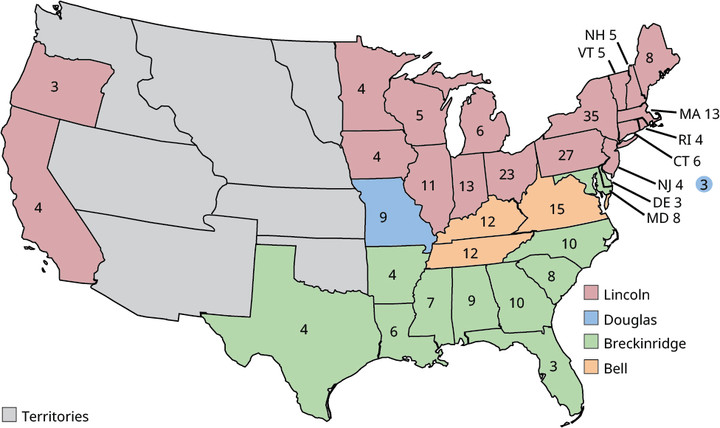
1860 presidential election map
- Lincoln 180
- Breckinridge 72
- Bell 39
- Douglas 12
Lincoln won about 40 percent of the popular vote, carried every free state except part of New Jersey, got no Southern electoral votes, and was not even on the ballot in most of the Deep South. The Democratic split helped him, but the bigger fact was Northern population growth. The North now had enough electoral power to elect a president on its own.
Why Secession Happened
Secessionists argued the South faced a hostile government it could no longer control. What they wanted to protect was tightly connected:
- slavery as property
- racial hierarchy and white supremacy
- political influence in the federal government
- state sovereignty language, usually in defense of slavery
The constitutional fight turned on two ideas. Secessionists used compact theory and said sovereign states could leave voluntarily. Unionists, including Lincoln, said the Union was perpetual and secession was legally void.
Southern opinion was divided:
- fire-eaters wanted immediate secession
- cooperationists wanted the South to act together
- conditional Unionists resisted secession unless force was used
Primary sources make the motives clear. Mississippi said slavery was “thoroughly identified” with its position. South Carolina attacked Northern hostility and weak fugitive slave enforcement. Georgia and Texas also centered slavery and white supremacy.
From Secession to War
The first wave came fast:
- South Carolina seceded on December 20, 1860.
- By February 1, 1861, Mississippi, Florida, Alabama, Georgia, Louisiana, and Texas followed.
Creation of the Confederacy
At Montgomery, Alabama, the seceded states formed the Confederate States of America. Jefferson Davis became president and Alexander H. Stephens vice president. The Confederate Constitution explicitly protected slavery, and Stephens’s Cornerstone speech openly tied the new nation to racial inequality and slavery.
Failed final compromises
- Crittenden Compromise proposed extending the Missouri Compromise line to the Pacific.
- Corwin Amendment would protect slavery in the states.
Republicans rejected expansion of slavery, so compromise collapsed.
Fort Sumter and the second wave
- Buchanan said secession was unconstitutional but also thought coercion was unconstitutional.
- Southern states seized federal property, but Fort Sumter stayed under U.S. control.
- In his First Inaugural, Lincoln said he would not interfere with slavery in the states, but secession was illegal.
- Confederates fired on Fort Sumter on April 12, 1861.
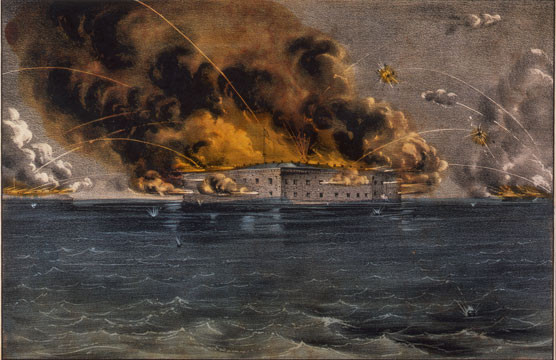
Bombardment of Fort Sumter, April 1861
- Lincoln called for 75,000 volunteers.
- The Upper South seceded: Virginia, Arkansas, North Carolina, Tennessee.
- Slave states that stayed in the Union were Delaware, Maryland, Kentucky, Missouri.
Why This Election Matters
Lincoln’s election was the catalyst, not the sole cause. Seven Deep South states seceded before he took office, the Confederacy formed, compromise failed, and the fight over federal property turned into war at Fort Sumter. The deeper cause was the long struggle over slavery’s expansion, and secession in defense of slavery turned an election crisis into the Civil War.
Key Takeaways
Republican Platform of 1860
Opposed slavery’s territorial expansion and supported a protective tariff, western homesteads, and federal aid for a transcontinental railroad
Lincoln–Douglas Debates
Seven 1858 Illinois debates over slavery in the territories that made Lincoln nationally prominent and weakened Douglas among Southern Democrats
Abraham Lincoln
Republican elected president in 1860 on a platform opposing slavery’s expansion but not abolishing it in existing states; his victory triggered secession
Stephen A. Douglas
Northern Democratic candidate in 1860 who defended popular sovereignty and won Missouri and part of New Jersey’s electoral vote
House Divided Speech
Lincoln’s warning that the nation could not remain permanently half slave and half free and would move toward either greater restriction or acceptance of slavery
Freeport Doctrine
Douglas’s claim that territorial settlers could exclude slavery by refusing to enact the local laws needed to protect it despite the Dred Scott decision
Breakup of the Democratic Party
The 1860 split in which Northern Democrats nominated Douglas for popular sovereignty while Southern Democrats nominated Breckinridge for federal protection of slavery
John C. Breckinridge
Southern Democratic candidate who demanded federal protection for slavery in the territories and carried most of the Deep South
Constitutional Union Party
Party of former Whigs and Southern moderates that avoided a firm slavery position and campaigned for the Constitution, the Union, and existing laws
John Bell
Constitutional Union candidate who emphasized preserving the Union and carried Virginia, Kentucky, and Tennessee
Election of 1860
Lincoln won about 40 percent of the popular vote and 180 electoral votes without carrying a slave state, proving a Northern sectional coalition could control the presidency
Compact Theory vs. Perpetual Union
Secessionists said sovereign states could withdraw from a voluntary compact; Unionists said the people created a permanent Union that no state could leave unilaterally
South Carolina Secession
South Carolina became the first state to secede when its convention unanimously adopted an ordinance on December 20, 1860
First Wave of Secession
South Carolina, Mississippi, Florida, Alabama, Georgia, Louisiana, and Texas left the Union before Lincoln’s inauguration, primarily to protect slavery
Confederate States of America
Government formed at Montgomery in February 1861 by the seven seceded Deep South states to preserve their independence and slaveholding order
Jefferson Davis
Mississippi politician selected as provisional president of the Confederate States of America in February 1861
Alexander H. Stephens
Confederate vice president who declared in the Cornerstone Speech that racial inequality and African American slavery were foundations of the Confederacy
Confederate Constitution
Confederacy’s governing document, modeled on the U.S. Constitution but explicitly protecting slavery and slaveholders’ property rights in Confederate territories
Cornerstone Speech
Alexander Stephens’s March 1861 speech identifying white supremacy and African American slavery as foundational principles of the Confederacy
Crittenden Compromise
Failed proposal to extend the 36°30′ line to the Pacific, banning slavery north of it and constitutionally protecting slavery south of it
Corwin Amendment
Unratified amendment that would have barred future constitutional amendments from authorizing federal interference with slavery in existing states
James Buchanan
Outgoing president who called secession unconstitutional but claimed the federal government lacked power to coerce a state, leaving no effective response to disunion
Lincoln’s First Inaugural Address
Lincoln denied secession’s legality, promised to hold federal property, and repeated that he would not interfere with slavery in existing states
Fort Sumter
Federal fort in Charleston Harbor bombarded by Confederate forces on April 12, 1861; its surrender began open warfare between the Union and Confederacy
Lincoln’s Call for 75,000 Volunteers
April 15, 1861 request for troops to suppress the rebellion, prompting four Upper South states to secede rather than fight the Confederacy
Second Wave of Secession
Virginia, Arkansas, North Carolina, and Tennessee seceded after Fort Sumter and Lincoln’s call for troops, raising the Confederacy to eleven states
Border Slave States
Delaware, Maryland, Kentucky, and Missouri, the four slave states that remained officially in the Union despite divided loyalties
Free-Soil Ideology
Opposition to expanding slavery into the western territories, not a demand for immediate abolition in existing states
Free-Labor Ideology
Belief that western land and opportunity should remain available to free farmers and wage earners rather than plantation slavery
Popular Sovereignty
Policy allowing territorial settlers to decide whether to permit slavery; supported by Stephen A. Douglas and Northern Democrats
Fire-Eaters
Southern secessionists who demanded immediate withdrawal from the Union after Lincoln’s election
Cooperationists
Southerners who supported secession but wanted the slave states to withdraw together
Conditional Unionists
Southerners who favored remaining in the Union unless the federal government attacked slavery or coerced a seceded state
John J. Crittenden
Kentucky senator who proposed the failed Crittenden Compromise as a final effort to prevent secession
Notes
Republican Platform of 1860
Opposed slavery’s territorial expansion and supported a protective tariff, western homesteads, and federal aid for a transcontinental railroad
Lincoln–Douglas Debates
Seven 1858 Illinois debates over slavery in the territories that made Lincoln nationally prominent and weakened Douglas among Southern Democrats
Abraham Lincoln
Republican elected president in 1860 on a platform opposing slavery’s expansion but not abolishing it in existing states; his victory triggered secession
Stephen A. Douglas
Northern Democratic candidate in 1860 who defended popular sovereignty and won Missouri and part of New Jersey’s electoral vote
House Divided Speech
Lincoln’s warning that the nation could not remain permanently half slave and half free and would move toward either greater restriction or acceptance of slavery
Freeport Doctrine
Douglas’s claim that territorial settlers could exclude slavery by refusing to enact the local laws needed to protect it despite the Dred Scott decision
Breakup of the Democratic Party
The 1860 split in which Northern Democrats nominated Douglas for popular sovereignty while Southern Democrats nominated Breckinridge for federal protection of slavery
John C. Breckinridge
Southern Democratic candidate who demanded federal protection for slavery in the territories and carried most of the Deep South
Constitutional Union Party
Party of former Whigs and Southern moderates that avoided a firm slavery position and campaigned for the Constitution, the Union, and existing laws
John Bell
Constitutional Union candidate who emphasized preserving the Union and carried Virginia, Kentucky, and Tennessee
Election of 1860
Lincoln won about 40 percent of the popular vote and 180 electoral votes without carrying a slave state, proving a Northern sectional coalition could control the presidency
Compact Theory vs. Perpetual Union
Secessionists said sovereign states could withdraw from a voluntary compact; Unionists said the people created a permanent Union that no state could leave unilaterally
South Carolina Secession
South Carolina became the first state to secede when its convention unanimously adopted an ordinance on December 20, 1860
First Wave of Secession
South Carolina, Mississippi, Florida, Alabama, Georgia, Louisiana, and Texas left the Union before Lincoln’s inauguration, primarily to protect slavery
Confederate States of America
Government formed at Montgomery in February 1861 by the seven seceded Deep South states to preserve their independence and slaveholding order
Jefferson Davis
Mississippi politician selected as provisional president of the Confederate States of America in February 1861
Alexander H. Stephens
Confederate vice president who declared in the Cornerstone Speech that racial inequality and African American slavery were foundations of the Confederacy
Confederate Constitution
Confederacy’s governing document, modeled on the U.S. Constitution but explicitly protecting slavery and slaveholders’ property rights in Confederate territories
Cornerstone Speech
Alexander Stephens’s March 1861 speech identifying white supremacy and African American slavery as foundational principles of the Confederacy
Crittenden Compromise
Failed proposal to extend the 36°30′ line to the Pacific, banning slavery north of it and constitutionally protecting slavery south of it
Corwin Amendment
Unratified amendment that would have barred future constitutional amendments from authorizing federal interference with slavery in existing states
James Buchanan
Outgoing president who called secession unconstitutional but claimed the federal government lacked power to coerce a state, leaving no effective response to disunion
Lincoln’s First Inaugural Address
Lincoln denied secession’s legality, promised to hold federal property, and repeated that he would not interfere with slavery in existing states
Fort Sumter
Federal fort in Charleston Harbor bombarded by Confederate forces on April 12, 1861; its surrender began open warfare between the Union and Confederacy
Lincoln’s Call for 75,000 Volunteers
April 15, 1861 request for troops to suppress the rebellion, prompting four Upper South states to secede rather than fight the Confederacy
Second Wave of Secession
Virginia, Arkansas, North Carolina, and Tennessee seceded after Fort Sumter and Lincoln’s call for troops, raising the Confederacy to eleven states
Border Slave States
Delaware, Maryland, Kentucky, and Missouri, the four slave states that remained officially in the Union despite divided loyalties
Free-Soil Ideology
Opposition to expanding slavery into the western territories, not a demand for immediate abolition in existing states
Free-Labor Ideology
Belief that western land and opportunity should remain available to free farmers and wage earners rather than plantation slavery
Popular Sovereignty
Policy allowing territorial settlers to decide whether to permit slavery; supported by Stephen A. Douglas and Northern Democrats
Fire-Eaters
Southern secessionists who demanded immediate withdrawal from the Union after Lincoln’s election
Cooperationists
Southerners who supported secession but wanted the slave states to withdraw together
Conditional Unionists
Southerners who favored remaining in the Union unless the federal government attacked slavery or coerced a seceded state
John J. Crittenden
Kentucky senator who proposed the failed Crittenden Compromise as a final effort to prevent secession
