Topic 7.10 Notes – The New Deal
What the New Deal Was
Roosevelt took office with banks failing, unemployment near 25 percent, farm prices collapsing, weak consumer demand, and local charities and state governments overwhelmed. He did not arrive with one master plan. He experimented.
The best way to organize it is the Three Rs:
- Relief gave immediate help to unemployed and poor Americans.
- Recovery tried to restart production, raise prices, and create jobs.
- Reform changed banking, labor, and markets to prevent another disaster.
This created New Deal liberalism. The federal government should regulate capitalism, protect labor, and provide some economic security. It still kept private property and private business. That’s a favorite AP distinction. The New Deal expanded capitalism’s safety rails. It did not create socialism.
Roosevelt’s style
- First Hundred Days from March to June 1933 brought a flood of emergency laws.
- Roosevelt closed banks in a bank holiday to stop panicked withdrawals.
- Congress passed major recovery and relief laws fast because the crisis was severe.
- Roosevelt used fireside chats on radio to explain policy in plain language and rebuild trust.
People call many programs alphabet agencies because of initials like CCC, AAA, TVA, and WPA.
The Twenty-First Amendment repealed Prohibition in 1933. It mattered as an early break from the 1920s and brought back tax revenue from legal alcohol.
Major New Deal Programs and What They Did
Many programs fit more than one R.
Relief and public jobs
- FERA gave federal money to states for direct relief.
- CCC hired young men for conservation work like planting trees and fighting erosion.
- CWA created short-term emergency winter jobs.
- PWA funded large public construction like schools, dams, and bridges.
- WPA became the biggest work program. It built roads, schools, airports, and parks.
- It also funded the Federal Writers’ Project, Federal Theatre Project, public murals, and oral histories of formerly enslaved people.
Banking and financial reform
- Emergency Banking Relief Act reopened only sound banks after inspection.
- Glass-Steagall Banking Act separated commercial and investment banking.
- FDIC insured deposits, which restored confidence.
- Securities Act of 1933 required honest financial disclosure.
- SEC regulated the stock market.
- Leaving the gold standard and the Gold Reserve Act gave the government more flexibility to fight deflation.
Agriculture and rural recovery
Farmers were already struggling before 1929, and the Dust Bowl made things worse. Migrant families and poor farmworkers became some of the clearest symbols of Depression hardship.
- AAA paid farmers to reduce production so prices would rise.
- Farm Credit Administration helped refinance farm debt.
- Resettlement Administration and Farm Security Administration aided poor farmers and migrants.
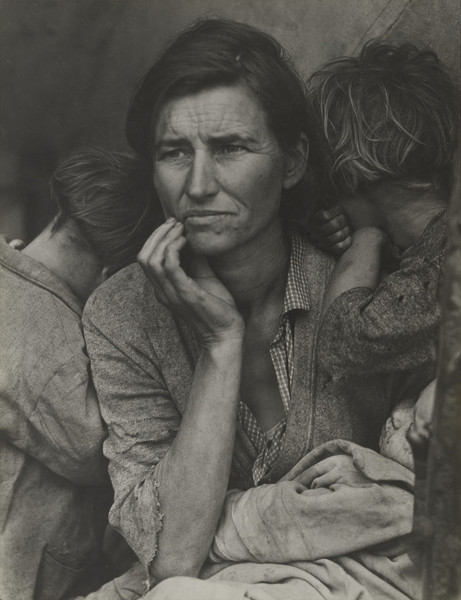
Dorothea Lange, Migrant Mother
Industry, labor, and regional development
- NIRA tried to restart industry.
- Its NRA used the Blue Eagle and codes for wages, hours, and prices. Section 7(a) supported workers’ right to organize.
- TVA built dams, controlled floods, and brought cheap electricity to the Tennessee Valley.
- REA extended electricity to rural areas.
Housing and home finance
- HOLC refinanced mortgages to prevent foreclosure.
- FHA insured mortgages and expanded home loans.
- Redlining was a major limit. Federal housing policy often denied loans in Black neighborhoods and reinforced segregation.
The Second New Deal and the Fight Over Its Limits
By 1935, recovery was incomplete, labor unrest was growing, and the Supreme Court had struck down early programs.
- Wagner Act protected unions and created the NLRB.
- CIO organized whole industries, not just skilled trades.
- The Flint sit-down strike helped the United Auto Workers win recognition.
- Social Security Act created old-age pensions and unemployment insurance.
- Fair Labor Standards Act set a minimum wage, maximum hours, and child labor restrictions.
Pressure came from the left too:
- Huey Long pushed Share Our Wealth
- Francis Townsend demanded old-age pensions
- Charles Coughlin attacked banks and the New Deal
- Socialists, communists, and militant unions pushed stronger action
Conservatives pushed back through the American Liberty League and the courts. Schechter Poultry v. United States killed the NRA. United States v. Butler struck down the AAA. Roosevelt answered with the court-packing plan, which failed politically, but later West Coast Hotel v. Parrish and NLRB v. Jones & Laughlin Steel upheld key New Deal measures.
The 1937-1938 recession showed the core limit. The New Deal helped a lot, but World War II finally ended the Depression.
Who Benefited, Who Was Left Out, and How the Country Changed
The New Deal helped millions, but access was unequal.
- African Americans
- The Black Cabinet, including Mary McLeod Bethune, increased access to federal power.
- Eleanor Roosevelt backed civil rights publicly, including support for Marian Anderson.
- Many Black workers were excluded from Social Security, the Wagner Act, and FLSA because farm and domestic labor were left out.
- The AAA displaced Black sharecroppers, and CCC camps were segregated.
- Women
- Frances Perkins became the first female cabinet member.
- Women got relief jobs, but often lower pay and fewer opportunities because policy assumed a male breadwinner.
- Native Americans
- John Collier backed the Indian Reorganization Act, which ended allotment and encouraged tribal self-government.
- Migration and geography
- Dust Bowl migrants called Okies moved west, especially to California.
- Many Americans also moved to cities looking for work and relief.
The lasting political result was the New Deal coalition of workers, unions, immigrants, Catholics, Jews, white southerners, many farmers, and African Americans in northern cities. Many Black voters and working-class ethnic voters shifted toward the Democratic Party.
Key Takeaways
Franklin D. Roosevelt
President who responded to the Great Depression with the experimental federal programs and reforms collectively called the New Deal
New Deal
Roosevelt’s programs using federal power for relief, recovery, and reform while preserving a regulated capitalist economy
Three Rs: Relief, Recovery, and Reform
Immediate aid for the distressed, economic revival, and structural changes intended to prevent future crises
New Deal Liberalism
The belief that liberty required economic security, regulated markets, collective bargaining rights, and active federal intervention
First Hundred Days
The emergency legislative session from March through June 1933 that enacted much of Roosevelt’s initial New Deal program
Fireside Chats
Roosevelt’s conversational radio addresses explaining policies and building public confidence in his administration
Twenty-First Amendment
The 1933 amendment that repealed Prohibition, permitted taxation of legal alcohol, and reversed the Eighteenth Amendment
National Bank Holiday
Roosevelt’s temporary nationwide closure of banks during the March 1933 banking crisis to halt withdrawals before sound banks reopened
Emergency Banking Relief Act of 1933
Authorized federal inspection of banks and the reopening of those judged financially sound, helping stop bank runs
Banking Act of 1933 / Glass-Steagall Act
Separated commercial from investment banking and created federal deposit insurance through the FDIC.
Federal Deposit Insurance Corporation (FDIC)
Federal agency that insures bank deposits, reducing bank runs and restoring confidence in the banking system
Gold Reserve Act of 1934
Devalued the dollar after Roosevelt ended domestic gold convertibility, allowing greater monetary expansion against deflation
Securities Act of 1933
Required companies selling securities to disclose relevant financial information to potential investors
Securities and Exchange Commission (SEC)
Agency created in 1934 to regulate securities markets and curb manipulation, insider abuses, and misleading sales
Federal Emergency Relief Administration (FERA)
Harry Hopkins’s agency that distributed federal money to states and localities for direct aid and work relief
Harry Hopkins
Influential New Deal administrator who directed FERA and the WPA and favored rapid federal work relief
Civilian Conservation Corps (CCC)
Employed young unmarried men in conservation work while providing housing, food, and wages sent partly to their families
Civil Works Administration (CWA)
Short-lived program that provided millions of emergency public jobs during the winter of 1933–1934
Public Works Administration (PWA)
Funded large, long-term construction projects such as dams, schools, hospitals, bridges, and public buildings
Works Progress Administration / Work Projects Administration (WPA)
The largest New Deal work-relief program, employing millions to construct public facilities and perform cultural work
Agricultural Adjustment Act / Agricultural Adjustment Administration (AAA)
Paid farmers to reduce production so agricultural prices and farm income would rise, often benefiting landowners over tenants
United States v. Butler
The 1936 decision invalidating the original AAA’s processing-tax system, forcing Congress to restructure farm supports
Farm Security Administration (FSA)
Agency assisting impoverished farmers, tenants, and migrants and documenting rural hardship through photography
National Industrial Recovery Act (NIRA)
The 1933 law that created the NRA and PWA and recognized workers’ organizing and bargaining rights in Section 7(a)
National Recovery Administration (NRA)
Encouraged industry codes governing prices, production, wages, and hours under the Blue Eagle slogan “We Do Our Part.”
Schechter Poultry Corporation v. United States
The 1935 decision invalidating the NRA for excessive delegation of legislative power and regulation beyond interstate commerce
Tennessee Valley Authority (TVA)
Regional authority that built dams, controlled floods, improved navigation, conserved soil, and supplied inexpensive hydroelectric power
Rural Electrification Administration (REA)
Provided loans to cooperatives and local organizations to extend electrical service into underserved rural areas
Home Owners’ Loan Corporation (HOLC)
Refinanced troubled urban mortgages but used neighborhood risk maps associated with discriminatory lending and redlining
Federal Housing Administration (FHA)
Insured private long-term mortgages, stimulating homeownership and construction while favoring segregated white communities
Redlining
Denial or restriction of mortgage credit in neighborhoods considered risky largely because of Black residence or racial integration
First New Deal vs. Second New Deal
The First emphasized emergency stabilization and business cooperation; the Second emphasized social insurance, public employment, labor rights, and regulation
National Labor Relations Act / Wagner Act
Protected most private-sector workers’ rights to organize and bargain collectively and prohibited specified unfair labor practices
National Labor Relations Board (NLRB)
Federal agency created by the Wagner Act to supervise union elections and enforce collective-bargaining rights
American Federation of Labor vs. Congress of Industrial Organizations
The AFL traditionally organized skilled workers by craft; the CIO organized all workers in mass-production industries regardless of skill
John L. Lewis
Labor leader associated with the CIO’s campaign to organize workers across mass-production industries
Flint Sit-Down Strike
The 1936–1937 factory occupation that prevented replacement labor and forced General Motors to recognize the United Auto Workers
Fair Labor Standards Act of 1938
Established a federal minimum wage, maximum hours, and child-labor restrictions but excluded several occupations
Social Security Act of 1935
Created payroll-tax-funded old-age insurance, federal-state unemployment insurance, and assistance for selected vulnerable groups
Charles Coughlin
Radio priest who attacked banks, broke with Roosevelt, and increasingly promoted inflationary, nationalist, antisemitic, and authoritarian ideas
American Liberty League
Business-backed organization of conservatives and anti-New Deal Democrats defending property rights and limited government
Court-Packing Plan
Roosevelt’s failed 1937 proposal to add up to six Supreme Court justices, intended to produce a pro-New Deal majority
West Coast Hotel Company v. Parrish
The 1937 decision upholding a state minimum-wage law and signaling greater judicial acceptance of economic regulation
NLRB v. Jones & Laughlin Steel Corporation
The 1937 decision upholding the Wagner Act and broader federal regulation of activities affecting interstate commerce
Roosevelt Recession
The 1937–1938 downturn caused partly by reduced federal spending, new payroll taxes, and tighter monetary policy
Black Cabinet
Informal group of African American federal advisers who promoted Black interests within the Roosevelt administration
Mary McLeod Bethune
Black Cabinet member who directed African American affairs in the National Youth Administration and advised the Roosevelt administration
Eleanor Roosevelt
First lady who expanded the office through public advocacy for workers, women, young people, and some African American civil rights causes
Frances Perkins
Secretary of Labor, major architect of Social Security and labor reform, and the first woman in a presidential cabinet
John Collier
Commissioner of Indian Affairs who led the Indian New Deal and promoted tribal landholding and self-government
Indian Reorganization Act / Wheeler-Howard Act
Ended tribal land allotment, supported restoration of some tribal lands, encouraged self-government, and provided development loans
Okies
Often-derogatory label for southwestern migrants who moved west, especially to California, seeking work during the 1930s
New Deal Coalition
Democratic alliance of workers, unions, farmers, white southerners, northern Black voters, immigrants, Catholics, Jews, and reformers
New Deal Political Realignment
Long-term shift of many workers, ethnic voters, and northern African Americans toward the Democratic Party and active federal government
Conservative Coalition
Alliance of conservative Republicans and southern Democrats that blocked many additional reforms after the 1938 elections
Dorothea Lange
FSA documentary photographer whose images recorded rural poverty and migrant hardship during the Depression
Migrant Mother
Lange’s 1936 photograph of Florence Owens Thompson and her children, an enduring image of Depression-era migrant hardship
Huey Long
Louisiana senator and populist critic who argued that concentrated wealth blocked recovery and challenged Roosevelt from the left
Share Our Wealth
Huey Long’s movement proposing heavy taxes on large fortunes to guarantee minimum household wealth and income
Francis Townsend
Physician and reformer whose popular pension campaign increased pressure for federal old-age security
Townsend Plan
Proposal for federal pensions to elderly Americans who would spend the money quickly, reducing poverty and stimulating demand
Farm Credit Administration
New Deal agency that refinanced some farm mortgages to ease indebted farmers’ financial burdens
Notes
Franklin D. Roosevelt
President who responded to the Great Depression with the experimental federal programs and reforms collectively called the New Deal
New Deal
Roosevelt’s programs using federal power for relief, recovery, and reform while preserving a regulated capitalist economy
Three Rs: Relief, Recovery, and Reform
Immediate aid for the distressed, economic revival, and structural changes intended to prevent future crises
New Deal Liberalism
The belief that liberty required economic security, regulated markets, collective bargaining rights, and active federal intervention
First Hundred Days
The emergency legislative session from March through June 1933 that enacted much of Roosevelt’s initial New Deal program
Fireside Chats
Roosevelt’s conversational radio addresses explaining policies and building public confidence in his administration
Twenty-First Amendment
The 1933 amendment that repealed Prohibition, permitted taxation of legal alcohol, and reversed the Eighteenth Amendment
National Bank Holiday
Roosevelt’s temporary nationwide closure of banks during the March 1933 banking crisis to halt withdrawals before sound banks reopened
Emergency Banking Relief Act of 1933
Authorized federal inspection of banks and the reopening of those judged financially sound, helping stop bank runs
Banking Act of 1933 / Glass-Steagall Act
Separated commercial from investment banking and created federal deposit insurance through the FDIC.
Federal Deposit Insurance Corporation (FDIC)
Federal agency that insures bank deposits, reducing bank runs and restoring confidence in the banking system
Gold Reserve Act of 1934
Devalued the dollar after Roosevelt ended domestic gold convertibility, allowing greater monetary expansion against deflation
Securities Act of 1933
Required companies selling securities to disclose relevant financial information to potential investors
Securities and Exchange Commission (SEC)
Agency created in 1934 to regulate securities markets and curb manipulation, insider abuses, and misleading sales
Federal Emergency Relief Administration (FERA)
Harry Hopkins’s agency that distributed federal money to states and localities for direct aid and work relief
Harry Hopkins
Influential New Deal administrator who directed FERA and the WPA and favored rapid federal work relief
Civilian Conservation Corps (CCC)
Employed young unmarried men in conservation work while providing housing, food, and wages sent partly to their families
Civil Works Administration (CWA)
Short-lived program that provided millions of emergency public jobs during the winter of 1933–1934
Public Works Administration (PWA)
Funded large, long-term construction projects such as dams, schools, hospitals, bridges, and public buildings
Works Progress Administration / Work Projects Administration (WPA)
The largest New Deal work-relief program, employing millions to construct public facilities and perform cultural work
Agricultural Adjustment Act / Agricultural Adjustment Administration (AAA)
Paid farmers to reduce production so agricultural prices and farm income would rise, often benefiting landowners over tenants
United States v. Butler
The 1936 decision invalidating the original AAA’s processing-tax system, forcing Congress to restructure farm supports
Farm Security Administration (FSA)
Agency assisting impoverished farmers, tenants, and migrants and documenting rural hardship through photography
National Industrial Recovery Act (NIRA)
The 1933 law that created the NRA and PWA and recognized workers’ organizing and bargaining rights in Section 7(a)
National Recovery Administration (NRA)
Encouraged industry codes governing prices, production, wages, and hours under the Blue Eagle slogan “We Do Our Part.”
Schechter Poultry Corporation v. United States
The 1935 decision invalidating the NRA for excessive delegation of legislative power and regulation beyond interstate commerce
Tennessee Valley Authority (TVA)
Regional authority that built dams, controlled floods, improved navigation, conserved soil, and supplied inexpensive hydroelectric power
Rural Electrification Administration (REA)
Provided loans to cooperatives and local organizations to extend electrical service into underserved rural areas
Home Owners’ Loan Corporation (HOLC)
Refinanced troubled urban mortgages but used neighborhood risk maps associated with discriminatory lending and redlining
Federal Housing Administration (FHA)
Insured private long-term mortgages, stimulating homeownership and construction while favoring segregated white communities
Redlining
Denial or restriction of mortgage credit in neighborhoods considered risky largely because of Black residence or racial integration
First New Deal vs. Second New Deal
The First emphasized emergency stabilization and business cooperation; the Second emphasized social insurance, public employment, labor rights, and regulation
National Labor Relations Act / Wagner Act
Protected most private-sector workers’ rights to organize and bargain collectively and prohibited specified unfair labor practices
National Labor Relations Board (NLRB)
Federal agency created by the Wagner Act to supervise union elections and enforce collective-bargaining rights
American Federation of Labor vs. Congress of Industrial Organizations
The AFL traditionally organized skilled workers by craft; the CIO organized all workers in mass-production industries regardless of skill
John L. Lewis
Labor leader associated with the CIO’s campaign to organize workers across mass-production industries
Flint Sit-Down Strike
The 1936–1937 factory occupation that prevented replacement labor and forced General Motors to recognize the United Auto Workers
Fair Labor Standards Act of 1938
Established a federal minimum wage, maximum hours, and child-labor restrictions but excluded several occupations
Social Security Act of 1935
Created payroll-tax-funded old-age insurance, federal-state unemployment insurance, and assistance for selected vulnerable groups
Charles Coughlin
Radio priest who attacked banks, broke with Roosevelt, and increasingly promoted inflationary, nationalist, antisemitic, and authoritarian ideas
American Liberty League
Business-backed organization of conservatives and anti-New Deal Democrats defending property rights and limited government
Court-Packing Plan
Roosevelt’s failed 1937 proposal to add up to six Supreme Court justices, intended to produce a pro-New Deal majority
West Coast Hotel Company v. Parrish
The 1937 decision upholding a state minimum-wage law and signaling greater judicial acceptance of economic regulation
NLRB v. Jones & Laughlin Steel Corporation
The 1937 decision upholding the Wagner Act and broader federal regulation of activities affecting interstate commerce
Roosevelt Recession
The 1937–1938 downturn caused partly by reduced federal spending, new payroll taxes, and tighter monetary policy
Black Cabinet
Informal group of African American federal advisers who promoted Black interests within the Roosevelt administration
Mary McLeod Bethune
Black Cabinet member who directed African American affairs in the National Youth Administration and advised the Roosevelt administration
Eleanor Roosevelt
First lady who expanded the office through public advocacy for workers, women, young people, and some African American civil rights causes
Frances Perkins
Secretary of Labor, major architect of Social Security and labor reform, and the first woman in a presidential cabinet
John Collier
Commissioner of Indian Affairs who led the Indian New Deal and promoted tribal landholding and self-government
Indian Reorganization Act / Wheeler-Howard Act
Ended tribal land allotment, supported restoration of some tribal lands, encouraged self-government, and provided development loans
Okies
Often-derogatory label for southwestern migrants who moved west, especially to California, seeking work during the 1930s
New Deal Coalition
Democratic alliance of workers, unions, farmers, white southerners, northern Black voters, immigrants, Catholics, Jews, and reformers
New Deal Political Realignment
Long-term shift of many workers, ethnic voters, and northern African Americans toward the Democratic Party and active federal government
Conservative Coalition
Alliance of conservative Republicans and southern Democrats that blocked many additional reforms after the 1938 elections
Dorothea Lange
FSA documentary photographer whose images recorded rural poverty and migrant hardship during the Depression
Migrant Mother
Lange’s 1936 photograph of Florence Owens Thompson and her children, an enduring image of Depression-era migrant hardship
Huey Long
Louisiana senator and populist critic who argued that concentrated wealth blocked recovery and challenged Roosevelt from the left
Share Our Wealth
Huey Long’s movement proposing heavy taxes on large fortunes to guarantee minimum household wealth and income
Francis Townsend
Physician and reformer whose popular pension campaign increased pressure for federal old-age security
Townsend Plan
Proposal for federal pensions to elderly Americans who would spend the money quickly, reducing poverty and stimulating demand
Farm Credit Administration
New Deal agency that refinanced some farm mortgages to ease indebted farmers’ financial burdens
