Topic 7.15 Notes – Comparison in Period 7
What Shaped American Identity Most from 1890 to 1945
American identity in this period means the answers to a few huge questions. What should the federal government do for the economy and people’s welfare? Who counts as fully American? Is the country about pluralism or pressure to conform? Is the U.S. mainly a republic at home or a global power abroad?
When you compare events, use the same standards teachers use on essays:
- Magnitude of change: how big was the shift?
- People affected: how many lives changed?
- Durability: did it last?
- Institutional and belief change: did government and public ideas change?
The strongest overall claim is:
- New Deal = most significant for domestic government
- Mass culture and migration = most significant for everyday social identity
- World War II = most significant for global identity
One qualifier always matters. Change often expanded opportunity and kept inequality, segregation, exclusion, imperial rule, and civil-liberties limits in place.
Industrialization, reform, and the new role of government
Industrialization is the base layer for almost everything else in Period 7. The U.S. shifted from a rural farm society to an urban industrial one with large corporations, wage workers, mass production, and consumer culture.
- Electrification, the telephone, and the automobile changed work and daily life.
- Henry Ford’s assembly line made cars cheaper and boosted mass production.
- Installment buying let people buy now and pay later, which expanded consumption.
- By 1920, most Americans lived in cities.
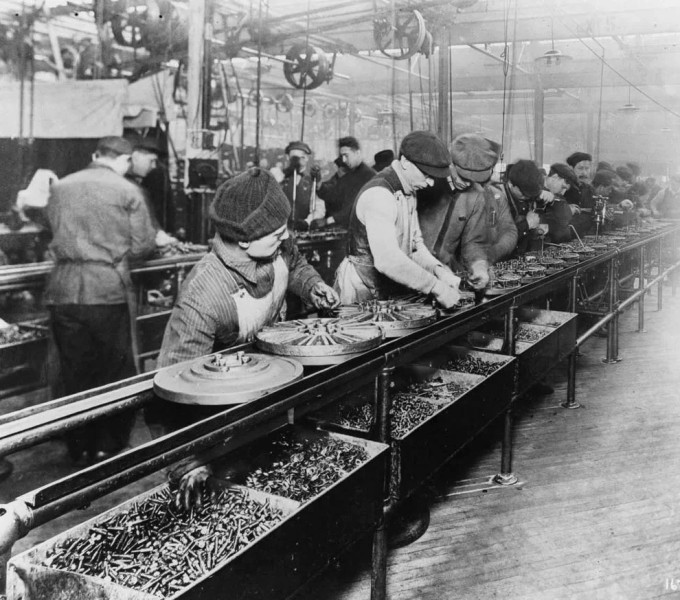
Ford assembly line, c. 1913
This factory image is the logic of mass production in one scene. Workers each handle a specialized step as parts move down the line, which is why industrial output rose so quickly in the early 1900s.
Progressive reform
Progressives responded to corruption, dangerous conditions, monopolies, and city problems by arguing that government had to act.
- Upton Sinclair, The Jungle exposed meatpacking conditions and helped lead to the Meat Inspection Act and Pure Food and Drug Act.
- The Federal Reserve Act created a more stable banking system.
- The Sixteenth Amendment allowed a federal income tax.
- The Seventeenth Amendment created direct election of senators.
- State reforms included initiative, referendum, recall, and direct primary.
- The Eighteenth Amendment created Prohibition.
- The Nineteenth Amendment gave women the vote.
- Conservation meant managed use of resources. Preservation meant protecting wilderness from use.
Progressivism built the regulatory state, but it still left segregation, nativism, and exclusion in place.
Great Depression and New Deal
The Depression pushed government much further. Causes included Black Tuesday, bank failures, overproduction, underconsumption, unequal income, weak regulation, and farm distress.
Roosevelt answered with relief, recovery, reform:
- Relief gave immediate help
- Recovery tried to restart the economy
- Reform tried to prevent another crash
- CCC gave jobs in conservation
- WPA funded public jobs and projects
- FDIC insured bank deposits
- SEC regulated the stock market
- Social Security Act created old-age pensions and unemployment insurance
The New Deal redefined modern liberalism. Freedom now meant some economic security and federal responsibility. It also built the New Deal coalition. Compared with Progressivism, it was the bigger turning point because it created a limited welfare state. Still, many agricultural and domestic workers were excluded, which hurt many African Americans and Mexican Americans.
Mass culture, migration, and who counted as American
New technology and movement of people changed daily life together. Radio, movies, advertising, recorded music, national magazines, and cars created a shared culture, while immigration and migration kept raising the question of who belonged.
Mass culture and cultural conflict
- Radio and film created a national audience.
- FDR’s fireside chats made the presidency feel personal.
- Consumer culture and celebrity culture grew.
- The Harlem Renaissance made Black creativity central to U.S. culture. Think Langston Hughes and Zora Neale Hurston.
- The Scopes trial showed conflict between religious traditionalism and modern science.
- The flapper symbolized changing gender norms in the 1920s.
Families often experienced this new mass culture together through radio in the home.
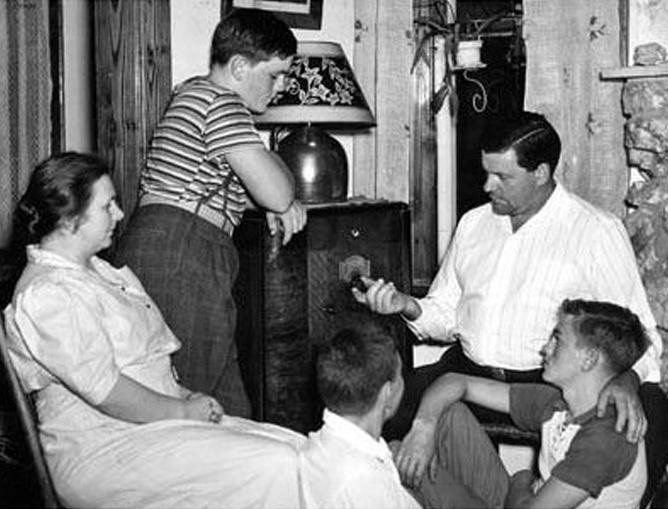
Family gathered around a home radio
This made culture more unified and more contested at the same time.
Migration and contested membership
- “New immigrants” came from southern and eastern Europe, including Italians, Poles, Russians, and Jews.
- Fear of radicals and outsiders fed the Espionage Act, Sedition Act, First Red Scare, and Palmer Raids.
- Restriction followed with the Emergency Quota Act and Immigration Act of 1924.
- The Great Migration was pushed by segregation, disenfranchisement, and racial violence, and pulled by industrial jobs.
- World War II brought more movement and the Bracero Program brought Mexican laborers on temporary contracts.
Migration reshaped cities, labor, and politics, but it also sharpened fights over race, ethnicity, and loyalty.
Empire, the world wars, and the rise of a global United States
Foreign policy changed American identity too. The U.S. stopped looking only inward and started acting like a world power.
Imperialism
- Annexation of Hawaii
- Spanish-American War
- U.S. gained Puerto Rico, Guam, and the Philippines
- Philippine-American War followed when Filipinos resisted U.S. rule
This sparked a debate between imperialists and anti-imperialists over whether a democratic republic could rule other peoples.
World War I
The U.S. entered because of unrestricted submarine warfare, the Zimmermann Telegram, and Wilson’s idealism about defending democracy. The war expanded federal power and repression at home. Wilson’s Fourteen Points and the League of Nations aimed at lasting international leadership, but the Senate rejected the Treaty of Versailles. So WWI showed U.S. power without creating lasting agreement on global leadership.
World War II
World War II was the decisive turning point abroad. Pearl Harbor triggered total mobilization, and war production helped end the Depression.
- Rosie the Riveter symbolized women in war work
- Double V campaign linked victory abroad with civil rights at home
- The military stayed segregated
- Executive Order 9066 led to Japanese American incarceration
- Korematsu v. United States upheld it
- The 442nd Regimental Combat Team became highly decorated
- Major examples include D-Day, island-hopping, the Manhattan Project, Hiroshima and Nagasaki, and the United Nations
WWI and WWII both grew government power and limited civil liberties. WWII mattered more because it permanently made the U.S. a global military, political, and industrial leader.
