Topic 1.4 Notes – Columbian Exchange, Spanish Exploration, and Conquest
What the Columbian Exchange Was
Columbus’s voyage under Ferdinand and Isabella mattered because it began sustained Atlantic contact. People had crossed oceans before, but this time voyages kept happening, and that changed whole societies and ecosystems.
- The Columbian Exchange was the movement of plants, animals, diseases, people, metals, and knowledge between the Old World and New World.
- It was not equal in real life. European conquest, colonization, and forced migration shaped who benefited and who suffered.
- Columbus did not prove the earth was round. Educated Europeans already knew that.
- Norse settlement in Newfoundland around 1000 happened earlier, but it did not create lasting Atlantic integration.
The map below gives you the big picture. Goods, animals, and diseases moved back and forth across the Atlantic, with especially deadly effects for Native peoples.
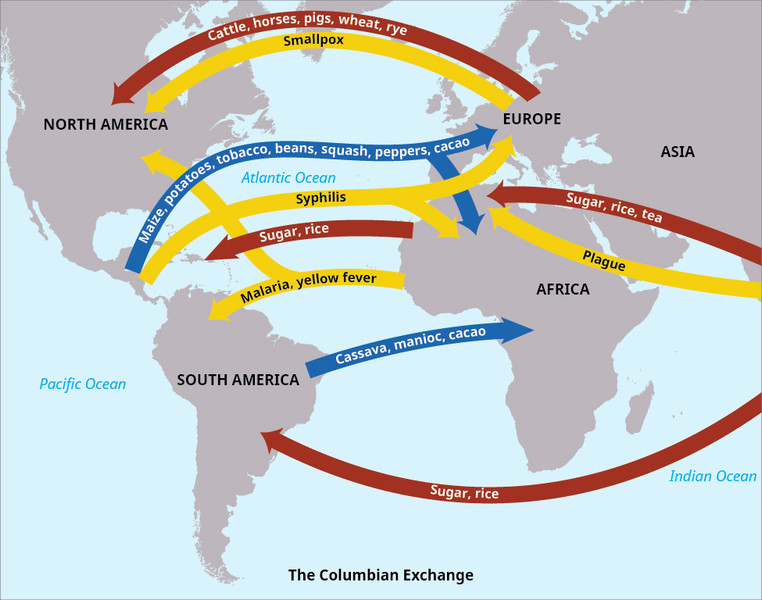
The Columbian Exchange
The core chain you need to see is this:
- Repeated Atlantic voyages became possible.
- That created the Columbian Exchange.
- Disease and disruption devastated Native societies.
- Spanish conquest became easier.
- Conquest led to more extraction, colonization, and Atlantic trade.
What Made Sustained Contact Possible
Europeans already wanted wealth, trade, imperial power, and Christian converts. What changed was their ability to keep crossing the Atlantic and come back.
- Caravels and stronger oceangoing ships could travel farther and carry more cargo.
- Lateen sails helped ships maneuver with changing winds.
- The magnetic compass helped sailors keep direction.
- The astrolabe helped calculate latitude.
- Improved maps and growing knowledge of Atlantic winds and currents made routes more reliable.
Political power and money mattered too.
- Strong monarchies could sponsor voyages, claim land, and defend trade.
- Spain and Portugal led early exploration.
- Joint-stock companies came a bit later, especially with the Dutch and English. They pooled investment and spread risk, which made expensive overseas ventures more practical.
These developments did not cause the exchange by themselves. They made repeated contact and empire-building possible.
What Moved Across the Atlantic
The exchange went both ways, but its effects were very uneven.
American goods to Europe, Africa, and Asia
- Maize, potatoes, sweet potatoes, cassava, tomatoes, cacao, beans, squash, peppers, peanuts, avocados, tobacco
- The biggest food examples are potatoes, maize, and cassava because they supported major population growth.
- Gold moved too, but silver mattered more.
- Potosí in the Andes became the great symbol of American silver extraction.
- Silver fueled trade, commercial growth, and the Price Revolution in Europe.
Old World goods to the Americas
- Wheat, rice, sugarcane, grapes, coffee, bananas, citrus
- Horses, cattle, pigs, sheep, goats
A few effects show up constantly on tests:
- Sugarcane became the base of plantation agriculture.
- Horses transformed transport, mobility, and warfare.
- Livestock damaged Native fields and changed ecosystems through overgrazing and trampling.
Disease to the Americas
- Smallpox, measles, influenza, typhus, diphtheria, whooping cough
- In many places, Native populations fell by 90 percent or more.
- The Taíno in the Caribbean are a major example of collapse.
- Disease often spread through Native trade networks before direct Spanish rule arrived.
- Disease worked together with warfare, famine, displacement, enslavement, and forced labor.
- Syphilis may have come from the Americas to Europe, but it did not cause comparable mass death there.
How Spain Conquered American Empires
Spanish victories were never just “better weapons.”
Aztec Empire
In 1519, Hernán Cortés moved against the Aztecs centered at Tenochtitlan.
- Tlaxcalans were crucial Native allies.
- Malintzin (Malinche) served as interpreter and intermediary.
- Moctezuma II was taken hostage.
- Spaniards were driven out in 1520, then returned.
- Smallpox weakened the region.
- Tenochtitlan fell after a siege in 1521.
Inca Empire
Francisco Pizarro entered an empire already weakened by disease and a civil war between Atahualpa and Huáscar.
- At Cajamarca in 1532, Pizarro captured Atahualpa.
- Atahualpa was later executed.
- Cuzco was occupied in 1533.
- Resistance continued after conquest.
Spanish exploration in North America
Spanish activity reached far beyond Mexico and Peru. This map highlights the expeditions of Hernando de Soto in the Southeast and Francisco Vásquez de Coronado in the Southwest and Great Plains.
- Juan Ponce de León explored Florida in 1513.
- Hernando de Soto traveled through the Southeast.
- Francisco Vásquez de Coronado explored the Southwest and Great Plains.
- St. Augustine was founded in 1565.
- Spanish missions spread Catholicism and Spanish influence.
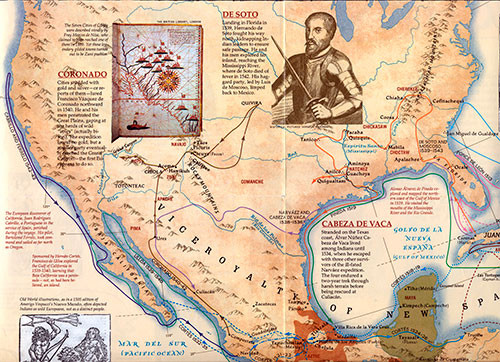
Spanish exploration routes in North America
Why This Topic Matters
The Columbian Exchange reshaped the environment, conquest, and the economy all at once.
- New crops, animals, and land use transformed the Americas.
- Spain built a huge empire partly through conquest and biological disruption.
- American silver and crops helped push Europe from feudalism toward capitalism, meaning more markets, private investment, profit, wage labor, and reinvestment.
- Spanish wealth had mixed results. It brought power, but also inflation, war spending, imports, and bullion flowing to other Europeans.
Key Takeaways
Columbian Exchange
Movement of plants, animals, diseases, people, commodities, and knowledge across the Atlantic after 1492; American crops and silver aided Old World growth and commerce, while diseases and introduced species transformed the Americas
Old World vs. New World
Old World means Europe, Africa, and Asia; New World means the Americas, the two regions connected by the Columbian Exchange
Christopher Columbus
Explorer sponsored by Ferdinand and Isabella whose 1492 voyage initiated sustained contact between Europe and the Americas, although he misunderstood the lands he reached
Caravel
Small, maneuverable oceangoing ship that helped Europeans conduct sustained Atlantic exploration
Lateen Sail
Triangular sail that improved a ship’s ability to travel across or partly against prevailing winds
Magnetic Compass
Navigational instrument used by sailors to maintain direction during ocean voyages
Astrolabe
Navigational instrument used to estimate latitude by observing celestial bodies
Joint-Stock Company
Business organization in which investors purchased shares, pooling capital for expensive overseas ventures while distributing the risk of loss
American Silver
Silver extracted chiefly from Mexico and the Andes that enlarged Europe’s money supply, expanded global commerce, and accelerated capitalist development
Price Revolution
Long period of European inflation to which the influx of American gold and especially silver contributed
Feudalism vs. Capitalism
Feudalism emphasized landholding and inherited obligations, while capitalism emphasized private investment, markets, profit, wage labor, and reinvested capital; American wealth accelerated the shift toward capitalism
Smallpox and Other Old World Epidemics
Imported diseases such as smallpox, measles, and influenza spread among Native peoples with little prior exposure, causing catastrophic deaths and weakening resistance to conquest
Native American Demographic Catastrophe
Catastrophic Indigenous population decline after contact, caused by interacting epidemics, warfare, displacement, hunger, exploitation, and colonial labor demands
Taíno
Caribbean people encountered by Columbus whose population collapsed under disease, violence, displacement, and Spanish exploitation
Conquistadors
Spanish military adventurers who pursued wealth, territory, status, and conversion, generally with royal authorization but privately raised men and resources
Tlaxcalans
Indigenous enemies of Aztec rule who supplied Cortés with thousands of soldiers, provisions, intelligence, and local knowledge
Malintzin, Malinche, or Doña Marina
Interpreter and political intermediary who helped Cortés communicate and negotiate with Native peoples during the conquest of Mexico
Moctezuma II
Aztec emperor whom Cortés seized as a hostage in Tenochtitlan, disrupting Aztec political authority before the city’s fall
Atahualpa
Inca ruler captured by Pizarro at Cajamarca and executed after providing the Spanish an enormous ransom of gold and silver
Juan Ponce de León
Spanish explorer who explored and claimed Florida for Spain in 1513
Hernando de Soto
Spanish explorer who led a 1530s–1540s expedition through the Southeast that sought riches, spread disease and violence, and gathered geographic information
Francisco Vásquez de Coronado
Spanish explorer who searched the Southwest and Great Plains for wealthy cities but found no expected mineral riches
St. Augustine
Spanish settlement founded in Florida in 1565 to defend sea routes and territorial claims; the oldest continuously inhabited European-established settlement in the present-day United States
Hernán Cortés
Spanish conquistador who led the campaign against the Aztec Empire beginning in 1519 and captured Tenochtitlan with extensive Native support
Conquest of the Aztec Empire
Spanish and Native allied campaign that brought down Tenochtitlan in 1521 through Native alliances, smallpox, siege warfare, and Spanish military methods
Francisco Pizarro
Spanish conquistador who captured Atahualpa at Cajamarca in 1532 and occupied Cuzco in 1533
Conquest of the Inca Empire
Spanish campaign aided by epidemics, an Inca civil war, Native factions, and the capture of Atahualpa; resistance continued after Cuzco fell
Horses
Old World animals introduced to the Americas that transformed Native transportation, hunting, warfare, and mobility
Notes
Columbian Exchange
Movement of plants, animals, diseases, people, commodities, and knowledge across the Atlantic after 1492; American crops and silver aided Old World growth and commerce, while diseases and introduced species transformed the Americas
Old World vs. New World
Old World means Europe, Africa, and Asia; New World means the Americas, the two regions connected by the Columbian Exchange
Christopher Columbus
Explorer sponsored by Ferdinand and Isabella whose 1492 voyage initiated sustained contact between Europe and the Americas, although he misunderstood the lands he reached
Caravel
Small, maneuverable oceangoing ship that helped Europeans conduct sustained Atlantic exploration
Lateen Sail
Triangular sail that improved a ship’s ability to travel across or partly against prevailing winds
Magnetic Compass
Navigational instrument used by sailors to maintain direction during ocean voyages
Astrolabe
Navigational instrument used to estimate latitude by observing celestial bodies
Joint-Stock Company
Business organization in which investors purchased shares, pooling capital for expensive overseas ventures while distributing the risk of loss
American Silver
Silver extracted chiefly from Mexico and the Andes that enlarged Europe’s money supply, expanded global commerce, and accelerated capitalist development
Price Revolution
Long period of European inflation to which the influx of American gold and especially silver contributed
Feudalism vs. Capitalism
Feudalism emphasized landholding and inherited obligations, while capitalism emphasized private investment, markets, profit, wage labor, and reinvested capital; American wealth accelerated the shift toward capitalism
Smallpox and Other Old World Epidemics
Imported diseases such as smallpox, measles, and influenza spread among Native peoples with little prior exposure, causing catastrophic deaths and weakening resistance to conquest
Native American Demographic Catastrophe
Catastrophic Indigenous population decline after contact, caused by interacting epidemics, warfare, displacement, hunger, exploitation, and colonial labor demands
Taíno
Caribbean people encountered by Columbus whose population collapsed under disease, violence, displacement, and Spanish exploitation
Conquistadors
Spanish military adventurers who pursued wealth, territory, status, and conversion, generally with royal authorization but privately raised men and resources
Tlaxcalans
Indigenous enemies of Aztec rule who supplied Cortés with thousands of soldiers, provisions, intelligence, and local knowledge
Malintzin, Malinche, or Doña Marina
Interpreter and political intermediary who helped Cortés communicate and negotiate with Native peoples during the conquest of Mexico
Moctezuma II
Aztec emperor whom Cortés seized as a hostage in Tenochtitlan, disrupting Aztec political authority before the city’s fall
Atahualpa
Inca ruler captured by Pizarro at Cajamarca and executed after providing the Spanish an enormous ransom of gold and silver
Juan Ponce de León
Spanish explorer who explored and claimed Florida for Spain in 1513
Hernando de Soto
Spanish explorer who led a 1530s–1540s expedition through the Southeast that sought riches, spread disease and violence, and gathered geographic information
Francisco Vásquez de Coronado
Spanish explorer who searched the Southwest and Great Plains for wealthy cities but found no expected mineral riches
St. Augustine
Spanish settlement founded in Florida in 1565 to defend sea routes and territorial claims; the oldest continuously inhabited European-established settlement in the present-day United States
Hernán Cortés
Spanish conquistador who led the campaign against the Aztec Empire beginning in 1519 and captured Tenochtitlan with extensive Native support
Conquest of the Aztec Empire
Spanish and Native allied campaign that brought down Tenochtitlan in 1521 through Native alliances, smallpox, siege warfare, and Spanish military methods
Francisco Pizarro
Spanish conquistador who captured Atahualpa at Cajamarca in 1532 and occupied Cuzco in 1533
Conquest of the Inca Empire
Spanish campaign aided by epidemics, an Inca civil war, Native factions, and the capture of Atahualpa; resistance continued after Cuzco fell
Horses
Old World animals introduced to the Americas that transformed Native transportation, hunting, warfare, and mobility
