Topic 3.11 Notes – Developing an American Identity
What American Identity Became After the Revolution
Before 1763, most colonists thought of themselves first as British subjects and then as Virginians, New Yorkers, Puritans, Anglicans, merchants, or planters. The colonies were separate places with their own histories and habits.
The Revolution pulled those separate identities into a shared story.
- Common grievances against Britain gave colonists a reason to think together.
- The Continental Congresses, the war, and independence created shared experiences across colonies.
- The new republic turned many people, at least legally, from subjects of a king into citizens of a nation.
That new identity centered on political ideals more than ancestry.
- Liberty meant freedom from tyranny.
- Republicanism meant government by citizens, not monarchy.
- Civic virtue meant putting the public good above selfish interest.
- Americans praised public service, practical achievement, and distance from inherited privilege.
Still, this was not a total break from Europe. Americans kept European languages, religions, artistic styles, and classical Greek and Roman models. On tests, a very common point is that national identity grew alongside regional identity, not instead of it.
How a National Culture Took Shape
A nation becomes real when people who never meet still feel connected. Print, schools, writers, and artists helped do that.
Print and education
- Newspapers, pamphlets, almanacs, sermons, broadsides, and political essays created a national public conversation.
- Fierce party arguments actually helped build political culture because Americans were debating shared national issues.
- The Copyright Act of 1790 protected authors’ works.
- The Patent Act of 1790, plus constitutional protection for patents and copyrights, showed that the new nation valued invention and useful knowledge.
- Noah Webster’s American Spelling Book or “Blue-Backed Speller” pushed standard American spelling and patriotic education.
- Benjamin Franklin became a model American figure through self-education, thrift, science, diplomacy, and civic service.
- Poor Richard’s Almanack taught habits like industry and frugality.
- Franklin’s Autobiography helped create the self-made ideal.
Literature
American writers still used European forms, but their subjects became more American.
- Phillis Wheatley, Poems on Various Subjects, Religious and Moral (1773) showed literary talent that challenged racist assumptions.
- Wheatley’s 1775 poem to George Washington used Columbia, an early female symbol of America.
- Philip Freneau wrote on American politics and identity.
- Joel Barlow’s The Vision of Columbus imagined America’s past and future on an epic scale.
- Columbia became an early national personification of the United States.
Visual art and memory
Portraiture and history painting helped turn recent events into shared national memory. Washington's image became especially important.
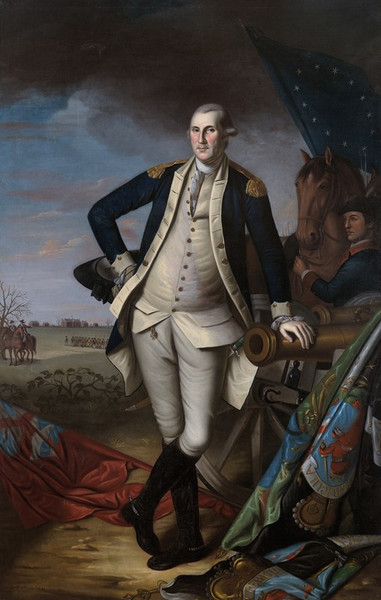
Charles Willson Peale, George Washington at the Battle of Princeton
- John Singleton Copley’s colonial portraits showed continuity with British artistic conventions.
- Benjamin West’s The Death of General Wolfe treated North American history as heroic subject matter.
- John Trumbull’s The Death of General Warren at the Battle of Bunker’s Hill and The Death of General Montgomery in the Attack on Quebec turned Revolutionary sacrifice into national memory.
- Charles Willson Peale’s portraits of Washington, especially George Washington at the Battle of Princeton, made Washington a civic hero.
- Peale’s Philadelphia museum linked national memory to science and useful knowledge.
- George Washington became the central national symbol of republican virtue, often compared to Cincinnatus.
Symbols, Architecture, and Religion in the New Nation
National symbols and civic ritual
- The flag resolution of 1777 created 13 stripes and 13 stars.
- The Great Seal in 1782 used the bald eagle, shield, olive branch, arrows, and E pluribus unum.
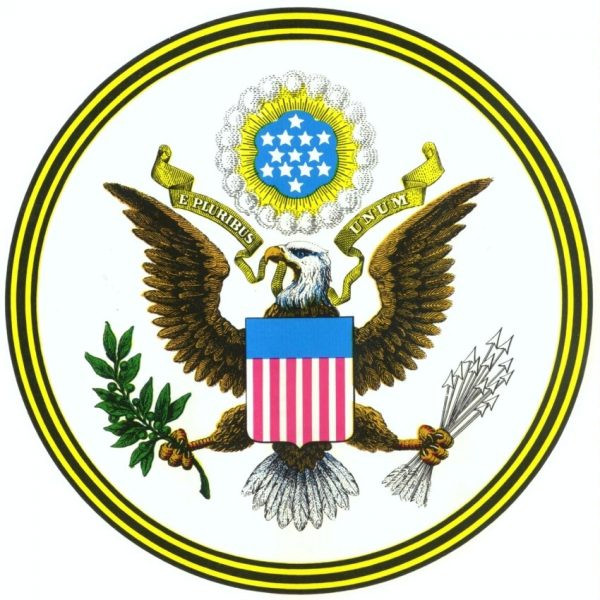
Great Seal of the United States
- Public readings of the Declaration, Fourth of July celebrations, civic processions, and military commemorations made nationalism visible.
- Washington’s death in 1799 became a major moment of national mourning.
- Common symbols included Liberty, eagles, liberty caps, columns, shields, stars, and groups of 13.
Architecture
- Georgian style continued from the colonial period.
- Federal style adapted British neoclassical forms to fit a republic.
- Classical architecture mattered because Americans linked Greece and Rome to republican government.
- Thomas Jefferson’s Virginia State Capitol, based on the Maison Carrée, expressed republican ideals.
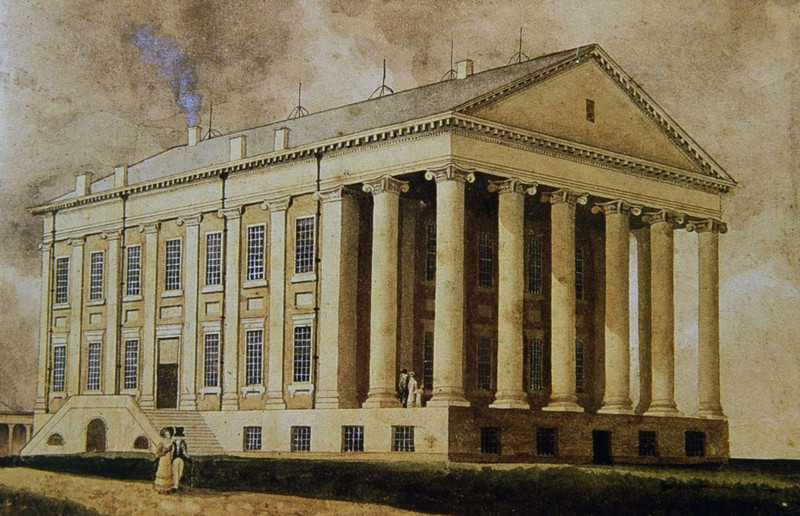
Virginia State Capitol, Richmond
- The Residence Act of 1790 created a permanent capital.
- Pierre Charles L’Enfant’s 1791 plan for Washington, D.C. gave the city a grand national design.
- The President’s House began in 1792 and the Capitol in 1793.
Religion and national identity
Religious diversity made one national church unrealistic.
- The Virginia Statute for Religious Freedom (1786) defended liberty of conscience.
- The First Amendment (1791) barred a national establishment of religion.
- Sermons still used providential language, feeding early ideas of American exceptionalism.
Regional Differences and the Limits of Unity
Americans were building one nation, but daily life still felt very regional.
| Region | Main traits |
|---|---|
| New England | towns, Congregationalism, maritime trade, high literacy, dense print culture |
| Mid-Atlantic | ethnic and religious diversity, big cities like Philadelphia and New York |
| Chesapeake and Lower South | plantation agriculture, Anglican/Episcopal influence, slavery, gentility |
| Backcountry | Scots-Irish and German settlers, small farming, evangelical religion, frontier culture |
Population diversity mattered too. The new nation included many European groups, enslaved Africans, free Black communities, and American Indian nations.
Belonging had sharp limits:
- The Naturalization Act of 1790 limited citizenship to “free white persons.”
- Republican motherhood gave women a civic role through raising virtuous citizens, but not political equality.
- Slavery directly contradicted revolutionary ideals.
- Indigenous nations remained outside U.S. citizenship and often in conflict with U.S. expansion.
Key Takeaways
Republicanism
Cultural ideal that a republic required civic virtue, public service, independence, frugality, education, and resistance to corruption and hereditary privilege
George Washington
Revolutionary commander and first president elevated into a national hero symbolizing civic virtue, restrained leadership, and the voluntary surrender of power
Benjamin Franklin
National model of the self-made American who combined self-education, practical knowledge, scientific curiosity, commercial success, diplomacy, and civic service
Poor Richard’s Almanack
Franklin’s annual publication using proverbs and practical advice to promote thrift, industry, self-discipline, and other republican virtues
Print Culture
Newspapers, pamphlets, books, sermons, and engravings that circulated shared arguments and symbols, connecting local readers to a national public
Copyright Act of 1790
Federal law protecting maps, charts, and books for 14 years, renewable once, to encourage domestic authorship and useful knowledge
Noah Webster
Educator who sought cultural independence from Britain by standardizing American language and using education to promote patriotic republican values
American Spelling Book / Blue-Backed Speller
Webster’s widely used 1783 textbook that taught reading and standardized spelling while promoting patriotic and moral lessons
Phillis Wheatley
Enslaved African-born poet whose Christian, neoclassical verse contradicted racist assumptions about Africans while her status highlighted the conflict between liberty and slavery
Columbia
Classically styled female personification of America used in late-eighteenth-century poetry and art as a national symbol
John Singleton Copley
Colonial portraitist whose European-style paintings displayed elite American status, illustrating the continuity of transatlantic artistic culture
Benjamin West
Pennsylvania-born London artist whose The Death of General Wolfe treated recent North American history as a heroic subject within European high culture
John Trumbull
Continental Army veteran whose battle paintings turned Revolutionary leaders, deaths, and events into scenes of patriotic sacrifice and national memory
Charles Willson Peale
Portraitist of Washington and founder of a Philadelphia museum combining national history, scientific specimens, inventions, and artifacts
United States Flag of 1777
National flag established with 13 alternating red and white stripes and 13 white stars representing a new constellation of states
Georgian Architecture
British-derived colonial style emphasizing symmetry, proportion, formal entrances, sash windows, and classical decoration; it remained influential after independence
Federal Style
Post-Revolutionary American style derived from British neoclassicism, marked by symmetry, lighter proportions, and refined classical decoration
Neoclassical Architecture
Architecture modeled on ancient Greece and Rome and used by Americans to associate public buildings with republican government and civic virtue
Thomas Jefferson
Leading advocate of classical republican architecture who modeled the Virginia State Capitol on the ancient Roman Maison Carrée
Pierre Charles L’Enfant
Designer of the 1791 plan for Washington, D.C., combining a street grid, broad diagonal avenues, and prominent sites for national buildings
Religious Pluralism
Coexistence of many denominations and faiths, making a single national church impractical and encouraging religious liberty as an American ideal
Disestablishment
Ending government support for an established church, a gradual and uneven process that strengthened religious liberty after independence
Virginia Statute for Religious Freedom
Jefferson-drafted law enacted in 1786 that ended Virginia’s established church support and protected belief from civil coercion
American Exceptionalism
Belief that the United States’ political system and history gave the nation a distinctive mission or place in the world
Eli Whitney
Inventor who patented the cotton gin in 1794, exemplifying practical ingenuity while helping expand cotton cultivation and enslaved labor
Cotton Gin
Whitney’s machine for separating seeds from short-staple cotton, making cotton more profitable and contributing to the expansion of slavery
Naturalization Act of 1790
Law restricting naturalization to “free white persons,” revealing the racial limits of citizenship despite universal revolutionary language
Republican Motherhood
Ideal assigning women the civic responsibility of educating virtuous republican citizens without granting them political equality
Great Seal of the United States
National emblem adopted in 1782 featuring a bald eagle, symbols of the 13 states, and the motto E pluribus unum, “Out of many, one.”
Franklin’s Autobiography
Franklin’s work, begun in 1771 and published after his death, that helped establish the enduring image of the self-made American
Notes
Republicanism
Cultural ideal that a republic required civic virtue, public service, independence, frugality, education, and resistance to corruption and hereditary privilege
George Washington
Revolutionary commander and first president elevated into a national hero symbolizing civic virtue, restrained leadership, and the voluntary surrender of power
Benjamin Franklin
National model of the self-made American who combined self-education, practical knowledge, scientific curiosity, commercial success, diplomacy, and civic service
Poor Richard’s Almanack
Franklin’s annual publication using proverbs and practical advice to promote thrift, industry, self-discipline, and other republican virtues
Print Culture
Newspapers, pamphlets, books, sermons, and engravings that circulated shared arguments and symbols, connecting local readers to a national public
Copyright Act of 1790
Federal law protecting maps, charts, and books for 14 years, renewable once, to encourage domestic authorship and useful knowledge
Noah Webster
Educator who sought cultural independence from Britain by standardizing American language and using education to promote patriotic republican values
American Spelling Book / Blue-Backed Speller
Webster’s widely used 1783 textbook that taught reading and standardized spelling while promoting patriotic and moral lessons
Phillis Wheatley
Enslaved African-born poet whose Christian, neoclassical verse contradicted racist assumptions about Africans while her status highlighted the conflict between liberty and slavery
Columbia
Classically styled female personification of America used in late-eighteenth-century poetry and art as a national symbol
John Singleton Copley
Colonial portraitist whose European-style paintings displayed elite American status, illustrating the continuity of transatlantic artistic culture
Benjamin West
Pennsylvania-born London artist whose The Death of General Wolfe treated recent North American history as a heroic subject within European high culture
John Trumbull
Continental Army veteran whose battle paintings turned Revolutionary leaders, deaths, and events into scenes of patriotic sacrifice and national memory
Charles Willson Peale
Portraitist of Washington and founder of a Philadelphia museum combining national history, scientific specimens, inventions, and artifacts
United States Flag of 1777
National flag established with 13 alternating red and white stripes and 13 white stars representing a new constellation of states
Georgian Architecture
British-derived colonial style emphasizing symmetry, proportion, formal entrances, sash windows, and classical decoration; it remained influential after independence
Federal Style
Post-Revolutionary American style derived from British neoclassicism, marked by symmetry, lighter proportions, and refined classical decoration
Neoclassical Architecture
Architecture modeled on ancient Greece and Rome and used by Americans to associate public buildings with republican government and civic virtue
Thomas Jefferson
Leading advocate of classical republican architecture who modeled the Virginia State Capitol on the ancient Roman Maison Carrée
Pierre Charles L’Enfant
Designer of the 1791 plan for Washington, D.C., combining a street grid, broad diagonal avenues, and prominent sites for national buildings
Religious Pluralism
Coexistence of many denominations and faiths, making a single national church impractical and encouraging religious liberty as an American ideal
Disestablishment
Ending government support for an established church, a gradual and uneven process that strengthened religious liberty after independence
Virginia Statute for Religious Freedom
Jefferson-drafted law enacted in 1786 that ended Virginia’s established church support and protected belief from civil coercion
American Exceptionalism
Belief that the United States’ political system and history gave the nation a distinctive mission or place in the world
Eli Whitney
Inventor who patented the cotton gin in 1794, exemplifying practical ingenuity while helping expand cotton cultivation and enslaved labor
Cotton Gin
Whitney’s machine for separating seeds from short-staple cotton, making cotton more profitable and contributing to the expansion of slavery
Naturalization Act of 1790
Law restricting naturalization to “free white persons,” revealing the racial limits of citizenship despite universal revolutionary language
Republican Motherhood
Ideal assigning women the civic responsibility of educating virtuous republican citizens without granting them political equality
Great Seal of the United States
National emblem adopted in 1782 featuring a bald eagle, symbols of the 13 states, and the motto E pluribus unum, “Out of many, one.”
Franklin’s Autobiography
Franklin’s work, begun in 1771 and published after his death, that helped establish the enduring image of the self-made American
