Topic 3.6 Notes – The Influence of Revolutionary Ideals
How Revolutionary Ideals Challenged Old Hierarchies
The same ideas that justified independence soon got turned inward. Americans had argued that government should rest on natural rights, popular sovereignty, republicanism, and consent of the governed. After the war, people started asking a dangerous question: if those ideas were true against Britain, why not against inequality at home?
- Natural rights meant rights came from being human, not from government.
- Popular sovereignty meant political power came from the people.
- Republicanism meant no king. Citizens and representatives should work for the common good.
- Consent of the governed meant legitimate government needed the people’s approval.
These ideas attacked monarchy and hereditary privilege. Equality in the 1770s and 1780s usually meant legal equality and rejection of inherited rank. It did not mean everyone should vote or that wealth should be equal.
Americans increasingly praised merit, virtue, and independence instead of birth. States ended primogeniture (eldest son gets the estate) and entail (land can’t be broken up or sold outside the family). The new republic also created no hereditary nobility. Loyalist estates were often confiscated or abandoned, which weakened part of the old elite.
George Washington became the model of republican virtue when he resigned his military commission in 1783 and returned to private life. That mattered because it showed civilian control of the military. He could have acted like a king. He didn’t.
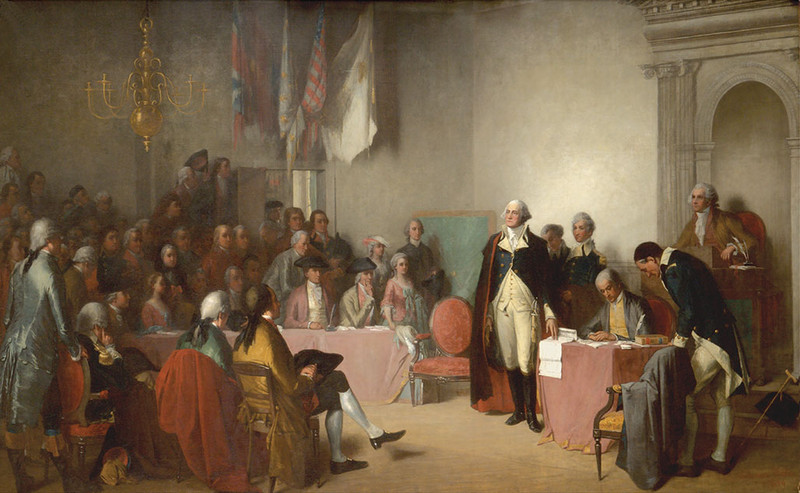
Washington resigns his military commission, 1783
How the Revolution Changed Society in the New Nation
The Revolution widened opportunity, but unevenly. White men gained the most. Women gained civic importance. Slavery faced stronger criticism. Religious liberty expanded. Excluded groups still hit hard limits.
Greater political democracy
Political participation grew among white artisans, laborers, small farmers, and militiamen because wartime service strengthened their claim to a voice in government.
- New state constitutions and elected legislatures rested on the people’s consent.
- Several states lowered property rules for voting, though many still required property or taxpaying.
- Pennsylvania Constitution of 1776 was the most democratic example. It gave suffrage to taxpaying adult men, created a unicameral legislature, and required annual elections.
- Leaders believed in popular sovereignty, but many feared “too much democracy.”
A useful exception is New Jersey’s 1776 constitution, which allowed some property-owning women and free Black people to vote. That ended in 1807, when suffrage was restricted to white men.
Slavery and antislavery action
The biggest contradiction was obvious. The nation said “all men are created equal” and kept slavery.
African Americans pushed for freedom through:
- military service
- escape
- petitions
- lawsuits
- resistance
Lord Dunmore’s Proclamation in 1775 offered freedom to enslaved people who fled rebel masters and joined the British. Free Black petitioners also used revolutionary language against slavery.
| Example | Why it matters |
|---|---|
| Pennsylvania Abolition Society, 1775 | organized antislavery activism |
| Vermont constitution, 1777 | banned adult slavery |
| Pennsylvania Gradual Abolition Act, 1780 | first gradual emancipation law |
| Massachusetts constitution, 1780 | “born free and equal” basis |
| Elizabeth Freeman and Quock Walker | freedom suits weakening slavery |
| Rhode Island and Connecticut, 1784 | gradual emancipation |
| Virginia manumission law, 1782 | easier private emancipation |
| New York gradual emancipation, 1799 | northern antislavery trend |
The Northwest Ordinance banned slavery in the Northwest Territory. By contrast, the South preserved and later expanded slavery. That North-South split matters a lot later.
Women’s participation and republican motherhood
Women had been deeply involved in the war through boycotts, homespun production, running farms and shops, nursing, and camp following.
- Ladies Association of Philadelphia raised money and made shirts for soldiers.
- Esther de Berdt Reed led that effort.
- Deborah Sampson served disguised as a man in the Continental Army.
- Abigail Adams told John Adams to “remember the ladies.” He brushed it off.
- Judith Sargent Murray, in On the Equality of the Sexes, argued women were not naturally inferior.
The most accepted new ideal was republican motherhood. Women were supposed to raise virtuous republican citizens, so female literacy and girls’ academies gained support. Still, coverture remained, and women usually could not vote or hold office.
Religious liberty
Revolutionary ideas also challenged established churches and forced support for religion.
- Virginia Declaration of Rights (1776) defended freedom of conscience.
- James Madison’s Memorial and Remonstrance Against Religious Assessments (1785) opposed tax support for religion.
- Thomas Jefferson’s Virginia Statute for Religious Freedom (1786) ended state support for the Anglican Church in Virginia.
These helped create the logic later used in the First Amendment.
The Limits of Revolutionary Equality
This is the theme teachers love to test. The Revolution expanded democracy most clearly for white men. Women gained civic value, not political equality. Slavery ended gradually only in parts of the North, and free Black people still lacked equal citizenship. American Indians mostly faced land loss and settler expansion.
The gap between ideals and reality mattered because later reformers could use revolutionary language against the nation itself.
How the American Revolution Influenced Other Revolutions
The Revolution showed that colonists could defeat an empire and build a republic. Other revolutions borrowed that example, but each had its own conditions. This map helps you see that spread from the Atlantic world into Latin America by the early 1800s.
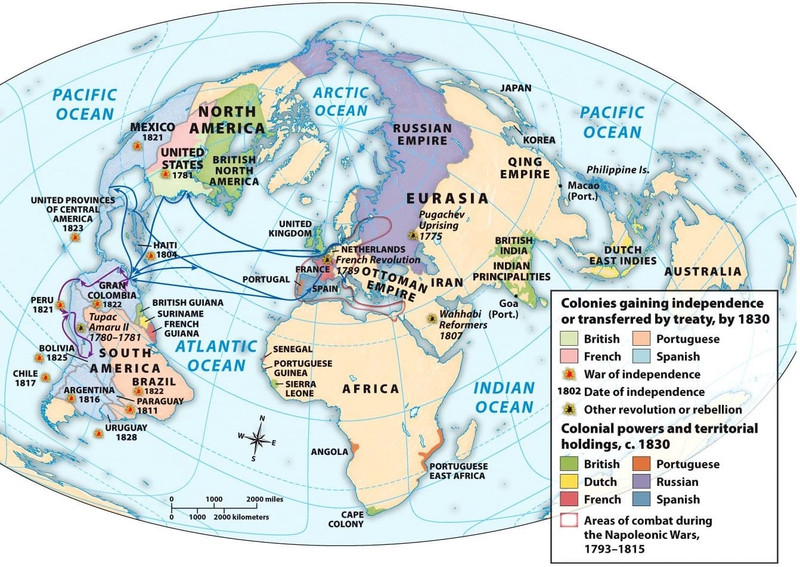
Atlantic world revolutions and independence movements, c. 1830
France
French officers like Marquis de Lafayette carried lessons home. French aid to America worsened France’s money crisis. The Declaration of the Rights of Man and of the Citizen echoed natural-rights language. France went further than America with the fall of the monarchy, the Reign of Terror, and then Napoleon.
Haiti
In Saint-Domingue, a brutal slave colony, the French Revolution helped spark an enslaved uprising in 1791. Toussaint Louverture and later Jean-Jacques Dessalines led the struggle. Haiti won independence in 1804.
It became the first independent Black republic and the only successful large-scale slave revolt to create an independent nation.
Latin America
On the map, notice how many independence dates cluster in the 1810s and 1820s. Revolutionary ideas mixed with the chaos caused by Napoleon’s invasion of Spain and Portugal. Simón Bolívar, in his Jamaica Letter, argued for independence. José de San Martín helped free much of Spanish South America. By the 1820s, independence movements had succeeded across most of the region, though hierarchy and coerced labor survived.
Key Takeaways
Republicanism
The principle that government rests on the people and should be conducted by citizens and representatives devoted to the common good
Popular Sovereignty
The principle that governmental authority originates with the people
Natural Rights
Rights individuals possess inherently, which government does not create and cannot legitimately remove without justification
Declaration of Independence
The 1776 declaration of natural rights and human equality whose principles inspired American reform efforts and later Atlantic revolutions
Primogeniture
The practice by which an estate passed to the eldest son; states abolished it to weaken inherited privilege
Entail
A legal restriction preventing inherited property from being freely sold or divided; states ended it to weaken landed privilege
George Washington's Resignation as Commander in Chief
Washington surrendered his military commission on December 23, 1783, affirming civilian control and republican opposition to military rule
Pennsylvania Constitution of 1776
A highly democratic state constitution granting taxpaying adult men suffrage and creating an annually elected unicameral legislature
New Jersey Constitution of 1776
A property-based voting system that allowed some women and free Black people to vote until suffrage was restricted to white men in 1807
Lord Dunmore's Proclamation
The 1775 British offer of freedom to enslaved people who escaped rebel masters and served the British
Pennsylvania Abolition Society
An antislavery organization founded in 1775 with prominent Quaker participation
Gradual Emancipation
Abolition that freed future generations only after specified dates or lengthy service rather than immediately freeing everyone enslaved
Vermont Constitution of 1777
The first constitution in an American jurisdiction to prohibit adult slavery
Pennsylvania Gradual Abolition Act of 1780
The first state statute providing for gradual emancipation
Massachusetts Constitution of 1780
A constitution declaring all people born free and equal, providing the basis for rulings that effectively ended Massachusetts slavery
Freedom Suits
Lawsuits in which enslaved people claimed that laws or constitutional principles entitled them to freedom
Elizabeth Freeman (Mum Bett)
An enslaved Massachusetts woman whose successful freedom suit helped establish that slavery violated the state constitution
Quock Walker
An enslaved Massachusetts man whose freedom cases helped produce rulings that effectively ended slavery in the state
Manumission
The legal freeing of an enslaved person by an individual slaveholder, made easier in Virginia by a 1782 law
Coverture
The legal doctrine under which a married woman's identity and property rights were largely represented by her husband
Ladies Association of Philadelphia
A women's organization founded in 1780 that collected money and made shirts for Continental soldiers
Esther de Berdt Reed
Leader of the Ladies Association of Philadelphia, which raised money and supplied shirts to Continental soldiers
Abigail Adams and "Remember the Ladies"
Her 1776 appeal to John Adams to prevent husbands from exercising unchecked power over women in the new legal order
Judith Sargent Murray
Writer who argued that women's apparent intellectual inferiority resulted from unequal education rather than nature
"On the Equality of the Sexes"
Judith Sargent Murray's 1790 essay arguing that women and men had equal intellectual potential but unequal educational opportunities
Republican Motherhood
The ideal that women served the republic by educating children in virtue, patriotism, and the principles of self-government
Religious Liberty
Freedom of individual conscience and voluntary worship without government-compelled belief or support for an established church
Virginia Declaration of Rights
A 1776 declaration describing religion as a matter of reason and conviction rather than governmental force
James Madison
Virginia statesman who opposed government support for religion in his 1785 Memorial and Remonstrance Against Religious Assessments
"Memorial and Remonstrance Against Religious Assessments"
James Madison's 1785 argument that government should not tax citizens to support Christian teachers
Thomas Jefferson
Author of the Virginia Statute for Religious Freedom, which ended state support for Virginia's Anglican establishment
Virginia Statute for Religious Freedom
The 1786 law ending Virginia's Anglican establishment and prohibiting government from compelling religious belief or worship
Atlantic Revolutions
The connected American, French, Haitian, and Latin American revolutionary movements that challenged imperial, monarchical, and social hierarchies
French Revolution
The revolution beginning in 1789 that challenged monarchy and privilege, proclaimed rights and national sovereignty, and eventually created a republic
Marquis de Lafayette
French officer who served in the American Revolution and carried experience with republican independence back to France
Declaration of the Rights of Man and of the Citizen
The French Revolution's 1789 declaration of natural rights, legal equality, liberty, and national sovereignty
Haitian Revolution
The 1791–1804 revolt that abolished slavery, defeated French rule, and created the first independent Black republic
Toussaint Louverture
The leading military and political figure during much of the Haitian Revolution, though he died before independence
Jean-Jacques Dessalines
Haitian leader whose forces defeated the French and who declared Haiti independent in 1804
Latin American Wars of Independence
Early nineteenth-century movements that used popular sovereignty and natural rights to end Spanish rule across most of mainland Latin America
Simón Bolívar
Revolutionary leader who helped win independence for Venezuela, Colombia, Ecuador, Peru, and the territory that became Bolivia
Jamaica Letter
Simón Bolívar's 1815 argument for Spanish American independence and discussion of the region's difficulties in creating stable governments
José de San Martín
Revolutionary general who played a central role in the independence of Argentina, Chile, and Peru
Abolitionism
The movement to end slavery, strengthened by revolutionary arguments that bondage violated natural rights and equality
Notes
Republicanism
The principle that government rests on the people and should be conducted by citizens and representatives devoted to the common good
Popular Sovereignty
The principle that governmental authority originates with the people
Natural Rights
Rights individuals possess inherently, which government does not create and cannot legitimately remove without justification
Declaration of Independence
The 1776 declaration of natural rights and human equality whose principles inspired American reform efforts and later Atlantic revolutions
Primogeniture
The practice by which an estate passed to the eldest son; states abolished it to weaken inherited privilege
Entail
A legal restriction preventing inherited property from being freely sold or divided; states ended it to weaken landed privilege
George Washington's Resignation as Commander in Chief
Washington surrendered his military commission on December 23, 1783, affirming civilian control and republican opposition to military rule
Pennsylvania Constitution of 1776
A highly democratic state constitution granting taxpaying adult men suffrage and creating an annually elected unicameral legislature
New Jersey Constitution of 1776
A property-based voting system that allowed some women and free Black people to vote until suffrage was restricted to white men in 1807
Lord Dunmore's Proclamation
The 1775 British offer of freedom to enslaved people who escaped rebel masters and served the British
Pennsylvania Abolition Society
An antislavery organization founded in 1775 with prominent Quaker participation
Gradual Emancipation
Abolition that freed future generations only after specified dates or lengthy service rather than immediately freeing everyone enslaved
Vermont Constitution of 1777
The first constitution in an American jurisdiction to prohibit adult slavery
Pennsylvania Gradual Abolition Act of 1780
The first state statute providing for gradual emancipation
Massachusetts Constitution of 1780
A constitution declaring all people born free and equal, providing the basis for rulings that effectively ended Massachusetts slavery
Freedom Suits
Lawsuits in which enslaved people claimed that laws or constitutional principles entitled them to freedom
Elizabeth Freeman (Mum Bett)
An enslaved Massachusetts woman whose successful freedom suit helped establish that slavery violated the state constitution
Quock Walker
An enslaved Massachusetts man whose freedom cases helped produce rulings that effectively ended slavery in the state
Manumission
The legal freeing of an enslaved person by an individual slaveholder, made easier in Virginia by a 1782 law
Coverture
The legal doctrine under which a married woman's identity and property rights were largely represented by her husband
Ladies Association of Philadelphia
A women's organization founded in 1780 that collected money and made shirts for Continental soldiers
Esther de Berdt Reed
Leader of the Ladies Association of Philadelphia, which raised money and supplied shirts to Continental soldiers
Abigail Adams and "Remember the Ladies"
Her 1776 appeal to John Adams to prevent husbands from exercising unchecked power over women in the new legal order
Judith Sargent Murray
Writer who argued that women's apparent intellectual inferiority resulted from unequal education rather than nature
"On the Equality of the Sexes"
Judith Sargent Murray's 1790 essay arguing that women and men had equal intellectual potential but unequal educational opportunities
Republican Motherhood
The ideal that women served the republic by educating children in virtue, patriotism, and the principles of self-government
Religious Liberty
Freedom of individual conscience and voluntary worship without government-compelled belief or support for an established church
Virginia Declaration of Rights
A 1776 declaration describing religion as a matter of reason and conviction rather than governmental force
James Madison
Virginia statesman who opposed government support for religion in his 1785 Memorial and Remonstrance Against Religious Assessments
"Memorial and Remonstrance Against Religious Assessments"
James Madison's 1785 argument that government should not tax citizens to support Christian teachers
Thomas Jefferson
Author of the Virginia Statute for Religious Freedom, which ended state support for Virginia's Anglican establishment
Virginia Statute for Religious Freedom
The 1786 law ending Virginia's Anglican establishment and prohibiting government from compelling religious belief or worship
Atlantic Revolutions
The connected American, French, Haitian, and Latin American revolutionary movements that challenged imperial, monarchical, and social hierarchies
French Revolution
The revolution beginning in 1789 that challenged monarchy and privilege, proclaimed rights and national sovereignty, and eventually created a republic
Marquis de Lafayette
French officer who served in the American Revolution and carried experience with republican independence back to France
Declaration of the Rights of Man and of the Citizen
The French Revolution's 1789 declaration of natural rights, legal equality, liberty, and national sovereignty
Haitian Revolution
The 1791–1804 revolt that abolished slavery, defeated French rule, and created the first independent Black republic
Toussaint Louverture
The leading military and political figure during much of the Haitian Revolution, though he died before independence
Jean-Jacques Dessalines
Haitian leader whose forces defeated the French and who declared Haiti independent in 1804
Latin American Wars of Independence
Early nineteenth-century movements that used popular sovereignty and natural rights to end Spanish rule across most of mainland Latin America
Simón Bolívar
Revolutionary leader who helped win independence for Venezuela, Colombia, Ecuador, Peru, and the territory that became Bolivia
Jamaica Letter
Simón Bolívar's 1815 argument for Spanish American independence and discussion of the region's difficulties in creating stable governments
José de San Martín
Revolutionary general who played a central role in the independence of Argentina, Chile, and Peru
Abolitionism
The movement to end slavery, strengthened by revolutionary arguments that bondage violated natural rights and equality
