Topic 2.8 Notes – Comparison in Period 2
How Colonial Societies Diverged in North America
From 1607 to 1754, colonies shared some patterns, but they did not grow in the same direction. The main reason is that imperial goals, geography, migration, labor supply, Native resistance, and imperial control varied from place to place.
A comparison answer works best when you do four things in one claim:
- name a similarity
- name a difference
- explain why that difference happened
- show its effect on society, politics, labor, or Native relations
Shared developments across regions:
- Atlantic markets connected colonies to Europe through tobacco, rice, grain, furs, fish, and shipping.
- Competition for land and resources pushed colonies and Native peoples into conflict.
- Conflict and exchange with American Indians happened everywhere, but in different forms.
- Social hierarchies grew based on wealth, race, religion, and legal status.
- Coerced labor appeared in many places, though its scale differed a lot.
The big significance is easy to miss. Colonial North America became more interconnected through trade and empire, but also more regionally distinct.
Spanish, French, Dutch, and British Colonial Models
It helps to picture where each empire was strongest before you compare how each one governed and interacted with Native peoples.
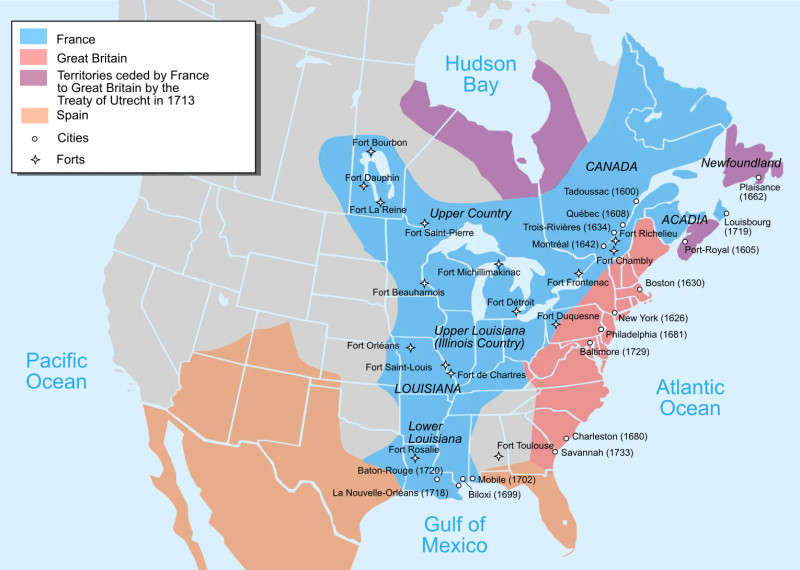
European claims in North America before 1754
Spanish colonies
- Goals centered on wealth extraction, conversion, and tight imperial control.
- Spain built missions, forts, and settlements and tried to fold Native peoples into a hierarchical Catholic society.
- Native relations often meant coercion, labor control, and conversion, not equal partnership.
- Pueblo Revolt (1680) drove Spain out of New Mexico for years; after returning in 1692, Spain allowed somewhat more Pueblo tolerance.
- Effect: stronger racial hierarchy and more direct control over Native communities than in British colonies.
French colonies
- Based in the St. Lawrence, Great Lakes, and Mississippi Valley.
- Fur trade and waterways mattered more than large settler farming.
- French colonists often relied on alliances, diplomacy, intermarriage, and missionary work with Native peoples.
- Effect: less Native displacement than British settlement, though warfare still happened.
Dutch colonies
- New Netherland and New Amsterdam grew as commercial centers on the Hudson.
- The Dutch wanted trade, profit, and fur access.
- The colony became multiethnic and relatively tolerant, mostly because commerce attracted many groups.
- Enslaved Africans were present, and conflict with Native peoples grew when settlement expanded.
- In 1664, the English seized New Netherland and turned New Amsterdam into New York.
- Effect: Dutch trade habits and diversity shaped the middle colonies.
British colonies
- British settlers wanted land, profit, social mobility, and sometimes religious refuge.
- Many migrants came as families, which helped create permanent settlements.
- British colonies usually kept more distance from Native societies and pressed harder onto Native land.
- Effect: larger settler population, stronger local governments, and frequent land conflict.
The map makes the contrast easier to remember. French claims stretched through inland waterways and trading zones, and British settlement clustered along the Atlantic coast. The comparison to lock in is this: the French often needed Native partners for trade, while the British often wanted Native land for settlement.
The Four British Colonial Regions
Start by locating the colonies on the Atlantic coast. This map helps you see how historians group the thirteen colonies into regional patterns.
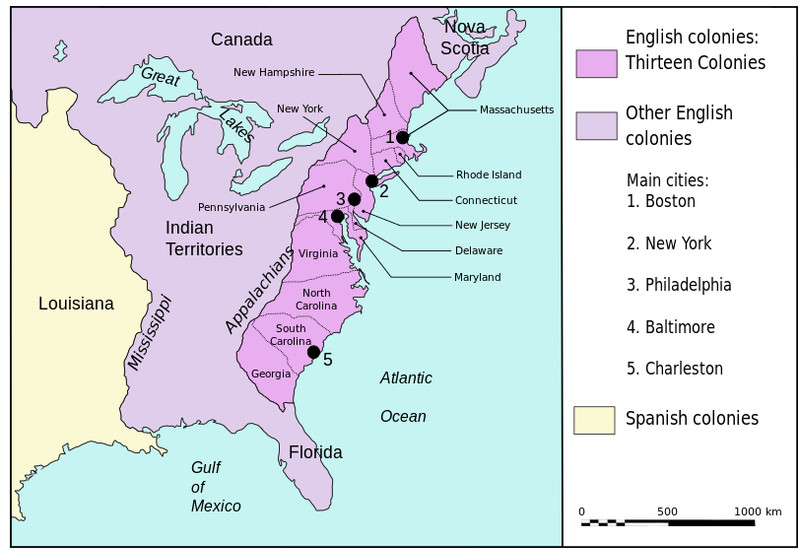
Map of the Thirteen Colonies
For APUSH, the key is connecting geography to economy, labor systems, and local government.
New England
- Rocky soil, short growing season, forests, fisheries, and good harbors encouraged small farms, shipping, and commerce.
- Puritan family migration created compact towns and natural increase.
- Town meetings gave many white male property holders local political power.
- Puritan control led to dissent from Roger Williams and Anne Hutchinson; Rhode Island became known for religious liberty.
- Metacom’s War (King Philip’s War) showed how settler expansion caused brutal Native conflict.
Middle colonies
- New York, New Jersey, Pennsylvania, Delaware
- Fertile soil and rivers supported grain exports and earned the region the “breadbasket” label.
- Strong ethnic and religious diversity
- William Penn made Pennsylvania a major Quaker colony.
- Effect: pluralism and mixed labor systems.
Chesapeake
- Virginia and Maryland built a tobacco economy with dispersed plantations.
- Early labor relied heavily on indentured servants, then shifted toward enslaved Africans.
- Politics included the House of Burgesses and planter-dominated county government.
- Bacon’s Rebellion exposed class tension and frontier anger.
- A 1662 Virginia law made status follow the mother, helping make slavery hereditary.
Lower South
- South Carolina and Georgia grew rice and indigo.
- The region copied the Barbados plantation model.
- Slavery was central early, and enslaved Africans brought important rice-growing knowledge.
- Gullah Geechee culture preserved African traditions.
- Stono Rebellion showed resistance and led to harsher slave laws.
- Effect: the mainland colonies’ most rigid racial and class hierarchy.
Labor, Government, and Culture Across the Colonies
Labor patterns show regional differences clearly:
| Region | Main labor pattern |
|---|---|
| New England | family labor, some slavery in ports |
| Middle colonies | mixed labor system |
| Chesapeake | indentured servitude shifting to slavery |
| Lower South | plantation slavery dominant |
| Spanish colonies | coerced Native labor in missions |
| French colonies | Native trade networks more important |
Because Britain often practiced salutary neglect, colonies had room to run local affairs. The Mayflower Compact, House of Burgesses, and town meetings all show colonial self-government, though participation stayed limited.
Through Anglicization, colonists bought British goods, read British ideas, and used British institutions. The First Great Awakening linked colonies through revival religion, and the Enlightenment spread ideas through print culture. So the colonies became more British and more connected, while keeping strong regional identities.
High-Value Comparison Claims to Memorize
- New England and Chesapeake both had representative government and Atlantic trade, but family farming built towns and local participation in New England, while tobacco built plantations, labor demand, and planter rule in the Chesapeake.
- French and British Native relations both included trade and war, but French fur trade needs encouraged alliances, while British settlement encouraged displacement.
- Lower South and Middle Colonies both used enslaved labor, but slavery organized the lower South far more completely, while the middle colonies stayed more diverse.
