Topic 8.1 Notes – Contextualizing Period 8
How World War II Created the Period 8 United States
Period 8 runs from 1945 to 1980. It opens with the U.S. coming out of World War II as the strongest non-Communist nation and closes with Ronald Reagan’s election.
The war matters because it changed both America’s place in the world and what Americans expected at home.
- The New Deal had already expanded federal power during the Depression. Postwar debates over welfare, regulation, and federal action build on that.
- Reconstruction’s unfinished promises still mattered too. Civil rights activists after 1945 were demanding enforcement of rights that had been promised in the 13th, 14th, and 15th Amendments long before.
World War II gave the U.S. huge advantages:
- Industrial supremacy because American factories produced on a massive scale.
- Atomic bomb possession in 1945 made the U.S. militarily unique for a moment.
- No wartime destruction at home meant U.S. cities, factories, and infrastructure were intact.
- Massive military capacity and a much larger federal bureaucracy stayed in place after the war.
- Expanded federal spending became normal, especially through defense.
At the same time, Europe and Japan were weakened, old empires declined, and decolonization created many new nations. Germany itself was divided into occupation zones, and Berlin was split as well, which helped turn wartime alliance into Cold War rivalry.
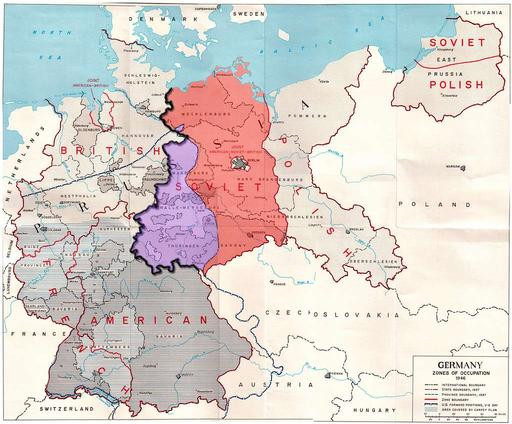
Postwar occupation zones in Germany and Berlin
The Soviet Union also emerged as a superpower. It was a one-party authoritarian state with a state-directed economy and control over Eastern Europe.
That set up the central tension of the period. American power and prosperity created confidence, but they also triggered conflict over race, war, rights, culture, and federal authority.
The Three Big Processes of Period 8
You can organize the whole era around three connected stories.
Cold War global leadership
The U.S. tried to contain communism, build a free-market international order, and create permanent alliances for collective security.
Postwar prosperity and demographic change
Economic growth fueled a bigger middle class, the baby boom, suburbanization, Sun Belt growth, and a shared mass culture shaped by TV and consumer goods.
Civil rights, liberal reform, and backlash
Federal power expanded through civil rights laws and welfare programs. Social movements demanded wider equality, and liberalism drew criticism from both the left and the right.
These are constantly connected. Cold War spending helped Sun Belt growth. TV spread consumer culture and also showed racial violence. Vietnam helped break trust in liberal leaders.
Cold War Leadership and Its Domestic Consequences
The key foreign policy idea was containment. That meant stopping the spread of communism, not invading every Communist country to overthrow it.
Institutions of U.S. leadership:
- Truman Doctrine: aid to nations resisting communism
- Marshall Plan: economic recovery for Western Europe
- NATO: military alliance based on collective security
- United Nations: international cooperation body
- Bretton Woods system: dollar-centered global economic order
Major Cold War markers you should recognize:
- Berlin crises
- Korean War
- nuclear arms race
- Cuban Missile Crisis
- Vietnam War
- détente in the 1970s, meaning reduced tensions, not the end of the Cold War
Decolonization made the rivalry global. Many new nations were nonaligned, but both superpowers often saw local revolutions through a Cold War lens.
At home, the Cold War created a national security state with the CIA, high defense spending, and overseas bases. Eisenhower warned about the military-industrial complex. Anti-Communism also produced civil liberties conflicts through loyalty programs, HUAC, McCarthyism, and the Rosenberg case. By Vietnam, presidents were exercising much more executive power in war-making.
Prosperity, Migration, and Mass Culture After 1945
Prosperity surged because wartime production had ended the Depression, consumers had money to spend, the GI Bill opened college and homeownership, defense spending stayed high, infrastructure expanded, and new technologies boosted productivity. The baby boom increased demand for homes, schools, and goods.
Suburbanization became the classic image of postwar prosperity, with Levittown, highways, FHA and VA mortgages, and cars.
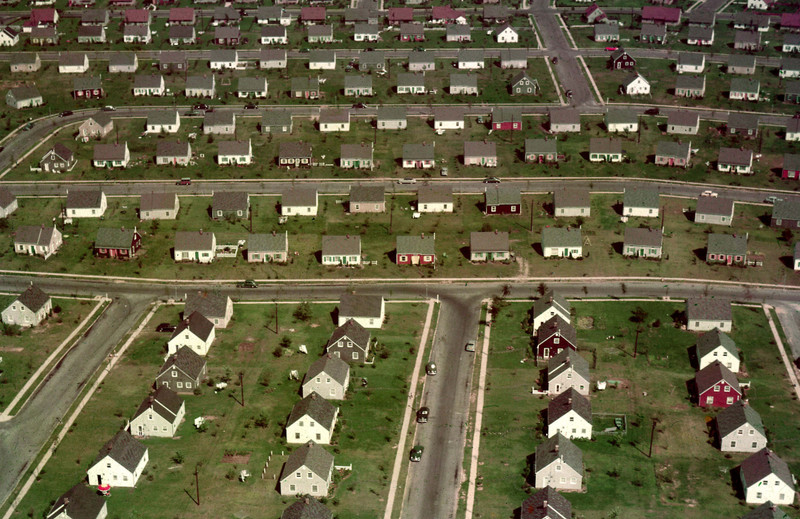
Postwar suburban housing development
Key outcomes fit together:
- middle-class growth
- higher education expansion
- homeownership and consumer culture
- television creating a more uniform national culture
But access was unequal. White flight, redlining, and restrictive covenants shut many Black families out and contributed to urban decline.
Regional change mattered too:
- Great Migration continued
- Sun Belt states like California, Texas, Arizona, and Florida grew fast
- growth came from defense, aerospace, air conditioning, cheap land, and military bases
- the Immigration and Nationality Act of 1965 repealed the old National Origins quota system
Prosperity had limits. Poverty persisted, gains were uneven by race and region, and the 1970s brought oil shocks, inflation, unemployment, and stagflation.
Rights Revolutions, Liberal Reform, and the Backlash
The civil rights movement was the push to finally fulfill Reconstruction-era promises, and the Cold War made segregation embarrassing for a nation claiming to lead the free world.
Key victories:
- Executive Order 8802 barred discrimination in defense jobs
- Truman desegregated the military
- Brown v. Board of Education
- Montgomery Bus Boycott
- Little Rock
- Civil Rights Act of 1964
- Voting Rights Act of 1965
Activists used litigation, boycotts, civil disobedience, mass protest, voter registration, and nonviolent direct action.
Other movements followed that model:
| Movement | Names and anchors |
|---|---|
| Latino | César Chávez, United Farm Workers |
| American Indian | American Indian Movement, Red Power |
| Feminism | Betty Friedan, NOW, ERA, Roe v. Wade |
| LGBTQ+ | Stonewall |
| Environmentalism | Rachel Carson, Earth Day, EPA |
Postwar liberalism peaked with the Warren Court, Great Society, War on Poverty, Medicare, and Medicaid.
The backlash came from multiple directions. The New Left, counterculture, antiwar movement, and Students for a Democratic Society attacked liberalism for moving too slowly and fighting Vietnam. Conservatives built strength through Barry Goldwater, Nixon’s silent majority, Sun Belt conservatism, and evangelical activism. Watergate and Vietnam deepened distrust of government.
