Topic 5.2 Notes – Manifest Destiny
What Manifest Destiny Meant
Manifest Destiny was the belief that the U.S. had a God-given mission and right to expand west. John L. O’Sullivan coined the phrase in 1845 during the debate over annexing Texas, but the idea built on older expansion. The difference in the 1840s was that continental expansion became a central national goal.
This idea bundled several beliefs together:
- American exceptionalism said U.S. institutions were superior and worth spreading.
- Republican government, private property, Protestant Christianity, and capitalism were treated as signs of “civilization.”
- Jefferson’s empire of liberty linked landownership to independent citizens and a healthy republic.
- Nationalism pushed Americans to block British, Mexican, and other foreign influence.
- White racial assumptions let expansionists dismiss Native and Mexican sovereignty.
John Gast’s American Progress captures how supporters imagined that mission, with settlers, farms, transportation, and communications pushing west as Native peoples and bison are driven back.
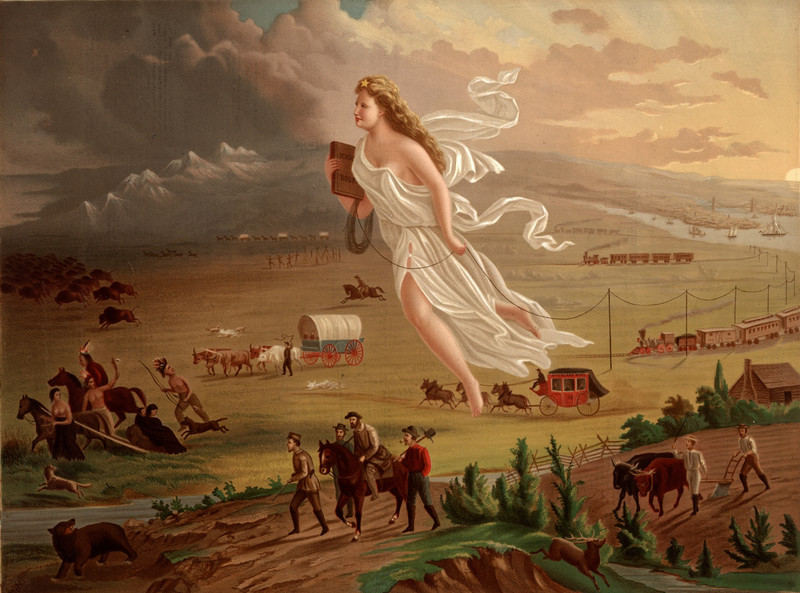
American Progress and Manifest Destiny
Manifest Destiny gave moral cover to expansion, but people also moved for very practical reasons like land, profit, and refuge.
- Democrats, especially James K. Polk, strongly backed expansion.
- Whigs often saw aggressive expansion as dangerous and reckless.
- Antislavery Northerners feared new slave territory.
- Native peoples and Mexicans resisted losing land and self-rule.
Why Americans Moved West
People rarely moved west for one reason. Economic opportunity, resources, religion, and escape from old limits all worked together.
- Cheap, fertile land attracted farmers shut out of eastern land markets.
- Texas drew cotton planters, cattle raisers, and speculators.
- Oregon offered rich farmland, forests, rivers, and Pacific access.
- Timber, grazing land, and gold promised wealth.
- Mormons wanted religious refuge.
- Trade and commerce pulled merchants west.
- Some migrants wanted to escape debt, crowding, and old hierarchies.
Major migrations
- California Gold Rush began after Sutter’s Mill in 1848. The huge wave in 1849 produced the name forty-niners.
- After Joseph Smith’s death, Brigham Young led Mormons to the Great Salt Lake in 1847, where they used irrigation and planned settlement.
Overland routes
These migration routes linked starting points in the Midwest to destinations in Oregon, California, the Great Salt Lake, and Santa Fe.
- Oregon Trail
- California Trail
- Mormon Trail
- Santa Fe Trail
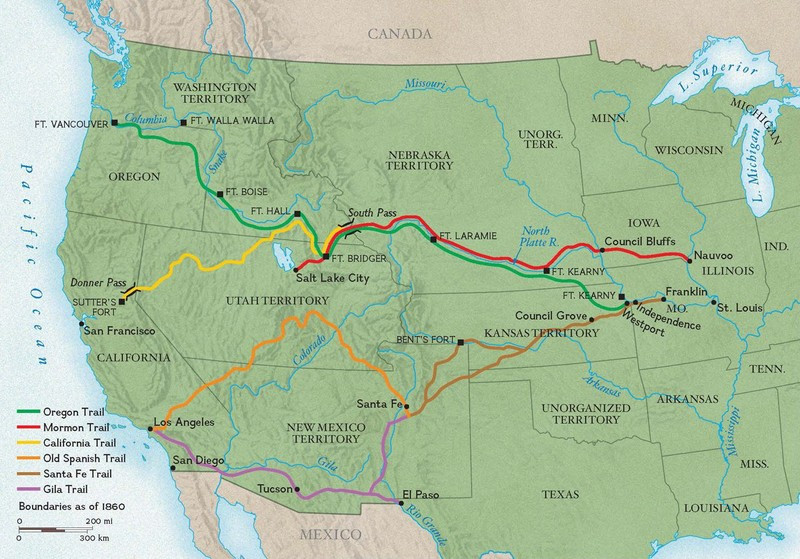
Major overland trails to the West
A common test trap is overplaying Native attacks. On most journeys, the routine dangers were disease, accidents, weather, and shortages.
How the United States Expanded West in the 1840s and 1850s
The main gains came in sequence, and this map helps you see how each addition built the continental United States:
- Texas annexation in 1845
- Oregon Treaty in 1846
- Mexican Cession in 1848
- Gadsden Purchase in 1853
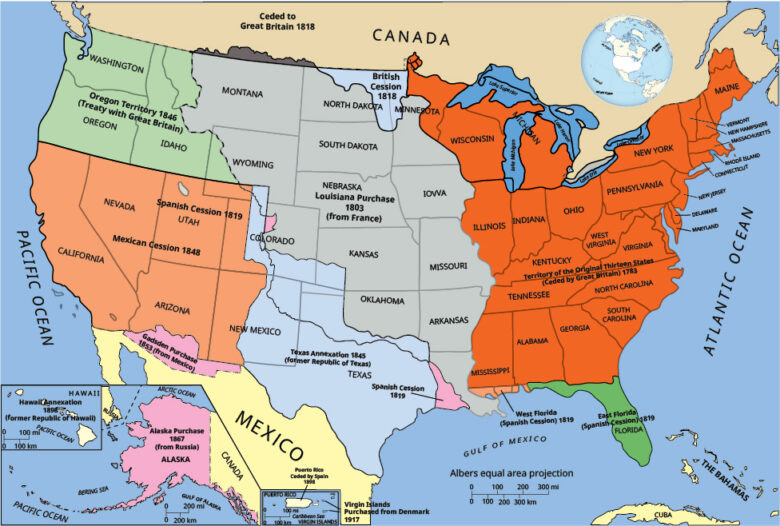
Major U.S. territorial acquisitions
- Texas had been independent from Mexico since 1836. John Tyler annexed it by joint resolution, and many Northerners saw it as pro-slavery expansion. It helped trigger the Mexican-American War.
- Oregon had been jointly occupied by Britain and the U.S. since 1818. “Fifty-four Forty or Fight!” showed expansionist pressure, but Polk compromised at the 49th parallel in the Oregon Treaty. That is the clearest diplomacy example.
- The Mexican Cession gave the U.S. California and much of the Southwest.
- The Gadsden Purchase added land useful for a southern transcontinental railroad.
- California became the clearest resource-driven case. Gold plus U.S. control brought massive migration, San Francisco exploded in growth, and California entered as a free state in 1850, worsening sectional tension.
What Expansion Cost and What It Changed
Expansion meant conflict over who controlled land.
- Native nations already lived on and used western lands. Settlers, miners, ranchers, and railroads disrupted water, game, movement, and treaty lines. U.S. policy moved toward reservations. Native responses included negotiation, adaptation, migration, and armed resistance.
- Mexicans in annexed lands often lost property through fraud, taxes, legal disputes, and violence.
The federal government heavily promoted western growth:
- Homestead Act (1862) gave settlers 160 acres.
- Pacific Railway Acts (1862, 1864) funded the transcontinental railroad. Union Pacific and Central Pacific met at Promontory Summit in 1869. Labor came heavily from Irish and Chinese workers.
- Morrill Land-Grant Act (1862) supported colleges in agriculture and mechanics.
Expansion also tied the U.S. to Asia:
- Treaty of Wangxia (1844) opened trade with China.
- Matthew Perry forced opening with Japan through the Treaty of Kanagawa (1854).
- The U.S. built stronger trade and missionary ties with Hawaii.
- Alaska was bought in 1867 and mocked as “Seward’s Folly.”
Key Takeaways
Manifest Destiny
Mid-19th-century belief that Providence and American superiority destined the United States to expand westward to the Pacific
John L. O’Sullivan
Democratic journalist who coined “Manifest Destiny” in 1845 while advocating the annexation of Texas
American Exceptionalism
Belief that the United States possesses uniquely superior institutions and a special national mission
James K. Polk
Expansionist Democratic president elected in 1844 who pursued American claims to Texas and Oregon and oversaw major territorial acquisition
California Gold Rush
Mass migration after California’s 1848 gold discovery that accelerated settlement, commerce, statehood, environmental damage, and Native dispossession
Forty-Niners
The international wave of gold seekers who migrated to California in 1849
Mormon (Latter-day Saint) Migration
Westward movement of persecuted Latter-day Saints who established a religious refuge in the Great Salt Lake Valley in 1847
Brigham Young
Leader who guided Mormon migrants west and established their settlements in the Great Salt Lake Valley
Oregon Trail
Major overland route carrying migrants from the Missouri River region to farms and settlements in the Pacific Northwest
Santa Fe Trail
Overland trade and migration route connecting Missouri with Santa Fe and the Southwest
Annexation of Texas
The 1845 addition of the former Republic of Texas, which heightened slavery concerns and the boundary dispute with Mexico
John Tyler
President who secured Texas annexation through a joint resolution of Congress shortly before leaving office in 1845
Oregon Country
Resource-rich Pacific Northwest region jointly occupied and claimed by Britain and the United States until 1846
Fifty-Four Forty or Fight!
Expansionist slogan demanding all Oregon territory south of latitude 54°40′ rather than compromise with Britain
Oregon Treaty
The 1846 agreement that peacefully divided Oregon at the 49th parallel while Britain retained Vancouver Island
Mexican Cession
The vast California and Southwestern territory acquired from Mexico in 1848, reopening conflict over slavery’s western expansion
Gadsden Purchase
The 1853 purchase from Mexico of land in southern Arizona and New Mexico suited to a southern railroad route
Reservation Policy
Federal policy that confined Native nations to restricted areas while opening their former lands and resources to non-Native settlement
Free-Labor Ideology
Belief that ordinary people should advance through their own work and gain independent farms or businesses rather than depend on slavery
Homestead Act
The 1862 law offering 160 acres of public land to eligible claimants who lived on and improved it for five years
Pacific Railway Acts
The 1862 and 1864 laws funding a transcontinental railroad through federal loans and large land grants
Transcontinental Railroad
Union Pacific and Central Pacific line completed in 1869 that cut cross-country travel to about a week and integrated western markets
Morrill Land-Grant Act
The 1862 law granting federal land to states to finance colleges teaching agriculture and mechanical arts
Treaty of Wangxia
The 1844 treaty granting the United States trading privileges in China similar to those previously obtained by Britain
Commodore Matthew Perry
American naval officer whose show of force in 1853–1854 pressured Japan to open ports to American ships
Treaty of Kanagawa
The 1854 agreement opening Shimoda and Hakodate to American ships and permitting an American consul in Japan
Alaska Purchase
The 1867 American purchase of Alaska from Russia for $7.2 million, extending expansion and strategic interest in the Pacific
William H. Seward
Secretary of state who negotiated the 1867 purchase of Alaska from Russia
American Progress
John Gast’s 1872 painting portraying westward expansion as civilization and technological progress while Native peoples and bison retreat
Union Pacific vs. Central Pacific
Union Pacific built west with much Irish immigrant labor; Central Pacific built east from California with much Chinese immigrant labor
Hydraulic Mining
Large-scale mining method that washed away hillsides, severely disrupting western landscapes and waterways
Notes
Manifest Destiny
Mid-19th-century belief that Providence and American superiority destined the United States to expand westward to the Pacific
John L. O’Sullivan
Democratic journalist who coined “Manifest Destiny” in 1845 while advocating the annexation of Texas
American Exceptionalism
Belief that the United States possesses uniquely superior institutions and a special national mission
James K. Polk
Expansionist Democratic president elected in 1844 who pursued American claims to Texas and Oregon and oversaw major territorial acquisition
California Gold Rush
Mass migration after California’s 1848 gold discovery that accelerated settlement, commerce, statehood, environmental damage, and Native dispossession
Forty-Niners
The international wave of gold seekers who migrated to California in 1849
Mormon (Latter-day Saint) Migration
Westward movement of persecuted Latter-day Saints who established a religious refuge in the Great Salt Lake Valley in 1847
Brigham Young
Leader who guided Mormon migrants west and established their settlements in the Great Salt Lake Valley
Oregon Trail
Major overland route carrying migrants from the Missouri River region to farms and settlements in the Pacific Northwest
Santa Fe Trail
Overland trade and migration route connecting Missouri with Santa Fe and the Southwest
Annexation of Texas
The 1845 addition of the former Republic of Texas, which heightened slavery concerns and the boundary dispute with Mexico
John Tyler
President who secured Texas annexation through a joint resolution of Congress shortly before leaving office in 1845
Oregon Country
Resource-rich Pacific Northwest region jointly occupied and claimed by Britain and the United States until 1846
Fifty-Four Forty or Fight!
Expansionist slogan demanding all Oregon territory south of latitude 54°40′ rather than compromise with Britain
Oregon Treaty
The 1846 agreement that peacefully divided Oregon at the 49th parallel while Britain retained Vancouver Island
Mexican Cession
The vast California and Southwestern territory acquired from Mexico in 1848, reopening conflict over slavery’s western expansion
Gadsden Purchase
The 1853 purchase from Mexico of land in southern Arizona and New Mexico suited to a southern railroad route
Reservation Policy
Federal policy that confined Native nations to restricted areas while opening their former lands and resources to non-Native settlement
Free-Labor Ideology
Belief that ordinary people should advance through their own work and gain independent farms or businesses rather than depend on slavery
Homestead Act
The 1862 law offering 160 acres of public land to eligible claimants who lived on and improved it for five years
Pacific Railway Acts
The 1862 and 1864 laws funding a transcontinental railroad through federal loans and large land grants
Transcontinental Railroad
Union Pacific and Central Pacific line completed in 1869 that cut cross-country travel to about a week and integrated western markets
Morrill Land-Grant Act
The 1862 law granting federal land to states to finance colleges teaching agriculture and mechanical arts
Treaty of Wangxia
The 1844 treaty granting the United States trading privileges in China similar to those previously obtained by Britain
Commodore Matthew Perry
American naval officer whose show of force in 1853–1854 pressured Japan to open ports to American ships
Treaty of Kanagawa
The 1854 agreement opening Shimoda and Hakodate to American ships and permitting an American consul in Japan
Alaska Purchase
The 1867 American purchase of Alaska from Russia for $7.2 million, extending expansion and strategic interest in the Pacific
William H. Seward
Secretary of state who negotiated the 1867 purchase of Alaska from Russia
American Progress
John Gast’s 1872 painting portraying westward expansion as civilization and technological progress while Native peoples and bison retreat
Union Pacific vs. Central Pacific
Union Pacific built west with much Irish immigrant labor; Central Pacific built east from California with much Chinese immigrant labor
Hydraulic Mining
Large-scale mining method that washed away hillsides, severely disrupting western landscapes and waterways
