Topic 1.3 Notes – European Exploration in the Americas
Why European States Explored and Conquered the Americas
Europeans already traded with Asia, but usually through Muslim and Mediterranean middlemen. That meant spices, silk, and other goods were expensive, and western European kingdoms had less control over profits.
Gold, glory, and God is the shortcut, but each part means something specific:
- Gold meant more than literal gold. Europeans wanted precious metals, spices, direct access to Asian trade, land, tribute, labor, and profitable crops.
- Glory meant competition. Monarchs wanted territory, military advantage, prestige, and tax revenue. Explorers also wanted titles and status.
- God meant spreading Roman Catholic Christianity. After the Reformation, religion also became part of Protestant-Catholic rivalry.
The Ottoman capture of Constantinople in 1453 raised western European interest in alternate routes to Asia. It did not completely cut off trade, which is a common overstatement.
Stronger monarchies could actually fund voyages. Portugal and Spain had centralized governments that could tax, borrow, and sponsor risky expeditions. Private profit and state power worked together.
Spain’s situation in 1492 mattered a lot:
- Ferdinand and Isabella completed the Reconquista by conquering Granada.
- That left Spain with a militant Catholic identity and freed resources for overseas expansion.
- In that same year, they backed Columbus.
The Renaissance helped through mapmaking and curiosity about the world, but on APUSH it is secondary. The main causes are still wealth, power, and religion.
What Made Long-Distance Voyages Possible
Technology explains how exploration happened, not why Europeans wanted it.
| Tool or knowledge | What it helped sailors do |
|---|---|
| Magnetic compass | Keep direction out of sight of land |
| Astrolabe | Estimate latitude using stars |
| Nautical and portolan charts | Navigate coasts, ports, and routes more accurately |
| Sternpost rudder | Steer ships better |
| Square sails | Move fast with favorable winds |
| Lateen sails | Maneuver across wind more effectively |
| Caravel | Small, agile ship suited for exploration |
| Atlantic winds and currents | Use nature to cross oceans more efficiently |
Atlantic wind patterns mattered a lot too. Sailors learned that the trade winds could carry ships south and west, and the westerlies could help bring them back east across the ocean.
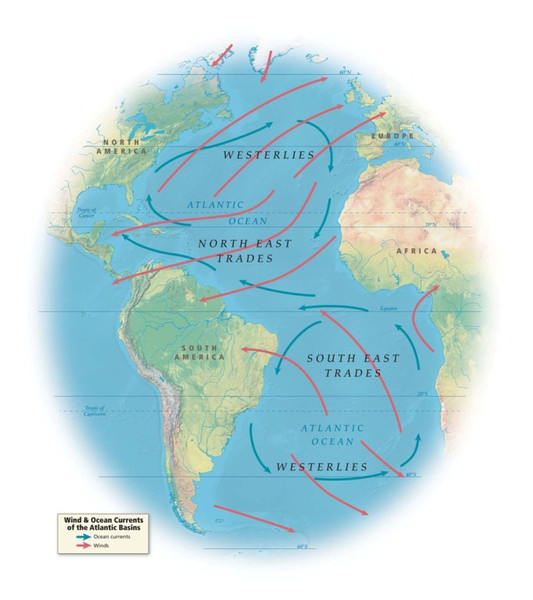
Atlantic winds and currents
The Portuguese used volta do mar, a sailing pattern that went out into the open Atlantic to catch better winds instead of hugging the coast. That sounds less direct, but it often worked better.
This knowledge came from many places, including Mediterranean, Islamic, and Asian traditions. Voyages were still dangerous because of storms, disease, spoiled food, shipwreck, and navigational mistakes.
The Main European Powers and What Each Wanted
All the major powers wanted profit, power, and religious influence. They just pursued those goals in different ways.
Portugal
- Prince Henry the Navigator supported Atlantic and African exploration.
- Portugal wanted West African gold, ivory, spices, ports, Christian influence, and a sea route to Asia.
- Bartolomeu Dias rounded the Cape of Good Hope in 1488.
- Vasco da Gama reached India in 1498.
- Pedro Álvares Cabral claimed Brazil in 1500.
- Portugal first built a network of trading posts and maritime commerce, rather than immediately conquering huge American empires.
Spain
Spain’s early Atlantic push is often tied to Columbus’s 1492 voyage, shown here from Spain to the Caribbean and back.
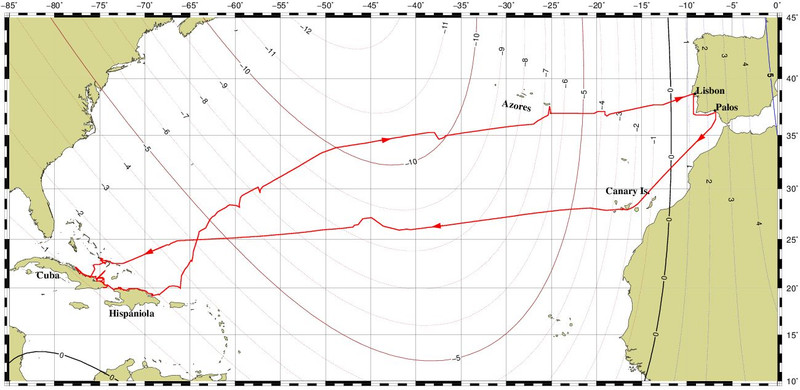
Columbus’s first voyage, 1492 to 1493
- Christopher Columbus sailed west in 1492 under Ferdinand and Isabella with the Niña, Pinta, and Santa María.
- He reached the Bahamas, encountered the Taíno, and claimed San Salvador for Spain.
- Columbus did not prove Earth was round. Educated Europeans already knew that. His mistake was underestimating Earth’s size and thinking he had reached Asia.
- Spanish exploration quickly blended into conquest. Conquistadores wanted wealth, land, titles, and converts.
- Hernán Cortés targeted the Aztec Empire.
- Francisco Pizarro targeted the Inca Empire.
- Juan Ponce de León explored Florida.
- Hernando de Soto explored the Southeast.
- Francisco Vázquez de Coronado explored the Southwest and Great Plains.
France and England
- France sent Jacques Cartier into the St. Lawrence region while searching for a Northwest Passage.
- French interests centered on fisheries, the fur trade, beaver pelts, and alliances with Native peoples.
- England based later claims partly on John Cabot’s 1497 voyage.
- English motives included a Northwest Passage, fisheries, land, settlement, and rivalry with Spain.
- Under Elizabeth I, Francis Drake practiced privateering, attacking Spanish shipping with state approval.
- Roanoke showed that early English colonization attempts could fail.
How Exploration Turned into Imperial Rivalry and Conquest
Columbus’s journal shows the motives clearly. He noticed cotton, parrots, trade goods, and resources. He also noted that the Taíno lacked iron weapons and suggested they could be subdued and made to serve Spanish goals. You can see wealth, conversion, and conquest operating together from the start.
Exploration already meant more than “finding” places. Europeans were mapping coasts, claiming land, judging resources, and reporting on Native societies in ways that prepared for conquest.
Treaty of Tordesillas
In 1494, Spain and Portugal divided overseas claims with an imaginary Atlantic line, shown here with later boundary lines that extended the same basic idea across the globe.
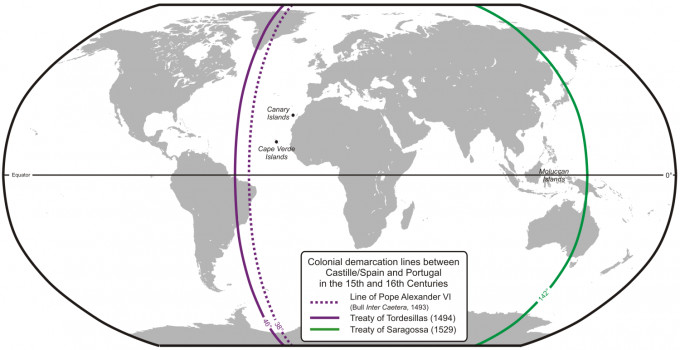
Treaty of Tordesillas world map
- Portugal got Brazil and eastern sea routes.
- Spain got most lands to the west.
- The treaty ignored Native sovereignty completely.
France and England rejected this Iberian monopoly, which widened imperial competition in North America. One successful voyage led to more voyages, more claims, and more rivalry by 1607.
Key Takeaways
Gold, Glory, and God
Summary of Europe’s motives: wealth and trade, national and personal power, and the spread of Christianity
Ottoman Conquest of Constantinople (1453)
Ottoman control and costly trade through intermediaries strengthened western Europe’s search for direct sea routes to Asia
Reconquista
Centuries-long Christian reconquest of Muslim-ruled Iberia, completed at Granada in 1492, which strengthened Spain’s militant Catholic expansion
Ferdinand of Aragon and Isabella of Castile
Spanish monarchs who completed the Reconquista and sponsored Columbus’s 1492 voyage in pursuit of trade, converts, and imperial power
Renaissance
Revival of geographical study, mapmaking, and worldly inquiry that aided exploration, though wealth, rivalry, and religion were more direct causes
Magnetic Compass
Navigational instrument that helped sailors maintain direction when landmarks were not visible
Astrolabe
Instrument mariners used to estimate latitude by observing celestial bodies
Portolan Charts
Nautical charts recording coastlines, ports, and sailing directions for mariners
Sternpost Rudder
Ship-mounted rudder that improved steering and control during ocean voyages
Caravel
Small, maneuverable Portuguese sailing ship suited to coastal exploration and unfamiliar waters
Volta do Mar
Portuguese navigation method of turning into the open Atlantic to use favorable winds and currents instead of hugging the coast
Prince Henry the Navigator
Portuguese prince whose sponsorship supported exploration of Atlantic islands and the western African coast
Bartolomeu Dias
Portuguese explorer who rounded southern Africa in 1488, proving a sea connection between the Atlantic and Indian oceans
Vasco da Gama
Portuguese explorer who reached India by sailing around Africa in 1498, establishing Portugal’s eastern sea route to Asia
Pedro Álvares Cabral
Portuguese explorer who reached and claimed the coast of present-day Brazil for Portugal in 1500
Portuguese Exploration Strategy
Pursuit of African gold, an eastern sea route to Asia, fortified trading posts, maritime commerce, Christianity, and Brazil
Christopher Columbus
Genoese mariner sponsored by Spain who sailed west in 1492, reached the Bahamas, and initiated sustained European contact with the Americas
Treaty of Tordesillas (1494)
Agreement dividing Spanish and Portuguese claims along an Atlantic line; Portugal received claim rights east of it, including the territory that became Brazil, while Spain claimed most lands to the west
Spanish Exploration Strategy
Pursuit of precious metals, territory, converts, tribute, and labor through royal claims and conquest of populous Native empires
Conquistadores
Spanish conquerors who combined private initiative with royal authorization to seek wealth, status, land, converts, and imperial expansion
Hernán Cortés
Spanish conquistador who entered Mexico in 1519 and led the campaign that defeated the Aztec Empire in 1521
Francisco Pizarro
Spanish conquistador who began the conquest of the Inca Empire in 1532 in pursuit of wealth and Spanish power
Juan Ponce de León
Spanish explorer who explored and claimed Florida in 1513 while seeking land, wealth, status, and royal authority
Hernando de Soto
Spanish explorer who traveled through the Southeast beginning in 1539 searching for wealth and extending Spanish knowledge and claims
Francisco Vázquez de Coronado
Spanish explorer who crossed parts of the Southwest and Great Plains from 1540 to 1542 while searching for wealthy lands
Protestant Reformation
Religious movement beginning in 1517 that intensified overseas competition between Protestant and Catholic powers for territory, trade, and converts
Northwest Passage
Hoped-for water route through or around North America that Europeans sought as a western connection to Asian markets
Jacques Cartier
French explorer who traveled through the Gulf and River of St. Lawrence in the 1530s and claimed northeastern territory for France
French Exploration Strategy
Search for a route to Asia followed by emphasis on Atlantic fisheries, the fur trade, and alliances with Native trading partners
John Cabot (Giovanni Caboto)
Italian navigator sailing for Henry VII who reached northeastern North America in 1497 and supported later English claims
Privateering
State-authorized raiding by privately owned ships against enemy shipping and settlements for strategic and commercial gain
Francis Drake
English privateer whose 1577–1580 circumnavigation and attacks on Spanish interests enriched England and demonstrated its maritime power
English Exploration Strategy
Search for Asian trade routes, fisheries, land, and Atlantic bases while Protestant England challenged Spanish power and pursued settlement
Square Sails
Sails that increased a ship’s speed when traveling with the wind
Lateen Sails
Triangular sails that improved maneuverability and allowed ships to sail across or partly against the wind
Political Centralization
The growing ability of monarchies to tax, mobilize resources, and sponsor expensive overseas voyages
Notes
Gold, Glory, and God
Summary of Europe’s motives: wealth and trade, national and personal power, and the spread of Christianity
Ottoman Conquest of Constantinople (1453)
Ottoman control and costly trade through intermediaries strengthened western Europe’s search for direct sea routes to Asia
Reconquista
Centuries-long Christian reconquest of Muslim-ruled Iberia, completed at Granada in 1492, which strengthened Spain’s militant Catholic expansion
Ferdinand of Aragon and Isabella of Castile
Spanish monarchs who completed the Reconquista and sponsored Columbus’s 1492 voyage in pursuit of trade, converts, and imperial power
Renaissance
Revival of geographical study, mapmaking, and worldly inquiry that aided exploration, though wealth, rivalry, and religion were more direct causes
Magnetic Compass
Navigational instrument that helped sailors maintain direction when landmarks were not visible
Astrolabe
Instrument mariners used to estimate latitude by observing celestial bodies
Portolan Charts
Nautical charts recording coastlines, ports, and sailing directions for mariners
Sternpost Rudder
Ship-mounted rudder that improved steering and control during ocean voyages
Caravel
Small, maneuverable Portuguese sailing ship suited to coastal exploration and unfamiliar waters
Volta do Mar
Portuguese navigation method of turning into the open Atlantic to use favorable winds and currents instead of hugging the coast
Prince Henry the Navigator
Portuguese prince whose sponsorship supported exploration of Atlantic islands and the western African coast
Bartolomeu Dias
Portuguese explorer who rounded southern Africa in 1488, proving a sea connection between the Atlantic and Indian oceans
Vasco da Gama
Portuguese explorer who reached India by sailing around Africa in 1498, establishing Portugal’s eastern sea route to Asia
Pedro Álvares Cabral
Portuguese explorer who reached and claimed the coast of present-day Brazil for Portugal in 1500
Portuguese Exploration Strategy
Pursuit of African gold, an eastern sea route to Asia, fortified trading posts, maritime commerce, Christianity, and Brazil
Christopher Columbus
Genoese mariner sponsored by Spain who sailed west in 1492, reached the Bahamas, and initiated sustained European contact with the Americas
Treaty of Tordesillas (1494)
Agreement dividing Spanish and Portuguese claims along an Atlantic line; Portugal received claim rights east of it, including the territory that became Brazil, while Spain claimed most lands to the west
Spanish Exploration Strategy
Pursuit of precious metals, territory, converts, tribute, and labor through royal claims and conquest of populous Native empires
Conquistadores
Spanish conquerors who combined private initiative with royal authorization to seek wealth, status, land, converts, and imperial expansion
Hernán Cortés
Spanish conquistador who entered Mexico in 1519 and led the campaign that defeated the Aztec Empire in 1521
Francisco Pizarro
Spanish conquistador who began the conquest of the Inca Empire in 1532 in pursuit of wealth and Spanish power
Juan Ponce de León
Spanish explorer who explored and claimed Florida in 1513 while seeking land, wealth, status, and royal authority
Hernando de Soto
Spanish explorer who traveled through the Southeast beginning in 1539 searching for wealth and extending Spanish knowledge and claims
Francisco Vázquez de Coronado
Spanish explorer who crossed parts of the Southwest and Great Plains from 1540 to 1542 while searching for wealthy lands
Protestant Reformation
Religious movement beginning in 1517 that intensified overseas competition between Protestant and Catholic powers for territory, trade, and converts
Northwest Passage
Hoped-for water route through or around North America that Europeans sought as a western connection to Asian markets
Jacques Cartier
French explorer who traveled through the Gulf and River of St. Lawrence in the 1530s and claimed northeastern territory for France
French Exploration Strategy
Search for a route to Asia followed by emphasis on Atlantic fisheries, the fur trade, and alliances with Native trading partners
John Cabot (Giovanni Caboto)
Italian navigator sailing for Henry VII who reached northeastern North America in 1497 and supported later English claims
Privateering
State-authorized raiding by privately owned ships against enemy shipping and settlements for strategic and commercial gain
Francis Drake
English privateer whose 1577–1580 circumnavigation and attacks on Spanish interests enriched England and demonstrated its maritime power
English Exploration Strategy
Search for Asian trade routes, fisheries, land, and Atlantic bases while Protestant England challenged Spanish power and pursued settlement
Square Sails
Sails that increased a ship’s speed when traveling with the wind
Lateen Sails
Triangular sails that improved maneuverability and allowed ships to sail across or partly against the wind
Political Centralization
The growing ability of monarchies to tax, mobilize resources, and sponsor expensive overseas voyages
