Topic 4.11 Notes – An Age of Reform
Why Reform Took Off from 1800 to 1848
This era produced a reform mindset. People increasingly thought social problems were not permanent. They could be fixed through organized effort.
The Second Great Awakening gave that idea emotional power. Evangelical Protestants stressed free will, personal salvation, moral responsibility, and perfectionism, the belief that people could move closer to moral perfection. That turned religion outward. Saving your own soul was not enough if society stayed sinful.
The market revolution made reform feel urgent. Urbanization, migration, wage labor, and growing inequality broke up older face-to-face communities. Reformers connected those changes to drinking, poverty, crime, and family instability.
Democratic and Revolutionary language mattered too. If Americans claimed to believe in equality and natural rights, reformers asked why slavery, women’s inequality, and social abuse still existed.
Reform was strongest in the Northeast and Old Northwest, where print networks, towns, churches, and voluntary groups were strongest. It was weaker in the South, where slavery and hostility to abolition shut down much organized reform.
Most reform happened through voluntary associations, not the federal government. Common methods included:
- Moral suasion: persuading people that a behavior or institution was sinful.
- Petitions to legislatures and Congress.
- Pamphlets, newspapers, sermons, autobiographies, broadsides to spread ideas fast.
- Lecture circuits and revival-style meetings to build mass support.
- Boycotts, fairs, fundraising, local chapters to organize ordinary people.
- Conventions and declarations to state common goals.
- Experimental communities to model a different society.
- Political action through antislavery parties when persuasion seemed too weak.
Major Reform Movements
Different movements tried to fix different problems, but all came from the same belief in improvement.
Temperance
The American Temperance Society formed in 1826. It first pushed moderation, then moved toward total abstinence. Reformers linked alcohol to poverty, crime, domestic violence, and family breakdown.
Women were heavily involved because a husband’s drinking could destroy a household. Temperance campaigns often used images of a drinker’s downward path into ruin, like this broadside. The Washingtonian movement in 1840 used testimony and mutual aid from recovering alcoholics.
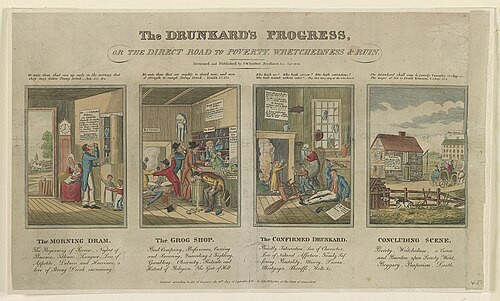
Temperance broadside, “The Drunkard’s Progress”
Education
The common school movement wanted free, tax-supported public elementary schools. Schools were supposed to create literate, disciplined republican citizens.
Horace Mann pushed better buildings, longer school terms, trained teachers, graded classrooms, and normal schools for teacher training. McGuffey Readers taught reading along with morality, patriotism, obedience, and self-control.
Women’s education expanded through Emma Willard’s Troy Female Seminary, Mary Lyon’s Mount Holyoke, and Oberlin College, which admitted women and African American students. Specialized schools included Thomas Gallaudet’s American School for the Deaf and Samuel Gridley Howe’s Perkins School for the Blind.
Prisons and asylums
Reformers wanted penitentiaries to rehabilitate, not just punish. The Pennsylvania system at Eastern State Penitentiary used solitary confinement. The Auburn system used silent group labor by day and isolation at night.
Dorothea Dix exposed abuse of the mentally ill and pushed states to fund hospitals. Her idea of moral treatment emphasized humane care, order, and routine.
Utopian and religious communities
Some reformers tried to build ideal societies from scratch.
- Shakers: communal property, celibacy, simple living, spiritual equality.
- Robert Owen’s New Harmony in Indiana: cooperative labor and communal life.
- Brook Farm in Massachusetts: transcendentalism plus cooperative labor.
- Oneida Community founded by John Humphrey Noyes in 1848: perfectionism and complex marriage.
- Church of Jesus Christ of Latter-day Saints: Joseph Smith, the Book of Mormon, Nauvoo, mob violence, then Brigham Young’s westward migration.
Antislavery and Abolition
Antislavery grew out of earlier northern emancipation and became much more radical by the 1830s.
Northern states gradually ended slavery. Pennsylvania began in 1780, and New York completed emancipation in 1827. This increased the free Black population, which built churches, schools, newspapers, mutual-aid societies, and conventions. They still faced segregation, discrimination, and voting restrictions.
The American Colonization Society founded in 1816 promoted migration to Liberia. Most free African Americans rejected it because they saw the U.S. as their home.
Around 1830, immediate abolition emerged.
- David Walker’s Appeal attacked slavery and American hypocrisy.
- William Lloyd Garrison started The Liberator in 1831 and helped found the American Anti-Slavery Society in 1833.
- Frederick Douglass published the Narrative of the Life of Frederick Douglass and later the North Star.
- Sarah and Angelina Grimké tied abolition to women’s activism.
- Theodore Dwight Weld published American Slavery as It Is.
- The Underground Railroad was a loose network, not one central organization.
Backlash was intense. The House gag rule of 1836 blocked antislavery petitions until John Quincy Adams helped win repeal in 1844. The Liberty Party in 1840 showed a shift from moral suasion to electoral politics. In 1837, an anti-abolition mob killed Elijah Lovejoy.
A major test point is this distinction. Many Northerners were antislavery but did not support immediate abolition or racial equality.
Women’s Rights and the Legacy of Reform
Women gained organizing experience in reform even though separate spheres ideology said their place was the home. Coverture left married women without full legal identity, property control, or political rights.
Lucretia Mott and Elizabeth Cady Stanton were excluded at the 1840 World Anti-Slavery Convention. That helped push them toward a separate women’s rights movement.
The Seneca Falls Convention in 1848, organized by Stanton, Mott, Martha Coffin Wright, Mary Ann M’Clintock, and Jane Hunt, produced the Declaration of Sentiments, modeled on the Declaration of Independence. The opening language, shown here, echoes Jefferson’s words and revises them to say that “all men and women are created equal.” It demanded equality in voting, property, education, religion, employment, and law. Frederick Douglass supported woman suffrage.
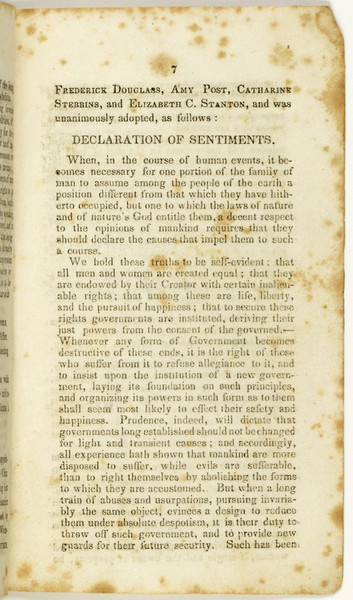
Declaration of Sentiments, 1848
The New York Married Women’s Property Act of 1848 gave married women greater control over property.
Reform movements overlapped constantly in people, methods, and ideas. Some challenged hierarchy directly, especially abolition and women’s rights. Others imposed Protestant middle-class discipline. By 1848, reform had not solved major inequalities, but it created lasting tools of activism and made slavery and women’s rights national issues.
Key Takeaways
Age of Reform
The proliferation of organized efforts from 1800 to 1848 to improve individuals, institutions, and society
Second Great Awakening
Protestant revival movement emphasizing free will and individual salvation that inspired efforts to overcome sin and reform society
Benevolent Empire
Interconnected network of Protestant missionary, temperance, educational, and moral-reform societies
Voluntary Associations
Privately organized groups that used dues, publications, lectures, petitions, and local chapters to pursue reform
Moral Suasion
Persuading individuals and the public that a practice was sinful or unjust and should be voluntarily abandoned
Market Revolution
Economic transformation that created social disruption and inequality while supplying reformers with transportation, printing, and middle-class resources
Enlightenment Rationalism
Confidence in human reason and the possibility of deliberately redesigning flawed institutions
Romanticism
Intellectual movement emphasizing emotion, individual potential, conscience, and resistance to corrupt conventions
Transcendentalism
Movement stressing individual conscience, human potential, and spiritual truth beyond established institutions
Separate Spheres
Ideology assigning men to public economic and political life and women to the domestic, religious, and moral sphere
Temperance Movement
Campaign against alcohol consumption that increasingly demanded total abstinence and linked drinking to poverty, violence, and disorder
American Temperance Society
Organization founded in 1826 that built a national temperance movement through local societies, publications, meetings, and abstinence pledges
Washingtonian Movement
Temperance movement founded in Baltimore in 1840 that used mutual support and testimony from working-class men recovering from alcoholism
Common School Movement
Campaign for free, tax-supported elementary schools intended to create literate, disciplined, and responsible citizens
Horace Mann
Massachusetts education reformer who promoted longer terms, graded instruction, better buildings, trained teachers, and common schools
Normal Schools
Schools established to provide professional training for teachers
McGuffey Readers
Widely used schoolbooks combining literacy lessons with Protestant-inflected teachings about industry, obedience, self-control, and patriotism
Emma Willard
Women’s education reformer who founded Troy Female Seminary in 1821 to offer women advanced academic study
Mary Lyon
Women’s education reformer who opened Mount Holyoke Female Seminary in 1837
Oberlin College
College notable for admitting women to its collegiate program in 1837 and for admitting African American students
Thomas Hopkins Gallaudet
Education reformer who helped establish the American School for the Deaf in Hartford in 1817
Samuel Gridley Howe
Education reformer who directed Massachusetts’s Perkins School for the Blind
Penitentiary
Prison designed to produce penitence and rehabilitation through confinement, labor, discipline, and reflection
Pennsylvania System vs. Auburn System
Pennsylvania used continuous solitary confinement; Auburn isolated prisoners at night but required silent group labor by day
Dorothea Dix
Reformer who documented abuse of people with mental illness and persuaded states to fund specialized, humane hospitals
Moral Treatment
Asylum approach using orderly surroundings, regular work, calm routines, and humane supervision to encourage recovery
Utopian Communities
Experimental settlements intended to create ideal cooperative, religious, or economic alternatives to mainstream society
Shakers / United Society of Believers in Christ’s Second Appearing
Religious communities practicing communal property, celibacy, disciplined labor, simple living, and unusual spiritual equality for women
Robert Owen
British industrialist and secular reformer who founded New Harmony to replace competition and inequality with cooperation and education
New Harmony
Robert Owen’s 1825 Indiana community based on communal property, cooperative labor, and education; it soon collapsed from conflict and economic problems
George Ripley
Transcendentalist who led the founding of Brook Farm in Massachusetts in 1841
Brook Farm
Transcendentalist community combining intellectual development with cooperative labor; financial problems and a fire helped end it in 1847
John Humphrey Noyes
Religious perfectionist who founded the Oneida Community and taught that genuine conversion could free believers from sin
Perfectionism
Doctrine that genuine conversion could free believers from sin and permit the creation of a perfected community
Oneida Community
Noyes’s 1848 New York community practicing communal ownership and regulated complex marriage instead of conventional monogamy
Church of Jesus Christ of Latter-day Saints
Religious movement organized in 1830 around new scripture and close communities whose beliefs and political influence provoked intense hostility
Joseph Smith
Founder of the Latter-day Saints who published the Book of Mormon, organized the church in 1830, and was killed by a mob in 1844
Brigham Young
Latter-day Saint leader who led many church members west beginning in 1846–1847 after Joseph Smith’s death
Antislavery vs. Abolitionism
Antislavery meant opposition to slavery in some form; abolitionism specifically sought slavery’s elimination
Gradual Emancipation
Northern process that ended slavery over time, often after long terms of service, increasing the free Black population while leaving it subject to severe discrimination
Fugitive Slave Act of 1793
Federal law requiring the return of people claimed as fugitives and exposing free African Americans to kidnapping
American Colonization Society
Organization founded in 1816 to send free African Americans to Africa, helping establish Liberia but drawing strong Black opposition
Immediate Abolitionism
Demand that emancipation begin at once without a prolonged transition or compensation to enslavers
David Walker
Black abolitionist whose 1829 Appeal condemned slavery and racial hypocrisy using Christian and Revolutionary principles
Appeal to the Coloured Citizens of the World
David Walker’s 1829 pamphlet denouncing slavery and exposing the contradiction between American ideals and racial oppression
William Lloyd Garrison
Immediate abolitionist who published The Liberator, helped found the American Anti-Slavery Society, and denounced slavery as a moral sin
The Liberator
Immediate-abolitionist newspaper begun by William Lloyd Garrison in Boston in 1831
American Anti-Slavery Society
Organization founded in 1833 that promoted immediate abolition through lecturers, petitions, local chapters, and mass publication
Frederick Douglass
Formerly enslaved abolitionist lecturer, author, and editor whose testimony exposed slavery and refuted claims of Black inferiority
Narrative of the Life of Frederick Douglass
Douglass’s 1845 autobiography exposing slavery’s violence, family destruction, denial of literacy, and corruption of enslavers
The North Star
Antislavery newspaper Frederick Douglass began publishing in 1847
Sarah and Angelina Grimké
South Carolina sisters who became abolitionist lecturers and connected opposition to slavery with criticism of women’s subordination
Theodore Dwight Weld
Abolitionist organizer who, with the Grimké sisters, compiled southern evidence of slavery’s brutality in American Slavery as It Is
American Slavery as It Is
1839 abolitionist work using southern newspapers’ own advertisements and reports as evidence of slavery’s violence and family separation
Underground Railroad
Decentralized network of routes, homes, churches, guides, and antislavery groups that assisted people escaping slavery
Gag Rule
House rule beginning in 1836 that automatically tabled antislavery petitions without discussion; it was repealed in 1844
John Quincy Adams
Former president and Massachusetts representative who led the congressional campaign against the antislavery gag rule
Liberty Party
Antislavery political party founded in 1840 by abolitionists who believed elections were necessary because moral suasion was insufficient
Elijah Lovejoy
Antislavery newspaper editor killed by an Illinois mob in 1837 while defending his printing press
Coverture
Legal doctrine incorporating a married woman’s identity into her husband’s and limiting her control of property, contracts, and wages
World Anti-Slavery Convention
1840 London meeting where women delegates were denied full participation and where Lucretia Mott and Elizabeth Cady Stanton met
Lucretia Mott
Quaker abolitionist and women’s rights leader who helped organize the Seneca Falls Convention after facing exclusion in abolitionism
Elizabeth Cady Stanton
Women’s rights leader who helped organize Seneca Falls and draft its Declaration of Sentiments
Seneca Falls Convention
First widely recognized public women’s rights convention, held in New York in 1848, which adopted the Declaration of Sentiments
Declaration of Sentiments
Seneca Falls document declaring that all men and women are created equal and demanding reforms including woman suffrage
New York Married Women’s Property Act
1848 law granting married women greater control over property they brought into marriage, weakening but not ending coverture
Women’s Rights Movement
Reform movement that grew from women’s religious, temperance, and abolitionist work and sought legal, educational, economic, and political equality
Notes
Age of Reform
The proliferation of organized efforts from 1800 to 1848 to improve individuals, institutions, and society
Second Great Awakening
Protestant revival movement emphasizing free will and individual salvation that inspired efforts to overcome sin and reform society
Benevolent Empire
Interconnected network of Protestant missionary, temperance, educational, and moral-reform societies
Voluntary Associations
Privately organized groups that used dues, publications, lectures, petitions, and local chapters to pursue reform
Moral Suasion
Persuading individuals and the public that a practice was sinful or unjust and should be voluntarily abandoned
Market Revolution
Economic transformation that created social disruption and inequality while supplying reformers with transportation, printing, and middle-class resources
Enlightenment Rationalism
Confidence in human reason and the possibility of deliberately redesigning flawed institutions
Romanticism
Intellectual movement emphasizing emotion, individual potential, conscience, and resistance to corrupt conventions
Transcendentalism
Movement stressing individual conscience, human potential, and spiritual truth beyond established institutions
Separate Spheres
Ideology assigning men to public economic and political life and women to the domestic, religious, and moral sphere
Temperance Movement
Campaign against alcohol consumption that increasingly demanded total abstinence and linked drinking to poverty, violence, and disorder
American Temperance Society
Organization founded in 1826 that built a national temperance movement through local societies, publications, meetings, and abstinence pledges
Washingtonian Movement
Temperance movement founded in Baltimore in 1840 that used mutual support and testimony from working-class men recovering from alcoholism
Common School Movement
Campaign for free, tax-supported elementary schools intended to create literate, disciplined, and responsible citizens
Horace Mann
Massachusetts education reformer who promoted longer terms, graded instruction, better buildings, trained teachers, and common schools
Normal Schools
Schools established to provide professional training for teachers
McGuffey Readers
Widely used schoolbooks combining literacy lessons with Protestant-inflected teachings about industry, obedience, self-control, and patriotism
Emma Willard
Women’s education reformer who founded Troy Female Seminary in 1821 to offer women advanced academic study
Mary Lyon
Women’s education reformer who opened Mount Holyoke Female Seminary in 1837
Oberlin College
College notable for admitting women to its collegiate program in 1837 and for admitting African American students
Thomas Hopkins Gallaudet
Education reformer who helped establish the American School for the Deaf in Hartford in 1817
Samuel Gridley Howe
Education reformer who directed Massachusetts’s Perkins School for the Blind
Penitentiary
Prison designed to produce penitence and rehabilitation through confinement, labor, discipline, and reflection
Pennsylvania System vs. Auburn System
Pennsylvania used continuous solitary confinement; Auburn isolated prisoners at night but required silent group labor by day
Dorothea Dix
Reformer who documented abuse of people with mental illness and persuaded states to fund specialized, humane hospitals
Moral Treatment
Asylum approach using orderly surroundings, regular work, calm routines, and humane supervision to encourage recovery
Utopian Communities
Experimental settlements intended to create ideal cooperative, religious, or economic alternatives to mainstream society
Shakers / United Society of Believers in Christ’s Second Appearing
Religious communities practicing communal property, celibacy, disciplined labor, simple living, and unusual spiritual equality for women
Robert Owen
British industrialist and secular reformer who founded New Harmony to replace competition and inequality with cooperation and education
New Harmony
Robert Owen’s 1825 Indiana community based on communal property, cooperative labor, and education; it soon collapsed from conflict and economic problems
George Ripley
Transcendentalist who led the founding of Brook Farm in Massachusetts in 1841
Brook Farm
Transcendentalist community combining intellectual development with cooperative labor; financial problems and a fire helped end it in 1847
John Humphrey Noyes
Religious perfectionist who founded the Oneida Community and taught that genuine conversion could free believers from sin
Perfectionism
Doctrine that genuine conversion could free believers from sin and permit the creation of a perfected community
Oneida Community
Noyes’s 1848 New York community practicing communal ownership and regulated complex marriage instead of conventional monogamy
Church of Jesus Christ of Latter-day Saints
Religious movement organized in 1830 around new scripture and close communities whose beliefs and political influence provoked intense hostility
Joseph Smith
Founder of the Latter-day Saints who published the Book of Mormon, organized the church in 1830, and was killed by a mob in 1844
Brigham Young
Latter-day Saint leader who led many church members west beginning in 1846–1847 after Joseph Smith’s death
Antislavery vs. Abolitionism
Antislavery meant opposition to slavery in some form; abolitionism specifically sought slavery’s elimination
Gradual Emancipation
Northern process that ended slavery over time, often after long terms of service, increasing the free Black population while leaving it subject to severe discrimination
Fugitive Slave Act of 1793
Federal law requiring the return of people claimed as fugitives and exposing free African Americans to kidnapping
American Colonization Society
Organization founded in 1816 to send free African Americans to Africa, helping establish Liberia but drawing strong Black opposition
Immediate Abolitionism
Demand that emancipation begin at once without a prolonged transition or compensation to enslavers
David Walker
Black abolitionist whose 1829 Appeal condemned slavery and racial hypocrisy using Christian and Revolutionary principles
Appeal to the Coloured Citizens of the World
David Walker’s 1829 pamphlet denouncing slavery and exposing the contradiction between American ideals and racial oppression
William Lloyd Garrison
Immediate abolitionist who published The Liberator, helped found the American Anti-Slavery Society, and denounced slavery as a moral sin
The Liberator
Immediate-abolitionist newspaper begun by William Lloyd Garrison in Boston in 1831
American Anti-Slavery Society
Organization founded in 1833 that promoted immediate abolition through lecturers, petitions, local chapters, and mass publication
Frederick Douglass
Formerly enslaved abolitionist lecturer, author, and editor whose testimony exposed slavery and refuted claims of Black inferiority
Narrative of the Life of Frederick Douglass
Douglass’s 1845 autobiography exposing slavery’s violence, family destruction, denial of literacy, and corruption of enslavers
The North Star
Antislavery newspaper Frederick Douglass began publishing in 1847
Sarah and Angelina Grimké
South Carolina sisters who became abolitionist lecturers and connected opposition to slavery with criticism of women’s subordination
Theodore Dwight Weld
Abolitionist organizer who, with the Grimké sisters, compiled southern evidence of slavery’s brutality in American Slavery as It Is
American Slavery as It Is
1839 abolitionist work using southern newspapers’ own advertisements and reports as evidence of slavery’s violence and family separation
Underground Railroad
Decentralized network of routes, homes, churches, guides, and antislavery groups that assisted people escaping slavery
Gag Rule
House rule beginning in 1836 that automatically tabled antislavery petitions without discussion; it was repealed in 1844
John Quincy Adams
Former president and Massachusetts representative who led the congressional campaign against the antislavery gag rule
Liberty Party
Antislavery political party founded in 1840 by abolitionists who believed elections were necessary because moral suasion was insufficient
Elijah Lovejoy
Antislavery newspaper editor killed by an Illinois mob in 1837 while defending his printing press
Coverture
Legal doctrine incorporating a married woman’s identity into her husband’s and limiting her control of property, contracts, and wages
World Anti-Slavery Convention
1840 London meeting where women delegates were denied full participation and where Lucretia Mott and Elizabeth Cady Stanton met
Lucretia Mott
Quaker abolitionist and women’s rights leader who helped organize the Seneca Falls Convention after facing exclusion in abolitionism
Elizabeth Cady Stanton
Women’s rights leader who helped organize Seneca Falls and draft its Declaration of Sentiments
Seneca Falls Convention
First widely recognized public women’s rights convention, held in New York in 1848, which adopted the Declaration of Sentiments
Declaration of Sentiments
Seneca Falls document declaring that all men and women are created equal and demanding reforms including woman suffrage
New York Married Women’s Property Act
1848 law granting married women greater control over property they brought into marriage, weakening but not ending coverture
Women’s Rights Movement
Reform movement that grew from women’s religious, temperance, and abolitionist work and sought legal, educational, economic, and political equality
