Topic 7.7 Notes – 1920s: Innovations in Communication and Technology
How a 1920s Consumer Economy Worked
The 1920s did not come out of nowhere. Late 1800s industrialization, national railroad and telegraph networks, big corporations, and World War I factory growth had already built the system. The 1920s pushed that system toward consumer goods.
The chain to remember is this:
- Electrified factories made production faster and more flexible.
- Scientific management and mass production cut costs.
- Cheaper goods reached more buyers.
- Advertising and installment credit expanded demand.
- Automobiles and mass media changed everyday life.
Electricity mattered in two places:
- In factories, electric motors let owners arrange machines more efficiently than old steam-power systems. That raised output and lowered costs.
- In homes, electricity powered refrigerators, washing machines, vacuum cleaners, irons, and toasters, which improved daily life for many families.
That prosperity had limits. Standards of living rose for many Americans, especially urban consumers, but rural families, farmers, minorities, and the poor often got less of the benefit. On tests, the safest claim is that technology increased productive capacity and consumption, not that everyone prospered equally.
Mass Production and Consumer Buying
Scientific management and Fordism
Factories needed a way to make huge amounts of identical goods. Frederick Winslow Taylor pushed Taylorism, which used time-and-motion studies to break work into tiny steps. Managers gained more control, and workers lost skill and independence through deskilling.
Mass production usually meant these pieces working together:
- Standardized products
- Interchangeable parts
- Specialized machinery
- Repetitive tasks
- Moving assembly line
Henry Ford is the best example. At the Highland Park plant in 1913, Ford introduced the moving assembly line for cars. The photo below shows the kind of assembly-line production that made the Model T a symbol of mass production.
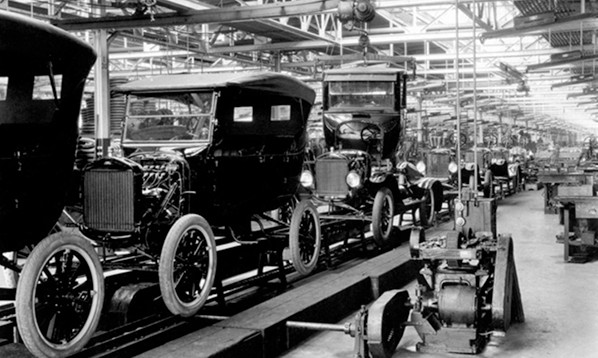
Ford assembly line production
Ford’s results are the numbers teachers love to ask about:
- Model T price fell from about $850 to under $300 by the mid-1920s.
- More than 15 million Model Ts had been produced by 1927.
- Ford’s $5 day in 1914 paid high wages, but it also aimed to reduce turnover and enforce discipline.
This system made goods cheaper and more available, but factory work became exhausting and repetitive.
Advertising, branding, and installment credit
Mass production only worked if people kept buying. Ads sold more than facts. They sold status, beauty, efficiency, romance, and modern identity.
- Listerine made the word “halitosis” famous and turned bad breath into a social fear. That is the classic example of advertising creating consumer anxiety.
- Installment buying meant “buy now, pay later” for cars, radios, furniture, and appliances.
That helped fuel the boom, but it also meant prosperity rested partly on debt, which connects the 1920s to the weakness exposed in the Great Depression.
Automobiles, Mobility, and Government Infrastructure
The automobile was the decade’s most important consumer technology. By 1929, more than 23 million passenger cars were registered.
Step by step, cars changed life:
- People could travel without train or streetcar schedules.
- Workers could live farther from work.
- Shopping, recreation, and dating became easier.
- Rural families gained better access to towns, schools, markets, and doctors.
- Cities spread outward into early suburbs.
Cars also boosted demand for steel, rubber, glass, petroleum, and machine tools, and created gas stations, repair shops, parking lots, restaurants, tourist cabins, and motels.
That new car culture also depended on better roads. Route 66 became the best-known symbol of this shift.
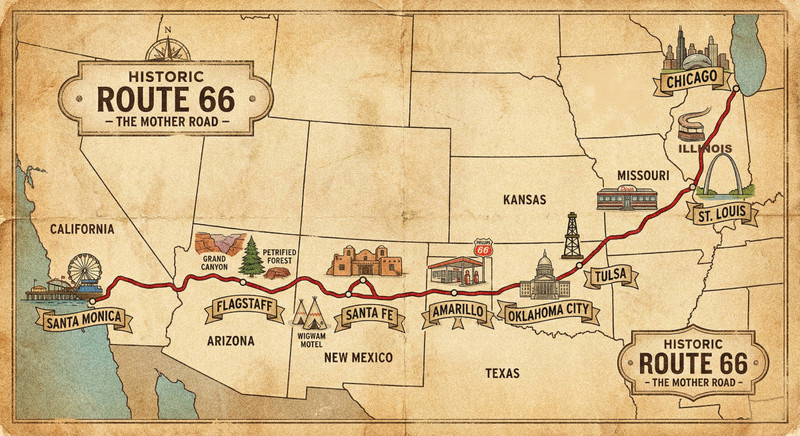
Historic Route 66 map
Cars had costs too: traffic, accidents, pollution, and uneven ownership.
Government mattered here. The Federal Highway Act of 1921 funded roads. In 1926, the U.S. created a numbered highway system, with Route 66 as the famous example. Gasoline taxes helped pay for construction and maintenance. This is a great reminder that private auto companies depended on public roads, traffic laws, licensing, and regulation.
Aviation
Airmail contracts helped commercial airlines grow. Charles Lindbergh’s 1927 solo Atlantic flight made aviation exciting and modern, though planes mattered less to everyday life in the 1920s than cars or radio.
Radio, Movies, Records, and National Culture
Together, radio, cinema, recorded music, and mass-circulation print created a national audience. At the same time, they spread regional cultures to people who had never encountered them before.
Radio
KDKA’s 1920 election broadcast is the usual starting point. By 1929, over 12 million households had radios.
Radio carried:
- News
- Speeches
- Music
- Sports
- Religion
- Comedy
- Drama
- Advertising
Networks made radio national. NBC formed in 1926 and CBS in 1927. The Radio Act of 1927 created the Federal Radio Commission to regulate frequencies.
Cinema
Hollywood became the production center, and the studio system controlled production, distribution, and exhibition. Charlie Chaplin symbolized silent-film stardom. The Jazz Singer in 1927 marked the breakthrough of the talkie. By 1929, weekly movie attendance reached about 90 million.
Recorded sound and print
Phonographs and records spread jazz, blues, and country nationwide. Louis Armstrong and Duke Ellington became national stars. Race records marketed African American music, and southern rural music was sold nationally too. In print, Reader’s Digest started in 1922 and Time in 1923.
Mass media gave Americans shared celebrities, brands, songs, movies, and news. It also spread awareness of African American, southern, rural, and ethnic cultures. Still, media could turn local traditions into products and spread stereotypes just as fast as it spread culture.
Key Takeaways
Electrification
Use of electrical networks and motors to increase factory efficiency and power household appliances, though rural access lagged behind urban access
Scientific Management (Taylorism)
System using time-and-motion studies, divided tasks, and standardized procedures to maximize worker efficiency and managerial control
Frederick Winslow Taylor
Engineer who developed scientific management, arguing that managers should scientifically determine the most efficient way to perform work
Deskilling
Division of skilled work into simple, repetitive tasks that less-skilled workers could be trained to perform and managers could closely control
Mass Production
Large-scale manufacture of standardized goods using interchangeable parts, specialized machinery, divided labor, and assembly lines
Moving Assembly Line
Production method in which a product moves past workstations while each worker repeatedly performs one specialized task
Henry Ford
Automaker who combined standardized cars, interchangeable parts, large-scale production, and the moving assembly line to make automobiles affordable
Fordism
Mass production of standardized goods paired with relatively high wages that reduced turnover and enabled workers to participate in mass consumption
Model T
Ford’s standardized, mass-produced automobile whose falling price helped make car ownership available to millions of Americans
Mass Consumption
Widespread purchasing of standardized consumer goods made possible by lower prices, advertising, rising productivity, and consumer credit
Advertising
Marketing that created consumer desire by associating products with status, beauty, health, efficiency, romance, or modernity
Installment Buying
“Buy now, pay later” purchasing through a down payment and regular payments, expanding consumption while increasing household debt
Automobile
The decade’s most consequential consumer technology, increasing personal mobility, encouraging suburban and roadside development, and stimulating related industries
Federal Highway Act of 1921
Law providing federal funds for state road construction and encouraging interconnected highway systems
Numbered U.S. Highway System
Standardized interstate road network established in 1926, with numbered routes such as U.S. Route 66
Commercial Aviation
Developing air transportation supported by federal airmail contracts, though passenger travel remained expensive and limited during the 1920s
Charles Lindbergh
Aviator whose 1927 solo nonstop flight from New York to Paris demonstrated aircraft reliability and made him a mass-media celebrity
Radio Broadcasting
One-to-many transmission of news, entertainment, music, speeches, and advertising that created simultaneous national experiences and reduced rural isolation
National Radio Networks
Systems such as NBC and CBS that linked local stations by telephone lines to broadcast advertiser-sponsored programs nationwide
Radio Act of 1927 and Federal Radio Commission
Law and agency that licensed stations and regulated frequencies in the “public interest, convenience, or necessity.”
Mass Media
Radio, cinema, recordings, and national print that reached large audiences, spread a shared national culture, and increased awareness of regional and ethnic cultures
Cinema
Mass entertainment medium that gave national audiences shared films, stars, fashions, behavior, and images of modern life
Hollywood
Center of American film production, favored for its climate, varied scenery, labor and capital access, and distance from eastern patent disputes
Studio System
Film-industry structure in which large studios integrated production, national distribution, and control or influence over theaters
The Jazz Singer
The 1927 film conventionally identified as the first commercially successful feature-length “talkie,” accelerating the transition to synchronized sound
Phonograph and Recorded Sound
Technology that reproduced and nationally marketed music, spreading jazz, blues, country, and other regional traditions beyond their original communities
Race Records
Commercial recordings by African American performers, especially in blues and jazz, marketed mainly to Black consumers but heard by wider audiences
Mass-Circulation Print Media
National magazines, newspaper chains, syndicates, tabloids, and other publications that distributed similar news, entertainment, and advertising across the country
National Mass Culture
Shared celebrities, brands, entertainment, news, and cultural references spread nationwide by radio, cinema, recordings, and mass-circulation print
Notes
Electrification
Use of electrical networks and motors to increase factory efficiency and power household appliances, though rural access lagged behind urban access
Scientific Management (Taylorism)
System using time-and-motion studies, divided tasks, and standardized procedures to maximize worker efficiency and managerial control
Frederick Winslow Taylor
Engineer who developed scientific management, arguing that managers should scientifically determine the most efficient way to perform work
Deskilling
Division of skilled work into simple, repetitive tasks that less-skilled workers could be trained to perform and managers could closely control
Mass Production
Large-scale manufacture of standardized goods using interchangeable parts, specialized machinery, divided labor, and assembly lines
Moving Assembly Line
Production method in which a product moves past workstations while each worker repeatedly performs one specialized task
Henry Ford
Automaker who combined standardized cars, interchangeable parts, large-scale production, and the moving assembly line to make automobiles affordable
Fordism
Mass production of standardized goods paired with relatively high wages that reduced turnover and enabled workers to participate in mass consumption
Model T
Ford’s standardized, mass-produced automobile whose falling price helped make car ownership available to millions of Americans
Mass Consumption
Widespread purchasing of standardized consumer goods made possible by lower prices, advertising, rising productivity, and consumer credit
Advertising
Marketing that created consumer desire by associating products with status, beauty, health, efficiency, romance, or modernity
Installment Buying
“Buy now, pay later” purchasing through a down payment and regular payments, expanding consumption while increasing household debt
Automobile
The decade’s most consequential consumer technology, increasing personal mobility, encouraging suburban and roadside development, and stimulating related industries
Federal Highway Act of 1921
Law providing federal funds for state road construction and encouraging interconnected highway systems
Numbered U.S. Highway System
Standardized interstate road network established in 1926, with numbered routes such as U.S. Route 66
Commercial Aviation
Developing air transportation supported by federal airmail contracts, though passenger travel remained expensive and limited during the 1920s
Charles Lindbergh
Aviator whose 1927 solo nonstop flight from New York to Paris demonstrated aircraft reliability and made him a mass-media celebrity
Radio Broadcasting
One-to-many transmission of news, entertainment, music, speeches, and advertising that created simultaneous national experiences and reduced rural isolation
National Radio Networks
Systems such as NBC and CBS that linked local stations by telephone lines to broadcast advertiser-sponsored programs nationwide
Radio Act of 1927 and Federal Radio Commission
Law and agency that licensed stations and regulated frequencies in the “public interest, convenience, or necessity.”
Mass Media
Radio, cinema, recordings, and national print that reached large audiences, spread a shared national culture, and increased awareness of regional and ethnic cultures
Cinema
Mass entertainment medium that gave national audiences shared films, stars, fashions, behavior, and images of modern life
Hollywood
Center of American film production, favored for its climate, varied scenery, labor and capital access, and distance from eastern patent disputes
Studio System
Film-industry structure in which large studios integrated production, national distribution, and control or influence over theaters
The Jazz Singer
The 1927 film conventionally identified as the first commercially successful feature-length “talkie,” accelerating the transition to synchronized sound
Phonograph and Recorded Sound
Technology that reproduced and nationally marketed music, spreading jazz, blues, country, and other regional traditions beyond their original communities
Race Records
Commercial recordings by African American performers, especially in blues and jazz, marketed mainly to Black consumers but heard by wider audiences
Mass-Circulation Print Media
National magazines, newspaper chains, syndicates, tabloids, and other publications that distributed similar news, entertainment, and advertising across the country
National Mass Culture
Shared celebrities, brands, entertainment, news, and cultural references spread nationwide by radio, cinema, recordings, and mass-circulation print
