Topic 8.3 Notes – The Red Scare
What the Second Red Scare Was
The Second Red Scare was the domestic side of the Cold War. Americans mostly agreed on containment overseas, but they argued hard about how to fight communism inside the United States.
- People feared communist influence in the federal government, labor unions, universities, and entertainment.
- The key test distinction is this. Real Soviet spying existed, but many investigations went far beyond spying and targeted people for their politics, friendships, past memberships, or reputations.
- McCarthyism means making reckless, sensational accusations of disloyalty without solid evidence. That idea is bigger than Joseph McCarthy himself.
- Compared with the First Red Scare of 1919-1920, this one grew out of Cold War tension, not mainly labor unrest and immigrant radicalism.
- The core conflict was national security vs. civil liberties. First Amendment freedoms, due process, and the presumption of innocence all came under pressure.
Why the Red Scare Grew So Powerful
Cold War events made communism feel like a fast-moving global threat, and partisan politics made accusations useful.
A map of Cold War Europe helps explain why many Americans saw communist expansion as immediate.
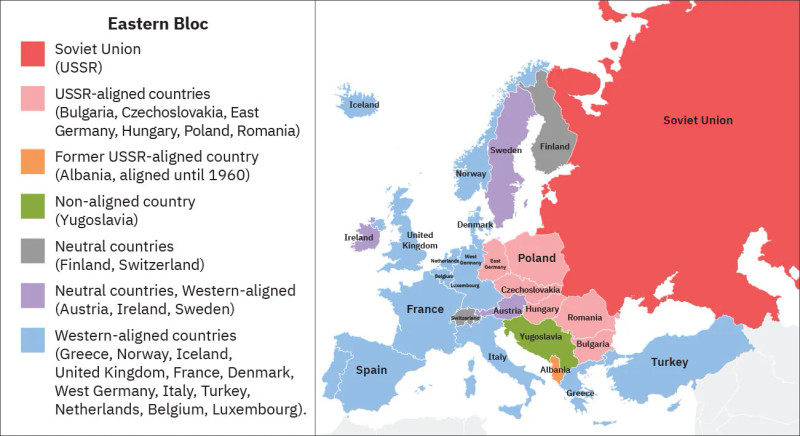
Cold War Europe
- The Soviet Union controlled Eastern Europe, which made expansion look real and immediate.
- In 1949 the Soviets tested an atomic bomb, shocking Americans who thought the U.S. had more time.
- In 1949 communists won in China, and critics charged Truman with having “lost China.”
- In 1950 the Korean War began, making communist expansion seem coordinated and aggressive.
- Republicans accused Democrats of being soft on communism, so both parties tried to prove they were tough.
Espionage cases
These mattered because they gave fear some real evidence behind it.
- Alger Hiss was accused in the HUAC investigation. Richard Nixon gained fame pursuing the case. The Pumpkin Papers supported the charge, and Hiss was convicted of perjury, not espionage.
- Julius and Ethel Rosenberg were convicted in an atomic espionage case. Later evidence strongly confirms Julius’s espionage. Ethel’s role remains more disputed.
- The Venona project later confirmed that some Soviet spy networks were real.
That said, the exam loves this nuance. Espionage is not the same thing as Communist Party membership, left-wing politics, or knowing accused people.
How the Government and Private Institutions Fought Communism
Anticommunism worked through many tools at once, and that is why it spread so widely.
Truman’s loyalty program
In 1947 Truman issued Executive Order 9835, creating the Federal Employee Loyalty Program.
- The FBI ran background checks and loyalty boards reviewed workers.
- Millions were screened, but few proven spies were found.
- The deeper effect was cultural and legal. It made it normal to judge workers by beliefs and associations, not just actions.
Laws and court cases
| Item | What it did |
|---|---|
| Smith Act | Used against Communist Party leaders |
| Dennis v. United States | Upheld those convictions |
| McCarran Internal Security Act | Required communist groups to register; passed over Truman’s veto |
| McCarran-Walter Act | Allowed exclusion/deportation for subversive ties |
| Yates v. United States | Narrowed broad Smith Act enforcement |
| Watkins v. United States | Limited sweeping congressional investigations |
HUAC and Hollywood
HUAC was the House Un-American Activities Committee. It investigated suspected communist influence, especially in film.
The Hollywood hearings became one of the most famous examples.
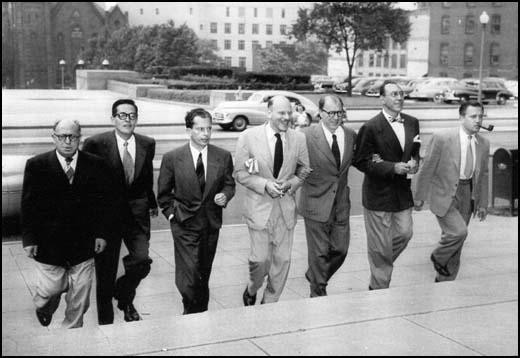
The Hollywood Ten during the HUAC era
- In the 1947 Hollywood hearings, the Hollywood Ten refused to answer and were cited for contempt of Congress.
- The Waldorf Statement helped create the blacklist, a private punishment system reinforced by public pressure.
- Witnesses first leaned on the First Amendment, and later many used the Fifth Amendment.
McCarthyism and the Backlash Against It
Joseph McCarthy, a senator, rose in 1950 by claiming he had a list of communists in the State Department. His timing mattered because China, the Soviet bomb, Hiss, and Korea had already created panic.
- His methods included guilt by association, shifting numbers, unsupported charges, public accusation before proof, and pressure to name names.
- Important distinction. HUAC was a House committee. McCarthy was a senator.
That style is visible in photos from his hearings, where he used charts and accusations to put witnesses on the defensive.
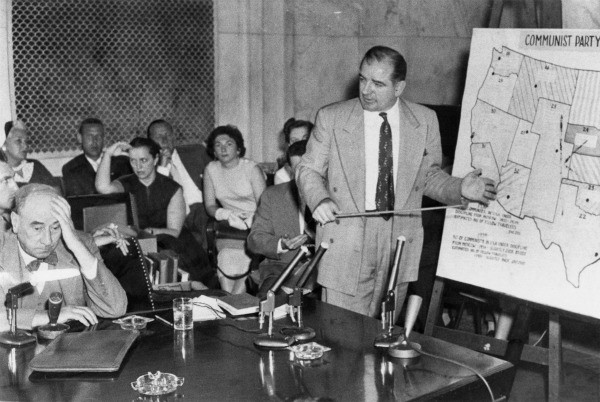
Joseph McCarthy at a Senate hearing
The Army-McCarthy hearings in 1954 were televised, so Americans could watch his bullying style directly. Joseph Welch’s line, “Have you no sense of decency?” became the turning point. Edward R. Murrow also attacked McCarthy on television. The Senate censured/condemned McCarthy in 1954, ending most of his influence, though anticommunism continued.
What the Red Scare Changed
The Red Scare narrowed civil liberties and pushed conformity across American life.
- Labor unions weakened. Taft-Hartley required noncommunist affidavits, and the CIO expelled communist-led unions.
- Universities, teachers, and public employees faced loyalty oaths and investigations.
- Civil rights activists could be red-baited. Paul Robeson and W. E. B. Du Bois both faced scrutiny and accusations.
- The Lavender Scare targeted gay men and lesbians as supposed security risks. Executive Order 10450 under Eisenhower removed many from federal jobs.
- The broad effect was a chilling effect. People avoided dissent, controversial groups, and even certain friendships.
Key Takeaways
Second Red Scare
Postwar fear of communist infiltration, especially from 1947–1954, that produced loyalty investigations, prosecutions, blacklists, political conformity, and civil-liberties abuses
Communist Party USA (CPUSA)
American communist party active in labor and reform movements that followed Soviet policy and included some clandestine ties to the Soviet Union
Harry S. Truman
Democratic president who established the federal loyalty program while opposing some congressional measures and sensational accusations as ineffective and repressive
Federal Employee Loyalty Program (Executive Order 9835)
Truman’s 1947 program screening federal workers for disloyalty, often using associations and undisclosed allegations rather than proof of espionage
Smith Act
1940 law criminalizing advocacy of violent government overthrow and membership in groups devoted to it, used after World War II against Communist Party leaders
Dennis v. United States
1951 Supreme Court decision upholding Smith Act convictions despite no immediate uprising because the threatened harm was considered sufficiently grave
McCarran Internal Security Act
1950 law requiring communist organizations to register and authorizing restrictions and emergency detention; Congress enacted it over Truman’s veto
McCarran-Walter Immigration and Nationality Act
1952 law retaining national-origins quotas and permitting exclusion or deportation for communist or allegedly subversive affiliations
House Un-American Activities Committee (HUAC)
House committee that publicly investigated alleged communist influence and pressured witnesses to disclose their affiliations and identify others
Hollywood Ten
Ten writers and directors imprisoned for contempt after refusing in 1947 to answer HUAC questions about Communist Party membership
Hollywood Blacklist
Private entertainment-industry practice denying work to accused communists and uncooperative witnesses without requiring a criminal conviction
Alger Hiss
Former State Department official accused of Soviet activity who was convicted of perjury in 1950 after denying Whittaker Chambers’s allegations
Whittaker Chambers
Former communist who accused Alger Hiss of belonging to an underground network and produced copied documents known partly as the Pumpkin Papers
Richard Nixon
HUAC member who gained national recognition by aggressively pursuing the Alger Hiss investigation
Julius and Ethel Rosenberg
Couple executed in 1953 for conspiracy to commit espionage; later evidence confirmed Julius’s spying but left Ethel’s operational role much less certain
Joseph McCarthy
Wisconsin Republican senator who rose through unsupported claims of communists in government and lost influence after the 1954 Army hearings and Senate condemnation
McCarthyism
Use of sensational, poorly supported accusations, guilt by association, and demands to denounce others in order to attack alleged subversion
Army-McCarthy Hearings
Televised 1954 hearings that exposed McCarthy’s aggressive methods during his dispute with the Army and accelerated his downfall
Joseph Welch
Army counsel who publicly rebuked McCarthy during the Army-McCarthy hearings with “Have you no sense of decency, sir?”
Edward R. Murrow
Journalist whose 1954 television broadcast used McCarthy’s own statements to expose his contradictions and unsupported accusations
Lavender Scare
Purge of suspected gay men and lesbians from federal employment based on claims that they were morally unfit or vulnerable to blackmail
Dwight D. Eisenhower
President who expanded federal security screening in 1953 and authorized removal or exclusion of suspected homosexual employees
Executive Order 10450
Eisenhower’s 1953 order expanding federal security investigations and listing “sexual perversion” as grounds for exclusion or dismissal
Yates v. United States
1957 Supreme Court decision narrowing the Smith Act by distinguishing abstract revolutionary advocacy from incitement to concrete illegal action
Watkins v. United States
1957 Supreme Court decision requiring congressional investigations to state a legislative purpose and respect witnesses’ due-process rights
Notes
Second Red Scare
Postwar fear of communist infiltration, especially from 1947–1954, that produced loyalty investigations, prosecutions, blacklists, political conformity, and civil-liberties abuses
Communist Party USA (CPUSA)
American communist party active in labor and reform movements that followed Soviet policy and included some clandestine ties to the Soviet Union
Harry S. Truman
Democratic president who established the federal loyalty program while opposing some congressional measures and sensational accusations as ineffective and repressive
Federal Employee Loyalty Program (Executive Order 9835)
Truman’s 1947 program screening federal workers for disloyalty, often using associations and undisclosed allegations rather than proof of espionage
Smith Act
1940 law criminalizing advocacy of violent government overthrow and membership in groups devoted to it, used after World War II against Communist Party leaders
Dennis v. United States
1951 Supreme Court decision upholding Smith Act convictions despite no immediate uprising because the threatened harm was considered sufficiently grave
McCarran Internal Security Act
1950 law requiring communist organizations to register and authorizing restrictions and emergency detention; Congress enacted it over Truman’s veto
McCarran-Walter Immigration and Nationality Act
1952 law retaining national-origins quotas and permitting exclusion or deportation for communist or allegedly subversive affiliations
House Un-American Activities Committee (HUAC)
House committee that publicly investigated alleged communist influence and pressured witnesses to disclose their affiliations and identify others
Hollywood Ten
Ten writers and directors imprisoned for contempt after refusing in 1947 to answer HUAC questions about Communist Party membership
Hollywood Blacklist
Private entertainment-industry practice denying work to accused communists and uncooperative witnesses without requiring a criminal conviction
Alger Hiss
Former State Department official accused of Soviet activity who was convicted of perjury in 1950 after denying Whittaker Chambers’s allegations
Whittaker Chambers
Former communist who accused Alger Hiss of belonging to an underground network and produced copied documents known partly as the Pumpkin Papers
Richard Nixon
HUAC member who gained national recognition by aggressively pursuing the Alger Hiss investigation
Julius and Ethel Rosenberg
Couple executed in 1953 for conspiracy to commit espionage; later evidence confirmed Julius’s spying but left Ethel’s operational role much less certain
Joseph McCarthy
Wisconsin Republican senator who rose through unsupported claims of communists in government and lost influence after the 1954 Army hearings and Senate condemnation
McCarthyism
Use of sensational, poorly supported accusations, guilt by association, and demands to denounce others in order to attack alleged subversion
Army-McCarthy Hearings
Televised 1954 hearings that exposed McCarthy’s aggressive methods during his dispute with the Army and accelerated his downfall
Joseph Welch
Army counsel who publicly rebuked McCarthy during the Army-McCarthy hearings with “Have you no sense of decency, sir?”
Edward R. Murrow
Journalist whose 1954 television broadcast used McCarthy’s own statements to expose his contradictions and unsupported accusations
Lavender Scare
Purge of suspected gay men and lesbians from federal employment based on claims that they were morally unfit or vulnerable to blackmail
Dwight D. Eisenhower
President who expanded federal security screening in 1953 and authorized removal or exclusion of suspected homosexual employees
Executive Order 10450
Eisenhower’s 1953 order expanding federal security investigations and listing “sexual perversion” as grounds for exclusion or dismissal
Yates v. United States
1957 Supreme Court decision narrowing the Smith Act by distinguishing abstract revolutionary advocacy from incitement to concrete illegal action
Watkins v. United States
1957 Supreme Court decision requiring congressional investigations to state a legislative purpose and respect witnesses’ due-process rights
