Topic 4.8 Notes – Jackson and Federal Power
Jacksonian Democracy and Federal Power
After the Era of Good Feelings, one-party politics fell apart, and that opened sharper fights over tariffs, the Bank, internal improvements, and expansion. Jackson rose right into that moment.
- Andrew Jackson’s rise started with military fame.
- Battle of New Orleans made him a national hero.
- First Seminole War showed his aggressive approach to frontier conflict and expansion.
- In the election of 1824, Jackson won a plurality but not a majority, so the House picked John Quincy Adams. Adams naming Henry Clay secretary of state led Jackson supporters to cry “corrupt bargain.”
- In 1828, Jackson won with expanded white male suffrage, party organizing, rallies, newspapers, and local committees.
Jackson claimed to speak directly for the people, meaning mostly ordinary white men. That is the core of Jacksonian democracy. It broadened political participation for white men, but it excluded women, most African Americans, and Native peoples.
Jackson also changed the presidency itself.
- He used the veto as a policy weapon, not just when he thought a bill was unconstitutional.
- He treated the president as the direct representative of the national majority.
Rotation in office
Jackson said long-term officeholders became corrupt elites, so he supported rotation in office.
- Spoils system means giving jobs to political supporters.
- Patronage appointments helped build party loyalty.
- “To the victor belong the spoils” captured the idea.
- The Kitchen Cabinet was Jackson’s informal circle of trusted advisers.
Supporters called this democratic because ordinary people got access to office. Critics called it corruption because loyalty mattered more than skill.
Democrats and Whigs in the Second Party System
These fights produced two national parties with different ideas about government.
| Party | Leaders | Main beliefs |
|---|---|---|
| Democrats | Andrew Jackson | Limited federal role in economic development, anti-Bank, lower tariffs, caution on internal improvements, support for expansion and Indian removal, strong president as voice of majority |
| Whigs | Henry Clay, Daniel Webster | Congress should lead, support American System, national bank, protective tariff, federally funded internal improvements, federal help for economic growth, opposition to “King Andrew” |
Whigs mocked Jackson as “King Andrew” because they believed he used presidential power too aggressively, especially in fights over the Bank and the veto.
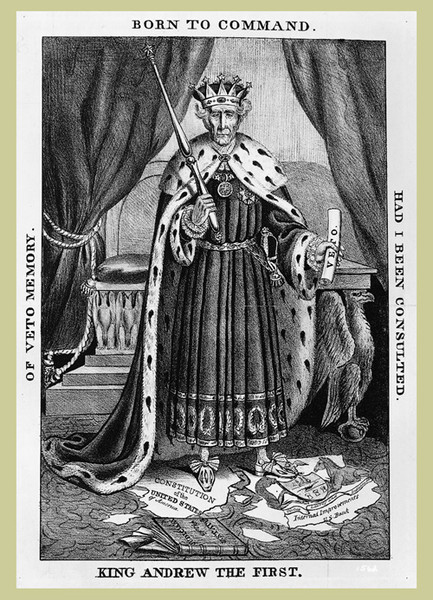
“King Andrew the First” political cartoon
The Second Party System mattered because politics became more organized and more popular.
- National party organizations
- Partisan newspapers
- Rallies, conventions, local committees
- High voter turnout among eligible white men
- 1840 election of William Henry Harrison proved Whigs could also build a mass coalition
The Big Federal Power Fights
These three conflicts belong together because each asks the same question. How much power should the federal government have, and who gets to use it?
Internal improvements
Henry Clay’s American System backed roads and canals. Jackson vetoed the Maysville Road bill in 1830 because the road was inside Kentucky and seemed local, not truly national. He was not against every transportation project. He opposed routine federal funding of local development.
Nullification
- The Tariff of 1828, called the Tariff of Abominations, angered South Carolina.
- John C. Calhoun argued in the South Carolina Exposition and Protest that a state could nullify a federal law.
- In the Webster-Hayne debate, Robert Hayne defended states’ rights and Daniel Webster defended Union and federal supremacy.
- Jackson answered with his toast, “Our Federal Union, it must be preserved.”
- South Carolina passed the Ordinance of Nullification in 1832.
- Jackson issued the Proclamation to the People of South Carolina and backed the Force Bill.
- Henry Clay helped pass the Compromise Tariff of 1833.
Effect: nullification was rejected and the Union held, but the deeper sectional argument stayed alive.
Bank War
The Second Bank of the United States, led by Nicholas Biddle, had already been upheld in McCulloch v. Maryland. Jackson saw it as elite privilege and monopoly power.
- 1832 recharter veto and the Bank Veto Message attacked concentrated wealth.
- Jackson removed federal deposits to pet banks.
- The Senate issued a censure, later expunged.
- The Specie Circular required hard money for land purchases.
This fed instability that helped lead to the Panic of 1837, along with land speculation, falling cotton prices, and changes in British credit.
Indian Removal and the Selective Use of Federal Power
This is where Jackson’s limits on federal power disappear. Settler demand, cotton expansion, and gold in Georgia pushed removal hard.
The main southeastern nations were the Five Civilized Tribes:
- Cherokee
- Choctaw
- Chickasaw
- Creek
- Seminole
The Indian Removal Act of 1830 authorized removal west. The map below shows those southeastern nations being pushed into Indian Territory.
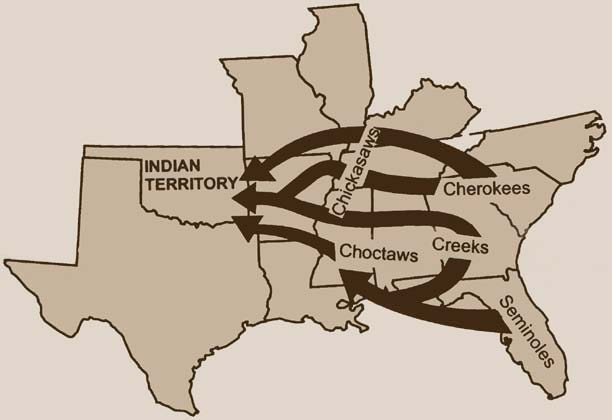
Indian removal to Indian Territory
The Cherokee resisted by adapting and using law.
- Sequoyah developed a writing system.
- The Cherokee Phoenix was a Cherokee newspaper.
- The Cherokee constitution showed organized self-government.
Supreme Court cases:
- Cherokee Nation v. Georgia said the Cherokee were not a foreign nation in the constitutional sense.
- Worcester v. Georgia said Georgia had no authority in Cherokee territory.
Here is Jackson’s biggest inconsistency. He defended federal supremacy against South Carolina, but he did not enforce Worcester against Georgia.
Examples of removal and resistance:
- Choctaw removal
- Creek War of 1836
- Second Seminole War
- Black Hawk War
- Treaty of New Echota
- Trail of Tears under Martin Van Buren, 1838-1839
Why This Era Matters
Jackson did not just expand or shrink federal power. He redirected it.
- Less national activism in banking and internal improvements
- More presidential power
- Strong defense of the Union against nullification
- Clear Democrats vs Whigs split
- Faster westward expansion through removal
Key Takeaways
Andrew Jackson
Democratic president from 1829 to 1837 who limited federal economic activism but strengthened the presidency, defended the Union, and enforced American Indian removal
Jacksonian Democracy
Expansion of mass politics and participation for white men while women, most African Americans, and American Indians remained excluded
Democratic Party
Jackson’s party, favoring limited federal economic intervention, states’ rights, expansion, opposition to concentrated privilege, and a strong popular president
Rotation in Office / Spoils System
Jackson’s practice of replacing some officeholders with party supporters, defended as democratic rotation but criticized as patronage and corruption
Kitchen Cabinet
Jackson’s informal circle of advisers, criticized as evidence that he governed through personal loyalty rather than established institutions
Henry Clay
Leading Whig who promoted the American System, supported the national bank, challenged Jackson, and negotiated the Compromise Tariff of 1833
American System
Clay’s program combining a national bank, protective tariffs, and federally supported internal improvements to develop an integrated national economy
Internal Improvements
Government-supported transportation projects such as roads and canals; Whigs favored federal funding, while Democrats resisted routine funding of local projects
Maysville Road Veto
Jackson’s 1830 rejection of federal investment in a Kentucky road as local, constitutionally doubtful, and an improper federal expense
Protective Tariffs
Import duties protecting American manufacturers but opposed by many southerners as raising prices and favoring northern industry
Tariff of 1828 / Tariff of Abominations
High protective tariff fiercely opposed in South Carolina that helped produce Calhoun’s nullification doctrine and the Nullification Crisis
John C. Calhoun
Jackson’s vice president and South Carolina states’ rights theorist who developed nullification and later broke with Jackson
South Carolina Exposition and Protest
Calhoun’s anonymously written argument that a state convention could nullify an unconstitutional federal law
Compact Theory
Theory that sovereign states created the Union and therefore retained authority to judge the constitutionality of federal actions
Nullification
Claim that an individual state could declare a federal law unconstitutional and prevent its enforcement within the state
Webster–Hayne Debate
1830 Senate debate in which Hayne defended states’ rights and compact theory while Webster defended a perpetual Union created by the people
Daniel Webster
Massachusetts nationalist and leading Whig who defended the Union in the Webster–Hayne debate and supported the national bank and federal development
Nullification Crisis
1832–1833 confrontation in which South Carolina nullified federal tariffs and Jackson defended federal supremacy while Clay arranged a tariff compromise
Ordinance of Nullification
South Carolina’s 1832 declaration that the tariffs of 1828 and 1832 were void within the state, with secession threatened if force was used
Proclamation to the People of South Carolina
Jackson’s 1832 declaration denying that a state could unilaterally nullify federal law or secede from the Union
Force Bill
1833 law authorizing Jackson to use military force if necessary to collect federal customs duties in South Carolina
Compromise Tariff of 1833
Clay’s settlement gradually reducing tariff rates, leading South Carolina to repeal its nullification ordinance
Second Bank of the United States
National bank that held federal deposits, issued credit, and regulated state banks, but was attacked by Jackson as unconstitutional privilege
McCulloch v. Maryland
1819 Supreme Court decision upholding Congress’s power to charter the national bank, a precedent Jackson disputed as binding on presidential judgment
Nicholas Biddle
President of the Second Bank who sought early recharter and later contracted credit during his struggle with Jackson
Bank War
Political struggle in which Jackson vetoed the Bank’s recharter and removed federal deposits, ending the Second Bank and expanding presidential power
Bank Veto Message
Jackson’s 1832 rejection of Bank recharter as privileged, dangerous, and unjust, asserting presidential authority to interpret the Constitution and public interest
Pet Banks
Selected state banks that received new federal revenues after Jackson ordered deposits removed from the Second Bank
Specie Circular
Jackson’s 1836 order requiring most federal land purchases to be paid in gold or silver, intended to restrain speculation but also tightening credit
Panic of 1837
Severe depression caused by unstable banking, speculation, falling cotton prices, British credit changes, and policies including the Bank War and Specie Circular
American Indian Removal
Federal policy coercively relocating eastern Native nations westward to open their lands to white settlement and plantation agriculture
Five Civilized Tribes
Historical white term for the Cherokee, Choctaw, Chickasaw, Creek, and Seminole, the southeastern nations most directly targeted for removal
Indian Removal Act
1830 law authorizing the president to arrange and fund exchanges of eastern Native lands for territory west of the Mississippi
Cherokee Nation v. Georgia
1831 decision denying the Cherokee original jurisdiction as a foreign state while describing tribes as domestic dependent nations
Worcester v. Georgia
1832 decision holding that Georgia law had no force in Cherokee territory and that Native relations belonged to federal authority
Second Seminole War
1835–1842 conflict in which Seminoles, Black Seminoles, and escaped enslaved people resisted removal from Florida
Black Hawk War
1832 conflict ending in the defeat of a group of Sauk and Meskwaki led by Black Hawk who attempted to return to lands east of the Mississippi
Treaty of New Echota
1835 treaty signed by a small Cherokee minority surrendering southeastern lands despite opposition from most Cherokee
Trail of Tears
Forced Cherokee removal to Indian Territory in 1838–1839 during which exposure, hunger, and disease killed roughly 4,000 people
Whig Party
Anti-Jackson party favoring congressional leadership, a national bank, protective tariffs, internal improvements, and restraints on presidential power
King Andrew
Whig portrayal of Jackson as a monarch who used vetoes, patronage, and executive control to subordinate Congress and other institutions
Second Party System
National competition between Democrats and Whigs from the late 1820s or early 1830s into the early 1850s
Senate Censure of Jackson
The Senate’s 1834 condemnation of Jackson for asserting unauthorized power in removing federal deposits; Democrats expunged it in 1837
Creek War of 1836
Conflict following continued Creek dispossession that ended with federal suppression and the removal of many Creek people westward
Notes
Andrew Jackson
Democratic president from 1829 to 1837 who limited federal economic activism but strengthened the presidency, defended the Union, and enforced American Indian removal
Jacksonian Democracy
Expansion of mass politics and participation for white men while women, most African Americans, and American Indians remained excluded
Democratic Party
Jackson’s party, favoring limited federal economic intervention, states’ rights, expansion, opposition to concentrated privilege, and a strong popular president
Rotation in Office / Spoils System
Jackson’s practice of replacing some officeholders with party supporters, defended as democratic rotation but criticized as patronage and corruption
Kitchen Cabinet
Jackson’s informal circle of advisers, criticized as evidence that he governed through personal loyalty rather than established institutions
Henry Clay
Leading Whig who promoted the American System, supported the national bank, challenged Jackson, and negotiated the Compromise Tariff of 1833
American System
Clay’s program combining a national bank, protective tariffs, and federally supported internal improvements to develop an integrated national economy
Internal Improvements
Government-supported transportation projects such as roads and canals; Whigs favored federal funding, while Democrats resisted routine funding of local projects
Maysville Road Veto
Jackson’s 1830 rejection of federal investment in a Kentucky road as local, constitutionally doubtful, and an improper federal expense
Protective Tariffs
Import duties protecting American manufacturers but opposed by many southerners as raising prices and favoring northern industry
Tariff of 1828 / Tariff of Abominations
High protective tariff fiercely opposed in South Carolina that helped produce Calhoun’s nullification doctrine and the Nullification Crisis
John C. Calhoun
Jackson’s vice president and South Carolina states’ rights theorist who developed nullification and later broke with Jackson
South Carolina Exposition and Protest
Calhoun’s anonymously written argument that a state convention could nullify an unconstitutional federal law
Compact Theory
Theory that sovereign states created the Union and therefore retained authority to judge the constitutionality of federal actions
Nullification
Claim that an individual state could declare a federal law unconstitutional and prevent its enforcement within the state
Webster–Hayne Debate
1830 Senate debate in which Hayne defended states’ rights and compact theory while Webster defended a perpetual Union created by the people
Daniel Webster
Massachusetts nationalist and leading Whig who defended the Union in the Webster–Hayne debate and supported the national bank and federal development
Nullification Crisis
1832–1833 confrontation in which South Carolina nullified federal tariffs and Jackson defended federal supremacy while Clay arranged a tariff compromise
Ordinance of Nullification
South Carolina’s 1832 declaration that the tariffs of 1828 and 1832 were void within the state, with secession threatened if force was used
Proclamation to the People of South Carolina
Jackson’s 1832 declaration denying that a state could unilaterally nullify federal law or secede from the Union
Force Bill
1833 law authorizing Jackson to use military force if necessary to collect federal customs duties in South Carolina
Compromise Tariff of 1833
Clay’s settlement gradually reducing tariff rates, leading South Carolina to repeal its nullification ordinance
Second Bank of the United States
National bank that held federal deposits, issued credit, and regulated state banks, but was attacked by Jackson as unconstitutional privilege
McCulloch v. Maryland
1819 Supreme Court decision upholding Congress’s power to charter the national bank, a precedent Jackson disputed as binding on presidential judgment
Nicholas Biddle
President of the Second Bank who sought early recharter and later contracted credit during his struggle with Jackson
Bank War
Political struggle in which Jackson vetoed the Bank’s recharter and removed federal deposits, ending the Second Bank and expanding presidential power
Bank Veto Message
Jackson’s 1832 rejection of Bank recharter as privileged, dangerous, and unjust, asserting presidential authority to interpret the Constitution and public interest
Pet Banks
Selected state banks that received new federal revenues after Jackson ordered deposits removed from the Second Bank
Specie Circular
Jackson’s 1836 order requiring most federal land purchases to be paid in gold or silver, intended to restrain speculation but also tightening credit
Panic of 1837
Severe depression caused by unstable banking, speculation, falling cotton prices, British credit changes, and policies including the Bank War and Specie Circular
American Indian Removal
Federal policy coercively relocating eastern Native nations westward to open their lands to white settlement and plantation agriculture
Five Civilized Tribes
Historical white term for the Cherokee, Choctaw, Chickasaw, Creek, and Seminole, the southeastern nations most directly targeted for removal
Indian Removal Act
1830 law authorizing the president to arrange and fund exchanges of eastern Native lands for territory west of the Mississippi
Cherokee Nation v. Georgia
1831 decision denying the Cherokee original jurisdiction as a foreign state while describing tribes as domestic dependent nations
Worcester v. Georgia
1832 decision holding that Georgia law had no force in Cherokee territory and that Native relations belonged to federal authority
Second Seminole War
1835–1842 conflict in which Seminoles, Black Seminoles, and escaped enslaved people resisted removal from Florida
Black Hawk War
1832 conflict ending in the defeat of a group of Sauk and Meskwaki led by Black Hawk who attempted to return to lands east of the Mississippi
Treaty of New Echota
1835 treaty signed by a small Cherokee minority surrendering southeastern lands despite opposition from most Cherokee
Trail of Tears
Forced Cherokee removal to Indian Territory in 1838–1839 during which exposure, hunger, and disease killed roughly 4,000 people
Whig Party
Anti-Jackson party favoring congressional leadership, a national bank, protective tariffs, internal improvements, and restraints on presidential power
King Andrew
Whig portrayal of Jackson as a monarch who used vetoes, patronage, and executive control to subordinate Congress and other institutions
Second Party System
National competition between Democrats and Whigs from the late 1820s or early 1830s into the early 1850s
Senate Censure of Jackson
The Senate’s 1834 condemnation of Jackson for asserting unauthorized power in removing federal deposits; Democrats expunged it in 1837
Creek War of 1836
Conflict following continued Creek dispossession that ended with federal suppression and the removal of many Creek people westward
