Topic 7.14 Notes – Postwar Diplomacy
How World War II Made the United States the Leading Global Power
By 1945, the U.S. stood in a position no country had held before. Europe and much of Asia were wrecked by bombing, invasion, and mass death. The map helps show the scale of destruction and occupation in Europe at the war’s height. The continental United States was largely untouched, so its factories, farms, and transportation systems were still working at full strength.
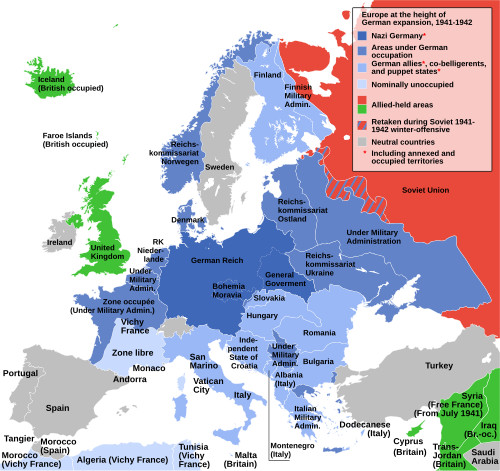
Europe at the height of German expansion, 1941-1942
- Wartime mobilization ended Depression-era unemployment and turned the U.S. into the arsenal of democracy, supplying weapons and goods on a huge scale.
- By the end of the war, the U.S. produced about half of the world’s manufactured goods and held major financial reserves.
- Its military power was unmatched. It had the strongest navy and air force, troops around the world, and the ability to fight in Europe and the Pacific at the same time.
- The U.S. also had a temporary atomic monopoly until the Soviet bomb test in 1949.
This changed foreign policy. After World War I, the Senate rejected the League of Nations and the U.S. pulled back from permanent commitments. After World War II, that kind of limited role no longer made sense because the U.S. now had the power, wealth, and global reach to shape the postwar world.
The Main Parts of the Postwar Settlement
The postwar settlement fits into four connected pieces. Allied leaders bargained at wartime conferences, built the United Nations, created a new global economic system, and occupied former Axis states. All of it aimed to prevent another world war, but it also protected American power and interests.
Yalta and Potsdam
At Yalta in February 1945, Franklin Roosevelt, Winston Churchill, and Joseph Stalin tried to plan the peace before Germany surrendered.
- Germany and Berlin were divided into four occupation zones.
- Stalin promised to join the war against Japan.
- In the Declaration on Liberated Europe, Stalin also promised free elections in Eastern Europe.
- The voting structure of the United Nations, including the permanent-member veto, was finalized.
A common AP mistake is treating Yalta like complete agreement. It was a compromise with vague wording, especially over Eastern Europe, so each side could claim it meant something different later.
At Potsdam in July-August 1945, Harry Truman, Stalin, and Churchill/Clement Attlee met after Germany had surrendered.
- They confirmed the occupation of Germany and the four Ds: demilitarization, denazification, democratization, decentralization.
- Arguments over reparations, Poland, and Eastern Europe showed the alliance was already weakening.
- The Potsdam Declaration demanded Japan’s unconditional surrender.
- Truman’s position was stronger because the U.S. had just successfully tested the atomic bomb.
The United Nations
The United Nations showed that the U.S. had accepted permanent international leadership.
- Created in 1945 with strong U.S. backing; Senate approved membership 89-2
- Goals included collective security, diplomacy, cooperation, and human rights
- General Assembly = all member states
- Security Council = five permanent members with veto power
- United States
- Soviet Union
- Britain
- France
- China
- Headquarters in New York City
- Universal Declaration of Human Rights in 1948, drafted with major help from Eleanor Roosevelt
Bretton Woods and the postwar economy
The U.S. also shaped the rules of global capitalism.
- Bretton Woods Conference in 1944 created a dollar-centered system
- Fixed exchange rates were tied to the dollar, and the dollar was convertible to gold at $35 per ounce
- IMF gave short-term aid and helped stabilize exchange rates
- World Bank funded reconstruction and development
- GATT in 1947 lowered trade barriers
This system promoted stable currencies and open trade, but it also locked in American financial dominance.
How the United States Reshaped Germany and Japan
Victory gave the U.S. and its allies the power to rebuild defeated enemies.
- Germany was divided into U.S., British, French, and Soviet zones; Berlin was also divided. Austria and Vienna were divided too. The goals were disarmament, destroying Nazism, prosecuting war criminals, decentralizing power, and building democracy. A major fight appeared quickly. The Soviets wanted heavy reparations, while the U.S. and Britain increasingly wanted German recovery.
- Japan was occupied mainly by the U.S. under Douglas MacArthur and, unlike Germany, was not split into zones. The 1947 constitution created parliamentary democracy, civil liberties, women’s rights, and universal suffrage. Article 9 renounced war. Land reform and attacks on industrial conglomerates tried to weaken militarism. Emperor Hirohito stayed, but gave up divine status and lost direct political power.
War Crimes, Nuclear Power, and the Road to the Cold War
Postwar justice and postwar tension developed at the same time.
- Nuremberg Trials prosecuted Nazi leaders for crimes against peace, war crimes, and crimes against humanity. The lasting principle was individual responsibility under international law.
- Tokyo Trials prosecuted Japanese leaders for aggressive war and atrocities. Hirohito was not tried, which shows diplomacy could shape justice.
Atomic weapons gave the U.S. huge leverage, but they also made the Soviets fear American power even more. The deepest disagreements were over Eastern Europe, Poland, reparations, Germany, and whether postwar governments should reflect self-determination or Soviet security needs.
Key Takeaways
Yalta Conference
February 1945 meeting of Roosevelt, Churchill, and Stalin that established occupation plans for Germany, secured Soviet entry against Japan, promised free elections in liberated Europe, and settled UN voting arrangements
Declaration on Liberated Europe
Yalta agreement promising representative governments and free elections in liberated Europe, but lacking enforcement and allowing conflicting American and Soviet interpretations
Potsdam Conference
July–August 1945 meeting of Truman, Stalin, and Churchill and then Attlee that confirmed Germany’s occupation and restructuring while disputes over reparations and Eastern Europe exposed the weakening alliance
Potsdam Declaration
July 1945 demand by the United States, Britain, and China for Japan’s unconditional surrender, warning of “prompt and utter destruction” if Japan refused
Collective Security
The principle that nations cooperate through an international organization to deter aggression and preserve peace, central to the design of the United Nations
United Nations
International organization founded in 1945 to maintain peace, provide a forum for diplomacy, promote international cooperation, and encourage respect for human rights; U.S. membership marked sustained international engagement
United Nations General Assembly
The UN’s principal deliberative body, in which every member nation has one vote
United Nations Security Council
UN body primarily responsible for peace and security; the United States, Soviet Union, Britain, France, and China became permanent members with veto power
Universal Declaration of Human Rights
Nonbinding 1948 UN declaration establishing broad civil, political, economic, and social rights as universal standards after fascism, war, and the Holocaust
Eleanor Roosevelt
Former first lady who chaired the UN commission that prepared the Universal Declaration of Human Rights
Bretton Woods System
Postwar monetary system created in 1944 with fixed exchange rates tied to the dollar and U.S. conversion of foreign governments’ dollars into gold at $35 per ounce
International Monetary Fund (IMF)
Bretton Woods institution created to stabilize exchange rates and provide short-term assistance to nations with balance-of-payments problems
International Bank for Reconstruction and Development (World Bank)
Bretton Woods institution created to finance postwar reconstruction and, later, economic development
General Agreement on Tariffs and Trade (GATT)
1947 agreement promoting reductions in trade barriers and complementing the Bretton Woods system’s open, stable international economy
Occupation of Germany
Germany and Berlin were divided among American, British, French, and Soviet zones for demilitarization, denazification, democratization, decentralization, and war-crimes prosecution
Occupation of Japan
U.S.-dominated occupation that demilitarized and democratized Japan, ended the emperor’s direct political authority, reformed landholding and industry, and introduced a democratic constitution
Douglas MacArthur
American general who served as Supreme Commander for the Allied Powers and directed the U.S.-dominated occupation and reform of Japan from 1945 to 1951
Japanese Constitution of 1947
Occupation-era constitution establishing parliamentary democracy, civil liberties, women’s rights, universal adult suffrage, and the emperor’s removal from direct political power
Article 9
Provision of Japan’s 1947 constitution renouncing war as a sovereign right and declaring that armed forces and other war potential would not be maintained
Nuremberg Trials
1945–1946 international trials of major Nazi leaders that established individual responsibility for aggressive war, war crimes, and crimes against humanity
Tokyo Trials
1946–1948 international trials of Japanese leaders for aggressive war and atrocities; Hirohito was not prosecuted because U.S. officials believed retaining him would aid occupation stability
U.S. Nuclear Monopoly (1945–1949)
Temporary period when only the United States possessed atomic weapons, strengthening its initial diplomatic position but provoking Soviet insecurity and an accelerated nuclear program
Postwar Diplomacy
American use of its new global power after World War II to shape peace settlements, international institutions, occupied enemy states, and the world economy
Notes
Yalta Conference
February 1945 meeting of Roosevelt, Churchill, and Stalin that established occupation plans for Germany, secured Soviet entry against Japan, promised free elections in liberated Europe, and settled UN voting arrangements
Declaration on Liberated Europe
Yalta agreement promising representative governments and free elections in liberated Europe, but lacking enforcement and allowing conflicting American and Soviet interpretations
Potsdam Conference
July–August 1945 meeting of Truman, Stalin, and Churchill and then Attlee that confirmed Germany’s occupation and restructuring while disputes over reparations and Eastern Europe exposed the weakening alliance
Potsdam Declaration
July 1945 demand by the United States, Britain, and China for Japan’s unconditional surrender, warning of “prompt and utter destruction” if Japan refused
Collective Security
The principle that nations cooperate through an international organization to deter aggression and preserve peace, central to the design of the United Nations
United Nations
International organization founded in 1945 to maintain peace, provide a forum for diplomacy, promote international cooperation, and encourage respect for human rights; U.S. membership marked sustained international engagement
United Nations General Assembly
The UN’s principal deliberative body, in which every member nation has one vote
United Nations Security Council
UN body primarily responsible for peace and security; the United States, Soviet Union, Britain, France, and China became permanent members with veto power
Universal Declaration of Human Rights
Nonbinding 1948 UN declaration establishing broad civil, political, economic, and social rights as universal standards after fascism, war, and the Holocaust
Eleanor Roosevelt
Former first lady who chaired the UN commission that prepared the Universal Declaration of Human Rights
Bretton Woods System
Postwar monetary system created in 1944 with fixed exchange rates tied to the dollar and U.S. conversion of foreign governments’ dollars into gold at $35 per ounce
International Monetary Fund (IMF)
Bretton Woods institution created to stabilize exchange rates and provide short-term assistance to nations with balance-of-payments problems
International Bank for Reconstruction and Development (World Bank)
Bretton Woods institution created to finance postwar reconstruction and, later, economic development
General Agreement on Tariffs and Trade (GATT)
1947 agreement promoting reductions in trade barriers and complementing the Bretton Woods system’s open, stable international economy
Occupation of Germany
Germany and Berlin were divided among American, British, French, and Soviet zones for demilitarization, denazification, democratization, decentralization, and war-crimes prosecution
Occupation of Japan
U.S.-dominated occupation that demilitarized and democratized Japan, ended the emperor’s direct political authority, reformed landholding and industry, and introduced a democratic constitution
Douglas MacArthur
American general who served as Supreme Commander for the Allied Powers and directed the U.S.-dominated occupation and reform of Japan from 1945 to 1951
Japanese Constitution of 1947
Occupation-era constitution establishing parliamentary democracy, civil liberties, women’s rights, universal adult suffrage, and the emperor’s removal from direct political power
Article 9
Provision of Japan’s 1947 constitution renouncing war as a sovereign right and declaring that armed forces and other war potential would not be maintained
Nuremberg Trials
1945–1946 international trials of major Nazi leaders that established individual responsibility for aggressive war, war crimes, and crimes against humanity
Tokyo Trials
1946–1948 international trials of Japanese leaders for aggressive war and atrocities; Hirohito was not prosecuted because U.S. officials believed retaining him would aid occupation stability
U.S. Nuclear Monopoly (1945–1949)
Temporary period when only the United States possessed atomic weapons, strengthening its initial diplomatic position but provoking Soviet insecurity and an accelerated nuclear program
Postwar Diplomacy
American use of its new global power after World War II to shape peace settlements, international institutions, occupied enemy states, and the world economy
