Topic 2.4 Notes – Transatlantic Trade
What the Atlantic Economy Was
The Atlantic economy was an integrated trading system that connected Europe, Africa, the Caribbean, and mainland colonies. It grew because European empires wanted wealth and power, and private merchants, planters, and shipowners wanted profit.
The basic chain matters a lot, and the map below gives you the big picture of those Atlantic connections:
- European demand for sugar, tobacco, rice, indigo, furs, and other goods pushed colonies to specialize in export crops and raw materials.
- Specialization meant bigger plantations and more shipping.
- Bigger plantations needed more labor, which drove the expansion of coerced labor, especially the Atlantic slave trade.
- This system moved more than goods. It also moved enslaved people, diseases, migration, and imperial power.
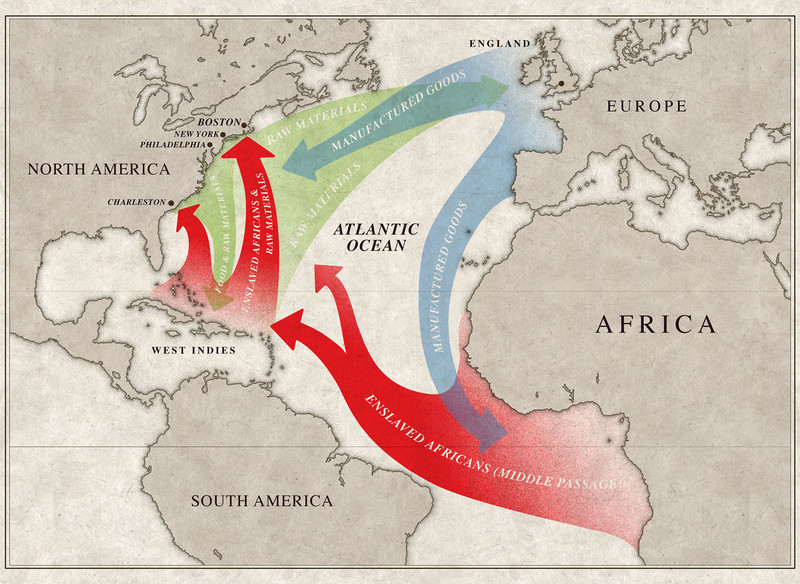
Atlantic trade routes and the Middle Passage
This was not one neat route run from one office in London. It was a web of overlapping imperial, regional, and local trade networks. That’s a favorite APUSH point. The Atlantic economy increased imperial integration but also made colonies dependent on distant markets and rules they did not control.
Goods, Routes, and Regional Specialization
Different parts of the Atlantic world played different roles, and the system only makes sense when you see them together.
| Region | Main role in trade |
|---|---|
| Europe | manufactured goods like textiles, metal goods, and weapons |
| Africa | captives for slavery, plus some trade goods |
| Caribbean | sugar plantations and molasses |
| Chesapeake | tobacco export economy tied to British credit and shipping |
| Lower South | rice and indigo |
| Middle Colonies | wheat, flour, and other grains |
| New England | fish, livestock, lumber, barrel staves, shipbuilding, rum, carrying trade |
| Interior and borderlands | furs and deerskins through Native trade networks |
The triangular trade model helps you picture the system, but don’t treat it like every ship followed one triangle.
- Europe → Africa with textiles, metal goods, weapons
- Africa → Americas through the Middle Passage with enslaved Africans
- Americas → Europe with sugar, tobacco, rice, indigo, furs, timber, naval stores
- Mainland colonies ↔ Caribbean with fish, lumber, provisions, sugar, molasses
A common mistake is forgetting mainland-to-Caribbean trade. That part was huge.
Labor, Slavery, and Trade with Native Peoples
Plantation crops like sugar, tobacco, rice, and indigo took intense labor. Colonizers increasingly relied on enslaved Africans as the main plantation workforce.
Middle Passage
African captives were obtained through warfare, kidnapping, and coastal slave trading systems shaped by European demand. The Middle Passage was the forced Atlantic crossing.
- conditions included overcrowding, violence, disease, malnutrition, and high death rates
- about 12 million Africans were transported across the Atlantic overall
- most were sent to Brazil and the Caribbean, though British North America also depended on slave labor
American Indian slavery existed too, especially in the Southeast, but it did not become the dominant long-term plantation labor system.
Native peoples were also active traders:
- traded furs, deerskins, food, captives, geographic knowledge
- received firearms, metal tools, cloth, beads, alcohol
Trade reshaped Native communities by increasing hunting for European markets, fueling warfare over trade routes, spreading dependence on European goods, and carrying smallpox, measles, and influenza inland, causing major demographic collapse.
Mercantilism and the Navigation Acts
Mercantilism meant colonies existed to strengthen the mother country. Britain wanted raw materials, colonial markets for finished goods, customs revenue, and naval power.
Britain used the Navigation Acts to enforce this system:
- Navigation Act of 1651 restricted trade to English or colonial ships
- Navigation Act of 1660 listed enumerated goods like tobacco and sugar
- Staple Act of 1663 required many European goods to pass through England
- Wool Act of 1699
- Hat Act of 1732
- Molasses Act of 1733
- Iron Act of 1750
- vice-admiralty courts and customs enforcement strengthened imperial control
These laws had mixed effects.
- They helped colonial shipbuilding and gave colonists access to British markets.
- They also limited trade partners, raised costs, and restricted colonial manufacturing.
Why Transatlantic Trade Mattered
Britain could not enforce trade laws consistently. Distance was huge, customs officers were few, bribery was common, and colonists smuggled goods constantly.
Salutary neglect
Salutary neglect meant loose and uneven enforcement of imperial trade rules. Colonists often traded as they pleased, especially by smuggling cheaper molasses from the French and Dutch Caribbean.
Trade helped colonies grow:
- port cities expanded, especially Boston, Newport, New York, Philadelphia, Charleston
- merchant elites, shipyards, warehouses, distilleries, and credit networks grew
- colonists consumed more British goods, which tied them more closely to Britain
This is the core APUSH takeaway. Transatlantic trade made the colonies richer and more connected to the British Empire, but it also taught colonists to resist imperial control. That prosperity rested on slavery, Native dispossession, disease, and imperial rivalry.
Key Takeaways
Atlantic Economy (Atlantic Trading System)
Integrated network linking Europe, Africa, the Caribbean, and mainland America through trade in commodities, manufactured goods, and enslaved people; it promoted regional specialization, prosperity, dependence, and coerced labor
Triangular Trade
Model of Atlantic trade in which goods moved among three regions, often European manufactures to Africa, enslaved Africans to the Americas, and plantation commodities to Europe; actual trade followed many different routes
Transatlantic Slave Trade
Forced transportation of about 12 million captive Africans to the Americas, mostly Brazil and the Caribbean, to supply coerced labor for plantation commodity production
Middle Passage
Forced Atlantic crossing of enslaved Africans to the Americas, marked by confinement, violence, disease, malnutrition, and high mortality
Fur Trade
Exchange in which Native communities supplied furs and deerskins for European goods, shifting hunting and diplomacy while increasing dependence, rivalry, and conflict
Mercantilism
Economic theory that colonies should enrich and strengthen the mother country by supplying raw materials, buying its manufactures, and trading through empire-controlled channels
Navigation Acts (Acts of Trade and Navigation)
British mercantilist laws beginning in 1651 that restricted colonial shipping, markets, imports, and manufacturing to keep commerce and wealth within the empire
Molasses Act of 1733
Law imposing a high duty on molasses from non-British Caribbean islands; mainland merchants widely evaded it through smuggling and bribery
Salutary Neglect
Britain’s loose and inconsistent enforcement of colonial regulations, especially in the early eighteenth century, which allowed colonists to develop expectations of practical economic autonomy
Smuggling
Colonists’ evasion of imperial trade laws through illegal foreign trade, false paperwork, and bribery, which weakened enforcement of British mercantilist policies
Notes
Atlantic Economy (Atlantic Trading System)
Integrated network linking Europe, Africa, the Caribbean, and mainland America through trade in commodities, manufactured goods, and enslaved people; it promoted regional specialization, prosperity, dependence, and coerced labor
Triangular Trade
Model of Atlantic trade in which goods moved among three regions, often European manufactures to Africa, enslaved Africans to the Americas, and plantation commodities to Europe; actual trade followed many different routes
Transatlantic Slave Trade
Forced transportation of about 12 million captive Africans to the Americas, mostly Brazil and the Caribbean, to supply coerced labor for plantation commodity production
Middle Passage
Forced Atlantic crossing of enslaved Africans to the Americas, marked by confinement, violence, disease, malnutrition, and high mortality
Fur Trade
Exchange in which Native communities supplied furs and deerskins for European goods, shifting hunting and diplomacy while increasing dependence, rivalry, and conflict
Mercantilism
Economic theory that colonies should enrich and strengthen the mother country by supplying raw materials, buying its manufactures, and trading through empire-controlled channels
Navigation Acts (Acts of Trade and Navigation)
British mercantilist laws beginning in 1651 that restricted colonial shipping, markets, imports, and manufacturing to keep commerce and wealth within the empire
Molasses Act of 1733
Law imposing a high duty on molasses from non-British Caribbean islands; mainland merchants widely evaded it through smuggling and bribery
Salutary Neglect
Britain’s loose and inconsistent enforcement of colonial regulations, especially in the early eighteenth century, which allowed colonists to develop expectations of practical economic autonomy
Smuggling
Colonists’ evasion of imperial trade laws through illegal foreign trade, false paperwork, and bribery, which weakened enforcement of British mercantilist policies
