Topic 7.11 Notes – Interwar Foreign Policy
What Interwar Foreign Policy Was
This period only makes sense if you keep one idea in mind. Isolationism did not mean total withdrawal.
- After World War I, the Senate rejected the Treaty of Versailles and the League of Nations because many feared collective security would weaken Congress’s power to decide on war.
- The U.S. still acted like a major power. It was the world’s leading creditor nation, had a strong navy, held Pacific and Caribbean interests, and cared about the Open Door in China.
- The best label for the 1920s is unilateral internationalism. The U.S. wanted influence abroad, but on its own terms.
Attitudes you need to tell apart
| View | What it meant |
|---|---|
| Isolationists / noninterventionists | Avoid war and binding commitments overseas |
| Unilateral internationalists | Use diplomacy, trade, loans, and treaties independently |
| Collective-security internationalists | Work with other nations against aggressors |
| Interventionists | Move toward aid, then possible military action against the Axis |
How the United States Tried to Shape the World in the 1920s
Rejecting the League did not end cooperation. The U.S. made a separate peace with Germany and debated joining the World Court, which showed many Americans accepted cooperation if it did not bind the country automatically.
Harding’s return to normalcy meant stepping away from Wilson’s crusading idealism, not abandoning foreign policy.
Arms limitation and peace diplomacy
The clearest example was the Washington Naval Conference, which tried to reduce naval rivalry and manage tensions in the Pacific.
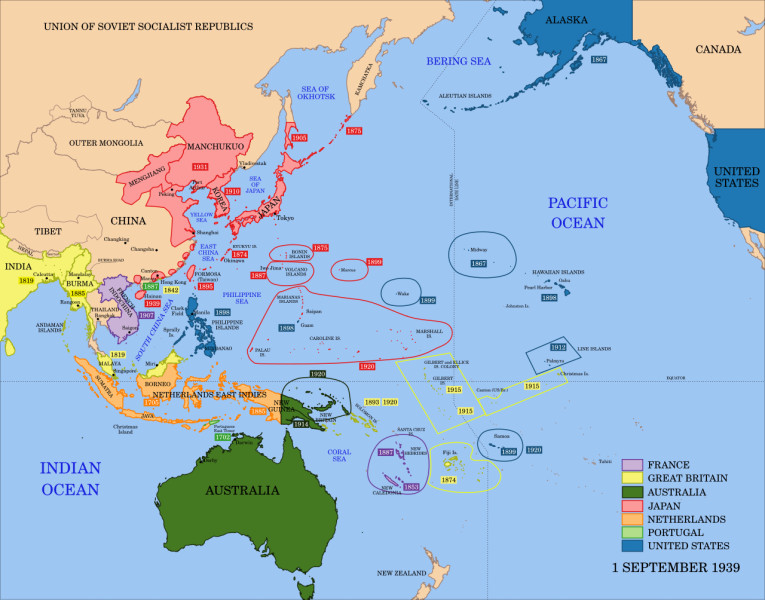
Pacific imperial holdings
- Five-Power Treaty set naval ratios at 5:5:3:1.75:1.75 for the U.S., Britain, Japan, France, and Italy.
- Four-Power Treaty said the U.S., Britain, France, and Japan would consult over Pacific disputes.
- Nine-Power Treaty supported the Open Door policy and China’s territorial integrity.
The Kellogg-Briand Pact of 1928, written by Frank Kellogg and Aristide Briand, renounced war as national policy. Its weakness was obvious. It had no enforcement, so it did nothing to stop Manchuria, Ethiopia, or later German expansion.
Economic diplomacy
The U.S. also tried to stabilize Europe through money.
- U.S. banks loaned money to Germany.
- Germany paid reparations to Britain and France.
- Britain and France repaid war debts to the U.S.
The Dawes Plan started this cycle, and the Young Plan revised it. The whole system was shaky because it depended on constant American lending and was hurt by high U.S. tariffs.
Intervention in the Western Hemisphere and the Good Neighbor Shift
Even during “isolationism,” the U.S. kept intervening in Latin America.
- U.S. occupation of Haiti lasted until 1934.
- U.S. involvement in Nicaragua lasted from 1912 to 1933.
- In Nicaragua, resistance was led by Augusto César Sandino.
Under Franklin Roosevelt, the Good Neighbor Policy changed the method.
- At the Montevideo Conference in 1933, the U.S. accepted nonintervention.
- The U.S. withdrew from Haiti in 1934.
- A 1934 Cuba treaty ended most of the Platt Amendment, though Guantánamo stayed.
- When Mexico nationalized oil in 1938, the U.S. negotiated instead of invading.
This was a real shift, but the goal stayed the same. The U.S. still wanted stability and influence in the hemisphere.
Why Nonintervention Stayed Strong in the 1930s
Aggression was rising fast. Japan took Manchuria in 1931, leading to the Stimson Doctrine. Italy invaded Ethiopia in 1935. Hitler’s Germany moved into the Rhineland, Austria, the Sudetenland, and then Czechoslovakia. Japan expanded deeper into China after 1937.
Many Americans still opposed war because of World War I trauma, unpaid debts, the Great Depression, and the Nye Committee, which blamed “merchants of death.”
Neutrality Acts
- 1935 banned arms sales to belligerents.
- 1936 added a ban on loans and credits.
- 1937 applied to civil wars and allowed limited cash-and-carry for nonmilitary goods, which mattered in the Spanish Civil War.
- 1939, after Germany invaded Poland, allowed arms sales on cash-and-carry, helping Britain and France most.
The problem was that neutrality treated aggressors and victims the same.
Roosevelt’s Shift from Neutrality to Aid and Pearl Harbor
Roosevelt moved carefully because public opinion was split. His Quarantine Speech in 1937 hinted that aggressors should be isolated, but many Americans disliked that idea. The USS Panay incident the same year showed how close conflict in Asia could come to the U.S.
After the fall of France in 1940, helping Britain looked more urgent. The debate sharpened between the America First Committee and Charles Lindbergh, versus the Committee to Defend America by Aiding the Allies.
Major steps short of war:
- Destroyers-for-Bases Agreement in 1940
- Selective Training and Service Act in 1940, the first peacetime draft
- Roosevelt’s arsenal of democracy speech
- Lend-Lease Act in 1941 for Britain, later the Soviet Union and China
- Atlantic Charter with Winston Churchill
- undeclared naval fighting after the USS Greer incident
Against Japan, the U.S. used sanctions and an oil embargo after Japan occupied southern French Indochina. Negotiations failed over China and East Asia. The attack on Pearl Harbor on December 7, 1941, brought the U.S. into the war.
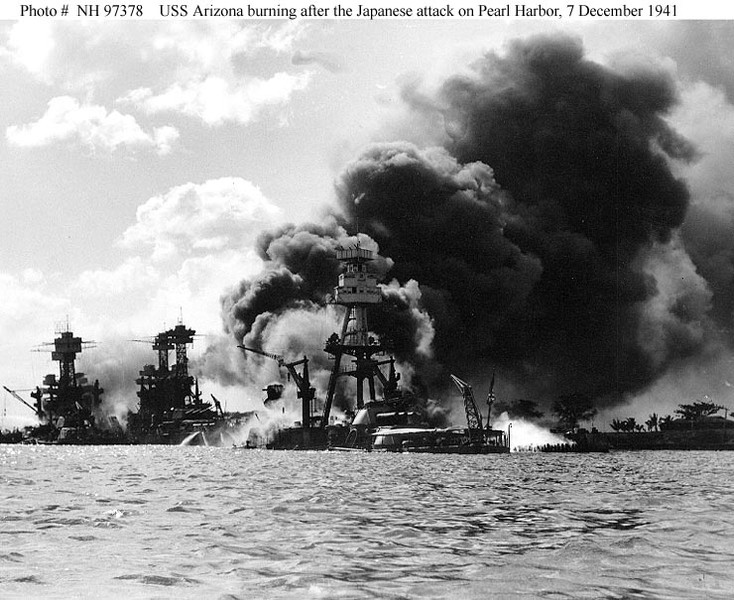
USS Arizona burning at Pearl Harbor, December 7, 1941
Jeannette Rankin cast the lone vote against war.
Key Takeaways
Unilateral Internationalism / Unilateral Foreign Policy
Active U.S. diplomacy, investment, treaties, and selective intervention without binding alliances or surrendering independent decision-making
Isolationism / Noninterventionism
Opposition to binding security commitments and direct participation in foreign wars, not complete diplomatic or economic withdrawal
Collective-Security Internationalism
The belief that nations should cooperate to deter or resist aggression
Interventionism
Support for material aid and, increasingly, military action against the Axis powers
Return to Normalcy
Harding’s call to move away from Wilsonian crusades and wartime conditions while continuing independent U.S. engagement abroad
Warren G. Harding
President who promoted a return to normalcy and favored negotiation, naval limitation, investment, and independent American action
World Court / Permanent Court of International Justice
International court the United States considered joining but ultimately avoided because of Senate conditions and fears of League entanglement
Washington Naval Conference
1921–1922 U.S.-led conference that limited naval armaments and addressed Pacific disputes through the Five-, Four-, and Nine-Power Treaties
Five-Power Treaty
Naval treaty limiting capital-ship tonnage at a 5:5:3:1.75:1.75 ratio for the United States, Britain, Japan, France, and Italy
Four-Power Treaty
Agreement among the United States, Britain, France, and Japan to consult over Pacific disputes without requiring automatic military action
Nine-Power Treaty
Agreement affirming Chinese territorial integrity and equal commercial access under the Open Door, but lacking effective enforcement
Open Door Policy
U.S. principle favoring Chinese territorial integrity and equal commercial access for foreign powers
Kellogg–Briand Pact
1928 pact negotiated by Frank Kellogg and Aristide Briand that renounced war but provided no effective enforcement mechanism
Economic Diplomacy
Use of American trade, investment, loans, and financial influence to promote stability and prosperity without military commitments
Dawes Plan
1924 arrangement in which U.S. banks loaned Germany money to pay Allied reparations, allowing Britain and France to repay U.S. war debts
Young Plan
1929 plan that reduced and rescheduled German reparations but left European recovery dependent on unstable American lending
Good Neighbor Policy
Franklin Roosevelt’s policy of renouncing armed intervention in Latin America and emphasizing consultation, trade, and diplomatic cooperation
Franklin D. Roosevelt
President who adopted the Good Neighbor Policy and gradually shifted the United States from neutrality toward aid for the Allies
Fascism
Dictatorial, expansionist system represented by Mussolini’s Italy and Hitler’s Nazi Germany that alarmed many Americans during the 1930s
Totalitarianism
A system in which a centralized government seeks extensive control over political, social, and cultural life and suppresses opposition
Benito Mussolini
Fascist dictator of Italy whose expansion included the 1935 invasion of Ethiopia
Adolf Hitler
Nazi dictator who rearmed Germany, overturned the Versailles settlement, and pursued territorial expansion across Europe
Japanese Militarism
Military-dominated Japanese expansion seeking control of China and Southeast Asia for empire, strategic power, and raw materials
Stimson Doctrine
Henry Stimson’s declaration that the United States would not recognize territorial changes produced by Japan’s treaty-violating conquest of Manchuria
Munich Agreement
1938 agreement that allowed Germany to acquire the Sudetenland from Czechoslovakia without stopping Hitler’s further expansion
Nye Committee
1934–1936 Senate investigation whose hearings encouraged the belief that bankers and arms makers had drawn the United States into World War I for profit
Neutrality Acts
Congressional laws restricting arms sales, loans, and other relations with belligerents to prevent another path into war like that of World War I.
Neutrality Act of 1935
Prohibited U.S. sales of arms and ammunition to belligerents once the president recognized a state of war
Neutrality Act of 1936
Renewed the arms embargo and prohibited American loans or credits to belligerent nations
Neutrality Act of 1937
Extended neutrality restrictions to civil wars while allowing cash-and-carry purchases of certain nonmilitary goods
Cash-and-Carry
Policy requiring belligerents to pay cash for permitted U.S. goods and transport them in their own ships
Neutrality Act of 1939
Ended the mandatory arms embargo and allowed belligerents to purchase weapons on a cash-and-carry basis, chiefly benefiting Britain and France
Quarantine Speech
Roosevelt’s 1937 call for peace-loving nations to quarantine aggressors; the hostile public reaction revealed strong noninterventionism
USS Panay Incident
Japan’s 1937 sinking of an American gunboat in China; Japan apologized and paid compensation, preventing escalation into war
America First Committee
Leading noninterventionist organization formed in 1940 to support national defense while opposing steps likely to bring the United States into war
Charles Lindbergh
Famous aviator and best-known spokesman for the noninterventionist America First Committee
Committee to Defend America by Aiding the Allies
Internationalist group arguing that aid to Britain could protect U.S. security and prevent the need for direct American combat
Destroyers-for-Bases Agreement
1940 executive agreement transferring 50 older U.S. destroyers to Britain for 99-year leases on British base sites in the Western Hemisphere
Selective Training and Service Act
1940 law establishing the first peacetime military draft in American history
Arsenal of Democracy
Roosevelt’s call for American industry to supply the nations fighting the Axis even while the United States remained formally outside the war
Lend-Lease Act
1941 law authorizing Roosevelt to provide defense materials to countries whose defense he considered vital to the United States
Atlantic Charter
1941 Roosevelt–Churchill statement supporting self-determination, freer trade, economic cooperation, freedom of the seas, and collective security
U.S. Oil Embargo Against Japan
The 1941 asset freeze and cutoff of American oil after Japan occupied southern French Indochina, creating a strategic crisis for Japan
Attack on Pearl Harbor
Japan’s December 7, 1941 attack on the U.S. Pacific Fleet in Hawaii, which ended the intervention debate and brought the United States into World War II.
League of Nations
Collective-security organization the United States never joined because opponents feared its obligations would limit Congress’s authority to decide on war
Herbert Hoover
President whose administration issued the Stimson Doctrine and began moving away from armed intervention in Latin America
Henry Stimson
Hoover’s secretary of state who announced that the United States would not recognize Japan’s conquest of Manchuria
Notes
Unilateral Internationalism / Unilateral Foreign Policy
Active U.S. diplomacy, investment, treaties, and selective intervention without binding alliances or surrendering independent decision-making
Isolationism / Noninterventionism
Opposition to binding security commitments and direct participation in foreign wars, not complete diplomatic or economic withdrawal
Collective-Security Internationalism
The belief that nations should cooperate to deter or resist aggression
Interventionism
Support for material aid and, increasingly, military action against the Axis powers
Return to Normalcy
Harding’s call to move away from Wilsonian crusades and wartime conditions while continuing independent U.S. engagement abroad
Warren G. Harding
President who promoted a return to normalcy and favored negotiation, naval limitation, investment, and independent American action
World Court / Permanent Court of International Justice
International court the United States considered joining but ultimately avoided because of Senate conditions and fears of League entanglement
Washington Naval Conference
1921–1922 U.S.-led conference that limited naval armaments and addressed Pacific disputes through the Five-, Four-, and Nine-Power Treaties
Five-Power Treaty
Naval treaty limiting capital-ship tonnage at a 5:5:3:1.75:1.75 ratio for the United States, Britain, Japan, France, and Italy
Four-Power Treaty
Agreement among the United States, Britain, France, and Japan to consult over Pacific disputes without requiring automatic military action
Nine-Power Treaty
Agreement affirming Chinese territorial integrity and equal commercial access under the Open Door, but lacking effective enforcement
Open Door Policy
U.S. principle favoring Chinese territorial integrity and equal commercial access for foreign powers
Kellogg–Briand Pact
1928 pact negotiated by Frank Kellogg and Aristide Briand that renounced war but provided no effective enforcement mechanism
Economic Diplomacy
Use of American trade, investment, loans, and financial influence to promote stability and prosperity without military commitments
Dawes Plan
1924 arrangement in which U.S. banks loaned Germany money to pay Allied reparations, allowing Britain and France to repay U.S. war debts
Young Plan
1929 plan that reduced and rescheduled German reparations but left European recovery dependent on unstable American lending
Good Neighbor Policy
Franklin Roosevelt’s policy of renouncing armed intervention in Latin America and emphasizing consultation, trade, and diplomatic cooperation
Franklin D. Roosevelt
President who adopted the Good Neighbor Policy and gradually shifted the United States from neutrality toward aid for the Allies
Fascism
Dictatorial, expansionist system represented by Mussolini’s Italy and Hitler’s Nazi Germany that alarmed many Americans during the 1930s
Totalitarianism
A system in which a centralized government seeks extensive control over political, social, and cultural life and suppresses opposition
Benito Mussolini
Fascist dictator of Italy whose expansion included the 1935 invasion of Ethiopia
Adolf Hitler
Nazi dictator who rearmed Germany, overturned the Versailles settlement, and pursued territorial expansion across Europe
Japanese Militarism
Military-dominated Japanese expansion seeking control of China and Southeast Asia for empire, strategic power, and raw materials
Stimson Doctrine
Henry Stimson’s declaration that the United States would not recognize territorial changes produced by Japan’s treaty-violating conquest of Manchuria
Munich Agreement
1938 agreement that allowed Germany to acquire the Sudetenland from Czechoslovakia without stopping Hitler’s further expansion
Nye Committee
1934–1936 Senate investigation whose hearings encouraged the belief that bankers and arms makers had drawn the United States into World War I for profit
Neutrality Acts
Congressional laws restricting arms sales, loans, and other relations with belligerents to prevent another path into war like that of World War I.
Neutrality Act of 1935
Prohibited U.S. sales of arms and ammunition to belligerents once the president recognized a state of war
Neutrality Act of 1936
Renewed the arms embargo and prohibited American loans or credits to belligerent nations
Neutrality Act of 1937
Extended neutrality restrictions to civil wars while allowing cash-and-carry purchases of certain nonmilitary goods
Cash-and-Carry
Policy requiring belligerents to pay cash for permitted U.S. goods and transport them in their own ships
Neutrality Act of 1939
Ended the mandatory arms embargo and allowed belligerents to purchase weapons on a cash-and-carry basis, chiefly benefiting Britain and France
Quarantine Speech
Roosevelt’s 1937 call for peace-loving nations to quarantine aggressors; the hostile public reaction revealed strong noninterventionism
USS Panay Incident
Japan’s 1937 sinking of an American gunboat in China; Japan apologized and paid compensation, preventing escalation into war
America First Committee
Leading noninterventionist organization formed in 1940 to support national defense while opposing steps likely to bring the United States into war
Charles Lindbergh
Famous aviator and best-known spokesman for the noninterventionist America First Committee
Committee to Defend America by Aiding the Allies
Internationalist group arguing that aid to Britain could protect U.S. security and prevent the need for direct American combat
Destroyers-for-Bases Agreement
1940 executive agreement transferring 50 older U.S. destroyers to Britain for 99-year leases on British base sites in the Western Hemisphere
Selective Training and Service Act
1940 law establishing the first peacetime military draft in American history
Arsenal of Democracy
Roosevelt’s call for American industry to supply the nations fighting the Axis even while the United States remained formally outside the war
Lend-Lease Act
1941 law authorizing Roosevelt to provide defense materials to countries whose defense he considered vital to the United States
Atlantic Charter
1941 Roosevelt–Churchill statement supporting self-determination, freer trade, economic cooperation, freedom of the seas, and collective security
U.S. Oil Embargo Against Japan
The 1941 asset freeze and cutoff of American oil after Japan occupied southern French Indochina, creating a strategic crisis for Japan
Attack on Pearl Harbor
Japan’s December 7, 1941 attack on the U.S. Pacific Fleet in Hawaii, which ended the intervention debate and brought the United States into World War II.
League of Nations
Collective-security organization the United States never joined because opponents feared its obligations would limit Congress’s authority to decide on war
Herbert Hoover
President whose administration issued the Stimson Doctrine and began moving away from armed intervention in Latin America
Henry Stimson
Hoover’s secretary of state who announced that the United States would not recognize Japan’s conquest of Manchuria
