Topic 4.5 Notes – Market Revolution: Industrialization
What the Market Revolution Was
The Market Revolution changed how Americans produced, sold, and bought goods. Before 1800, many families still made a lot of what they used and farmed partly for themselves. Markets already existed, but most exchange was local.
By the early 1800s, more people depended on:
- commercial agriculture instead of semisubsistence farming
- factory production instead of household production
- wage labor instead of working mainly for the household economy
- regional, national, and international markets instead of nearby buyers only
What changed was scale, speed, organization, and dependence on distant prices.
Industrialization was one piece of this larger shift. It happened because several forces worked together:
- population growth created more workers and consumers
- westward expansion onto Indigenous land opened new farmland
- abundant natural resources supplied land, rivers, timber, and minerals
- private investment funded mills, roads, and canals
- British industrial models gave Americans machinery ideas to copy
- Embargo Act of 1807 and the War of 1812 cut imports and pushed Americans to make more goods at home
How Production Became Mechanized and Organized
Entrepreneurs changed production by gathering capital, machinery, workers, and raw materials in one place. That became the factory system.
Instead of one artisan making a whole product, factories used:
- wage labor
- task specialization
- standardized output
Early industrialization grew fastest in the Northeast, especially in textiles.
Samuel Slater
- In 1790, Slater opened a mill in Pawtucket, Rhode Island.
- He copied British spinning technology from memory.
- His mill used water power to spin cotton and helped create the early mill village model.
Francis Cabot Lowell and the Waltham-Lowell system
- Lowell helped found the Boston Manufacturing Company at Waltham in 1814.
- This system put spinning and weaving under one roof.
- Lowell, Massachusetts became the classic factory town and the best example of organized factory production.
That factory-centered model is what students usually picture in Lowell, with large brick mill buildings gathered in one industrial complex.
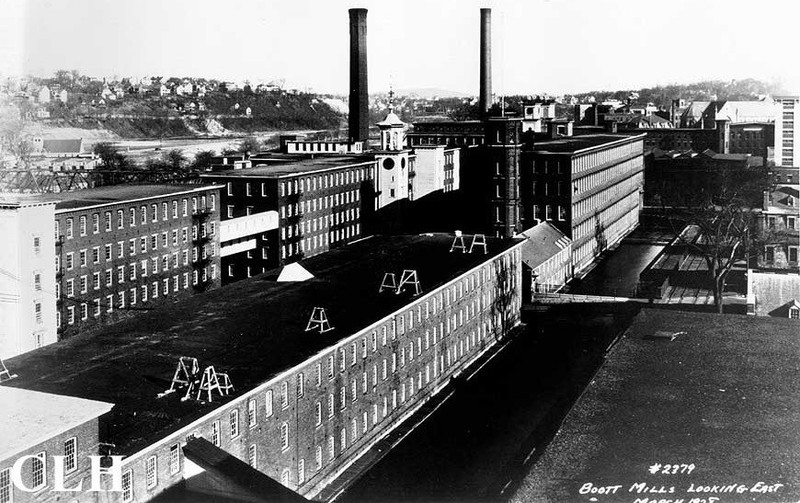
Boott Mills in Lowell, Massachusetts
Major industrial innovations
- textile machinery and power looms increased cloth output
- steam engines expanded machine power and transformed transportation
- interchangeable parts made standardized manufacturing possible
- Eli Whitney is the famous name here
- the system was developed in practice by federal armories at Springfield and Harpers Ferry and by Simeon North
- telegraph
- Samuel Morse
- in 1844, sent “What hath God wrought”
- sped up prices, orders, and business coordination
How Transportation and Government Expanded Markets
Factories and farms needed bigger markets, so transportation had to improve too. Roads, canals, steamboats, railroads, and the telegraph worked together to cut shipping time and cost.
- Lancaster Turnpike was an early road model.
- National Road or Cumberland Road
- authorized in 1806
- first major federally funded highway
- linked the East with the trans-Appalachian West
- Erie Canal
- completed in 1825 under DeWitt Clinton
- connected the Hudson River to Lake Erie
- slashed freight costs and helped make New York City the top commercial port
- Clermont
- Robert Fulton’s successful steamboat in 1807
- made upstream trade practical on the Mississippi and Ohio rivers
- Baltimore and Ohio Railroad
- chartered in 1827
- railroads spread in the 1830s and 1840s because they were faster and more flexible than canals
This map pulls several of those links together, especially the Erie Canal, the Hudson River route, the Ohio River system, and the early Baltimore and Ohio line.
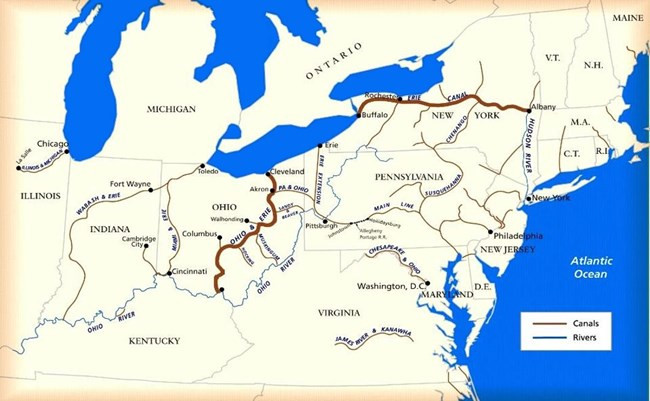
Early U.S. canals, rivers, and rail connections
Government helped this growth through charters, patents, stock purchases, corporate support, and eminent domain.
Important court cases:
- Dartmouth College v. Woodward protected corporate charters as contracts
- Gibbons v. Ogden supported federal power over interstate commerce
- Charles River Bridge v. Warren Bridge favored competition and new development
How Agriculture and Cotton Reshaped the National Economy
Agriculture became more productive and more market-oriented at the same time factories expanded.
- Eli Whitney’s cotton gin in 1793
- made short-staple cotton highly profitable
- expanded slavery instead of shrinking it
- helped build the Cotton Belt in Alabama, Mississippi, Louisiana, Arkansas, and Texas
- Cyrus McCormick’s mechanical reaper in 1834
- sped grain harvesting
- supported large-scale Midwestern wheat farming
- John Deere’s steel plow in 1837
- cut through prairie soil
- boosted Midwestern productivity
Cotton tied regions together:
- Southern plantations grew raw cotton with enslaved labor
- Northern mills turned it into textiles
- Northern banks, merchants, shippers, and insurers profited too
- British factories depended heavily on American cotton
- By 1840, cotton made up more than half of U.S. export value
Regional Specialization and Why It Mattered
The Market Revolution connected the country, but it also pushed regions into different roles.
| Region | Main specialization |
|---|---|
| Northeast | manufacturing, banking, shipping, commerce |
| Midwest | grain and livestock for eastern and southern markets |
| South | cotton and plantation agriculture |
Transportation tied the North and Midwest together more tightly than either was tied to the South. That matters because the same economy that made the U.S. more integrated also strengthened sectionalism. A national market grew, but so did slavery, cotton dependence, and the economic divide that fed later conflict.
Key Takeaways
Market Revolution
Early-1800s shift from local exchange and household production toward commercial farming, factories, wage labor, and regional, national, and international markets
Industrialization
Reorganization of manufacturing around mechanized factory production, specialized tasks, standardized goods, and wage labor
Entrepreneurs
Risk-taking investors who assembled capital, machinery, raw materials, transportation, and labor to increase output and reach larger markets
Putting-Out System
Manufacturing system in which merchants supplied raw materials to rural households that completed stages of production for payment
Factory System
Production system concentrating workers, machinery, power, and raw materials in one location under an owner's control
Wage Labor
Economic arrangement in which workers sell their labor for pay rather than owning the productive property themselves
Samuel Slater
British-trained mechanic who reconstructed spinning machinery and established a water-powered cotton-spinning mill in Pawtucket, Rhode Island, in 1790
Francis Cabot Lowell
Entrepreneur who helped introduce the power loom and created an integrated Massachusetts textile factory combining spinning and weaving
Lowell System
Integrated water-powered textile system combining spinning and weaving under one roof and initially employing young unmarried women housed in company boardinghouses
Textile Machinery
Mechanized spinning frames and power looms that greatly increased thread and cloth production and expanded demand for Southern cotton
Steam Engine
Machine converting heat into mechanical power, reducing dependence on waterpower and transforming transportation through steam navigation
Steamboats
Steam-powered vessels that carried freight and passengers reliably upstream and downstream, reducing the time and cost of inland commerce
Robert Fulton
Entrepreneur whose Clermont demonstrated commercially successful steam navigation on the Hudson River in 1807
Interchangeable Parts
Uniform components that could replace one another without custom fitting, simplifying assembly and repair and preparing the way for mass production
Eli Whitney
Inventor who patented the cotton gin and later promoted standardized, interchangeable gun parts through a federal firearms contract
Telegraph
Electrical communication system that transmitted business information rapidly across long distances, separating communication from physical transportation
Samuel Morse
Inventor who, with associates, developed an effective electrical telegraph and Morse code and demonstrated them between Washington and Baltimore in 1844
Cotton Gin
Eli Whitney's 1793 machine for separating cotton fiber from seeds, which made short-staple cotton profitable and encouraged plantation expansion and slavery
Cotton Belt
Expanding cotton-growing region stretching westward across the Deep South as profitable plantations and enslaved labor moved onto new lands
Mechanical Reaper
Grain-harvesting machine patented in 1834 that reduced harvest labor and encouraged large-scale commercial wheat farming in the Midwest
Cyrus McCormick
Inventor who patented the mechanical reaper in 1834, making grain harvesting faster and supporting Midwestern commercial agriculture
Steel Plow
Polished steel plow that cut through thick Midwestern prairie soil with less sticking, making cultivation more efficient
John Deere
Inventor who developed a successful steel plow in 1837 for cultivating the heavy prairie soils of the Midwest
Transportation Revolution
Expansion of roads, canals, steamboats, and railroads that lowered shipping costs, accelerated travel, and connected producers with distant markets
Turnpikes
Improved toll roads generally built by state-chartered private companies to speed travel and overland trade
National Road / Cumberland Road
First major federally funded highway, connecting the East with the Ohio River and facilitating migration, mail, travel, and trade
Internal Improvements
Government-supported transportation projects such as roads, canals, river improvements, and railroads intended to promote commerce and national integration
Erie Canal
New York canal completed in 1825 linking the Hudson River with Lake Erie, sharply reducing freight costs and connecting the Midwest to New York City
DeWitt Clinton
New York governor who led the state-financed construction of the Erie Canal after the federal government declined to support it
Railroads
Fast, increasingly year-round transportation lines that reached places without navigable waterways and linked the Northeast and Midwest especially closely
Corporations
State-chartered organizations legally distinct from their owners that pooled investors' capital for factories, banks, canals, turnpikes, and railroads
Patent System
Federal system granting inventors temporary exclusive rights to profit from inventions, encouraging technological experimentation and investment
Dartmouth College v. Woodward
1819 Supreme Court ruling that treated a corporate charter as a contract protected from state impairment, increasing security for corporations and investors
Gibbons v. Ogden
1824 Supreme Court ruling invalidating New York's steamboat monopoly and broadly affirming federal power over interstate commerce
Charles River Bridge v. Warren Bridge
1837 Supreme Court ruling rejecting an implied monopoly in an older charter and favoring competition and public improvement
Regional Specialization
Concentration of manufacturing, finance, and shipping in the Northeast; grain and livestock in the Midwest; and cotton agriculture in the South
Regional Interdependence
Mutual reliance as the Northeast supplied manufacturing and finance, the Midwest supplied food, and the South supplied cotton
Cotton Economy
Commercial system linking enslaved Southern cotton production with Northern manufacturing, banking, insurance, shipping, and British textile demand
Commercial Agriculture / Commercial Farming
Farming organized to produce crops and livestock for sale in distant markets rather than primarily for household use
Notes
Market Revolution
Early-1800s shift from local exchange and household production toward commercial farming, factories, wage labor, and regional, national, and international markets
Industrialization
Reorganization of manufacturing around mechanized factory production, specialized tasks, standardized goods, and wage labor
Entrepreneurs
Risk-taking investors who assembled capital, machinery, raw materials, transportation, and labor to increase output and reach larger markets
Putting-Out System
Manufacturing system in which merchants supplied raw materials to rural households that completed stages of production for payment
Factory System
Production system concentrating workers, machinery, power, and raw materials in one location under an owner's control
Wage Labor
Economic arrangement in which workers sell their labor for pay rather than owning the productive property themselves
Samuel Slater
British-trained mechanic who reconstructed spinning machinery and established a water-powered cotton-spinning mill in Pawtucket, Rhode Island, in 1790
Francis Cabot Lowell
Entrepreneur who helped introduce the power loom and created an integrated Massachusetts textile factory combining spinning and weaving
Lowell System
Integrated water-powered textile system combining spinning and weaving under one roof and initially employing young unmarried women housed in company boardinghouses
Textile Machinery
Mechanized spinning frames and power looms that greatly increased thread and cloth production and expanded demand for Southern cotton
Steam Engine
Machine converting heat into mechanical power, reducing dependence on waterpower and transforming transportation through steam navigation
Steamboats
Steam-powered vessels that carried freight and passengers reliably upstream and downstream, reducing the time and cost of inland commerce
Robert Fulton
Entrepreneur whose Clermont demonstrated commercially successful steam navigation on the Hudson River in 1807
Interchangeable Parts
Uniform components that could replace one another without custom fitting, simplifying assembly and repair and preparing the way for mass production
Eli Whitney
Inventor who patented the cotton gin and later promoted standardized, interchangeable gun parts through a federal firearms contract
Telegraph
Electrical communication system that transmitted business information rapidly across long distances, separating communication from physical transportation
Samuel Morse
Inventor who, with associates, developed an effective electrical telegraph and Morse code and demonstrated them between Washington and Baltimore in 1844
Cotton Gin
Eli Whitney's 1793 machine for separating cotton fiber from seeds, which made short-staple cotton profitable and encouraged plantation expansion and slavery
Cotton Belt
Expanding cotton-growing region stretching westward across the Deep South as profitable plantations and enslaved labor moved onto new lands
Mechanical Reaper
Grain-harvesting machine patented in 1834 that reduced harvest labor and encouraged large-scale commercial wheat farming in the Midwest
Cyrus McCormick
Inventor who patented the mechanical reaper in 1834, making grain harvesting faster and supporting Midwestern commercial agriculture
Steel Plow
Polished steel plow that cut through thick Midwestern prairie soil with less sticking, making cultivation more efficient
John Deere
Inventor who developed a successful steel plow in 1837 for cultivating the heavy prairie soils of the Midwest
Transportation Revolution
Expansion of roads, canals, steamboats, and railroads that lowered shipping costs, accelerated travel, and connected producers with distant markets
Turnpikes
Improved toll roads generally built by state-chartered private companies to speed travel and overland trade
National Road / Cumberland Road
First major federally funded highway, connecting the East with the Ohio River and facilitating migration, mail, travel, and trade
Internal Improvements
Government-supported transportation projects such as roads, canals, river improvements, and railroads intended to promote commerce and national integration
Erie Canal
New York canal completed in 1825 linking the Hudson River with Lake Erie, sharply reducing freight costs and connecting the Midwest to New York City
DeWitt Clinton
New York governor who led the state-financed construction of the Erie Canal after the federal government declined to support it
Railroads
Fast, increasingly year-round transportation lines that reached places without navigable waterways and linked the Northeast and Midwest especially closely
Corporations
State-chartered organizations legally distinct from their owners that pooled investors' capital for factories, banks, canals, turnpikes, and railroads
Patent System
Federal system granting inventors temporary exclusive rights to profit from inventions, encouraging technological experimentation and investment
Dartmouth College v. Woodward
1819 Supreme Court ruling that treated a corporate charter as a contract protected from state impairment, increasing security for corporations and investors
Gibbons v. Ogden
1824 Supreme Court ruling invalidating New York's steamboat monopoly and broadly affirming federal power over interstate commerce
Charles River Bridge v. Warren Bridge
1837 Supreme Court ruling rejecting an implied monopoly in an older charter and favoring competition and public improvement
Regional Specialization
Concentration of manufacturing, finance, and shipping in the Northeast; grain and livestock in the Midwest; and cotton agriculture in the South
Regional Interdependence
Mutual reliance as the Northeast supplied manufacturing and finance, the Midwest supplied food, and the South supplied cotton
Cotton Economy
Commercial system linking enslaved Southern cotton production with Northern manufacturing, banking, insurance, shipping, and British textile demand
Commercial Agriculture / Commercial Farming
Farming organized to produce crops and livestock for sale in distant markets rather than primarily for household use
