Topic 4.14 Notes – Causation in Period 4
How Politics Shaped American Identity
Politics gave many Americans a shared public life. The biggest change was expanded white male suffrage. States gradually dropped property requirements, so voting became tied to being an adult white man rather than a property owner. That made democracy feel broader, but only for some people.
The Election of 1800 mattered because power passed peacefully from Federalists to Democratic-Republicans. That showed partisan conflict could exist inside a stable republic.
Party politics as shared culture
National parties helped people feel connected to national issues, not just local ones.
- First Party System
- Federalists favored stronger central government and commercial growth.
- Democratic-Republicans favored limited federal power and an agrarian vision.
- Second Party System
- Democrats backed Jackson and claimed to defend the “common man.”
- Whigs backed Henry Clay’s activist government and economic development.
Campaigns became mass events through rallies, newspapers, conventions, slogans, and rising voter turnout. Citizenship started to feel like participation.
Who got left out
This democratic identity had hard boundaries:
- Women could not vote.
- Free African Americans lost voting rights in some states.
- American Indians were excluded from the political nation.
Federal power and sectional pushback
The Supreme Court strengthened national authority:
- Marbury v. Madison established judicial review.
- McCulloch v. Maryland upheld the national bank and denied states the right to tax it.
- Gibbons v. Ogden expanded federal control over interstate commerce.
That encouraged constitutional nationalism, but sectional conflict kept growing.
- Henry Clay’s American System tried to bind the nation together through a national bank, protective tariff, and internal improvements.
- The Nullification Crisis showed South Carolina resisting federal tariffs and claiming state power.
- The Missouri Compromise kept a temporary balance between free and slave states, but it exposed how expansion kept reopening the slavery issue.
A map of the compromise helps you see that balance at a glance, especially the split between free and slave states and the line drawn across the Louisiana Purchase.
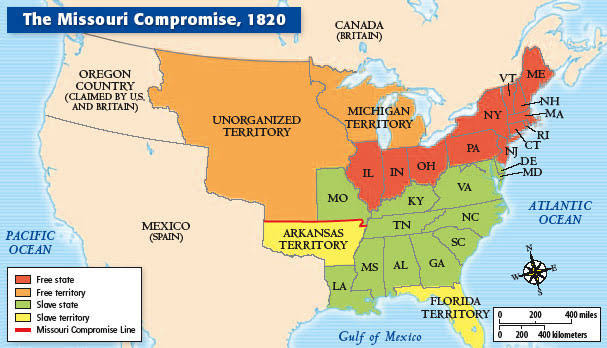
Missouri Compromise map, 1820
How the Market Revolution Connected the Nation and Divided It
The market revolution was the shift from producing mostly for local use to producing for distant markets. This changed how Americans worked, traveled, and thought about the economy.
Tools of change
- Cotton gin made short-staple cotton hugely profitable and expanded slavery.
- Textile machinery concentrated production in factories.
- Interchangeable parts sped up manufacturing.
- Steamboats, the National Road, the Erie Canal, and early railroads cut time and cost.
- The telegraph sped up communication.
- Government helped through charters, contract protection, and transportation funding.
The Embargo Act of 1807 and the War of 1812 disrupted foreign trade, which pushed Americans toward domestic manufacturing. Protective tariffs after the war helped that growth continue.
How integration worked
- Better transportation lowered shipping costs.
- Lower costs opened larger markets.
- Larger markets encouraged regional specialization.
- Regions became economically interdependent.
- Americans increasingly saw a single national economy.
New York's canal and rail network is a good example of how transportation tied local producers to wider markets.
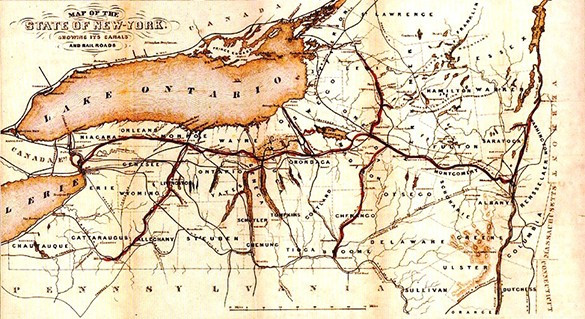
New York transportation network, including the Erie Canal
Regional patterns and social effects
| Region | Main pattern |
|---|---|
| Northeast | manufacturing, wage labor, urbanization, banking |
| West/Old Northwest | commercial agriculture |
| South | cotton plantation economy and slavery |
Socially, this created Lowell mills with young women workers, a larger wage labor force, sharper class divisions, and the separate spheres idea. Immigration also grew, especially Irish and German immigrants in the 1840s.
How Foreign Policy and Expansion Fueled Nationalism
Foreign policy made the U.S. look more independent and ambitious.
- Louisiana Purchase doubled U.S. territory.
- Lewis and Clark expedition explored and mapped it.
- Adams-Onís Treaty gained Florida.
- Annexation of Texas, Oregon settlement, Mexican-American War, and the Treaty of Guadalupe Hidalgo kept expansion going.
- Manifest Destiny gave that expansion a moral and nationalist language.
This map pulls those major land gains together, from the Louisiana Purchase to Oregon, Texas, Florida, and the Mexican Cession.
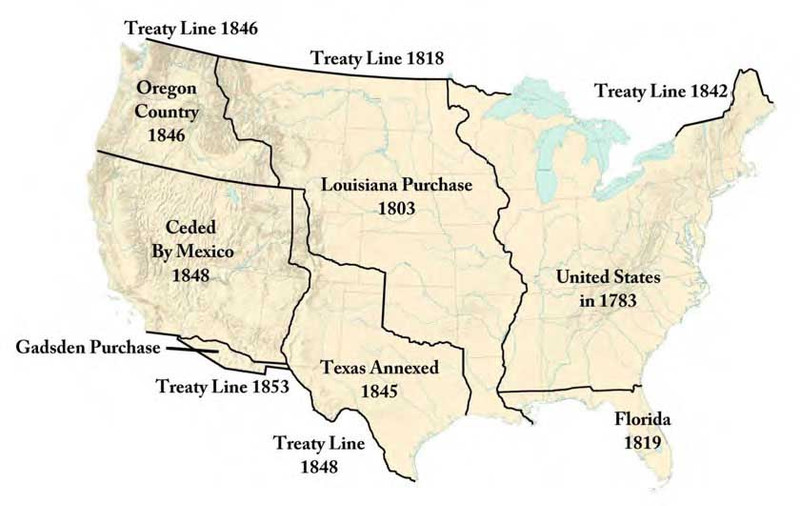
Major U.S. territorial expansion, 1783 to 1853
The War of 1812 also boosted nationalism. Causes included impressment, trade interference, and pressure from War Hawks. The Treaty of Ghent ended the war, the Battle of New Orleans created a sense of victory, and “The Star-Spangled Banner” became a patriotic symbol. The war also weakened the Federalists.
The Monroe Doctrine declared no new European colonization in the Western Hemisphere. It had little immediate force, but huge symbolic value.
Expansion had a brutal side. The Indian Removal Act, Worcester v. Georgia, and the Trail of Tears show that national growth often meant conquest and exclusion.
How Reform and Culture Defined the Nation’s Ideals
Americans also built identity through religion, art, writing, and reform. The Second Great Awakening emphasized individual salvation, moral improvement, and voluntary associations, which fed reform movements.
Reformers pushed temperance, abolitionism, education reform, prison and asylum reform, women’s rights, missionary work, and utopian communities. At Seneca Falls, the Declaration of Sentiments insisted that “all men and women are created equal.”
A distinct national culture appeared in Washington Irving, James Fenimore Cooper, the Hudson River School, and transcendentalism through Ralph Waldo Emerson and Henry David Thoreau.
Competing identities stayed strong too:
- Southern proslavery identity
- African American community institutions
- Immigrant ethnic and religious cultures
