Topic 6.7 Notes – Labor in the Gilded Age
How Industrial Capitalism Changed Work and Living Standards
After 1865, wage labor expanded fast in factories, mines, mills, railroads, and construction. Wage work already existed before the Civil War, but now huge corporations employed thousands of people under centralized management, often across state lines.
- Craft production gave way to large corporations. Instead of one worker making most of a product, production got broken into small tasks.
- Mechanization increased output and often caused deskilling. A machine plus repetitive labor made many workers easier to replace.
- Workers lost control over their own tools, shops, pace, and finished products. They depended more on wages to survive.
This system raised output and lowered the price of many goods. That matters because real wages means purchasing power, not just paycheck size.
- If wages stay steady but clothes, food, and household goods get cheaper, workers can buy more.
- Many Americans did gain access to more goods and services, so material living standards improved.
Over time, wages rose faster than prices, which meant many workers could afford more than earlier generations.
But improvement was uneven.
- Wealth concentrated in the hands of industrial capitalists.
- The gap between rich and poor widened.
- Panic of 1873 and Panic of 1893 brought unemployment, wage cuts, and instability.
What Work Was Like for Industrial Laborers
Cheaper goods did not mean safe or secure lives. Industrial jobs were usually exhausting and dangerous.
- Workers commonly put in 10- or 12-hour days, six days a week.
- Mines meant cave-ins, explosions, and bad air.
- Railroads meant heavy machinery and frequent accidents.
- Factories meant heat, dust, poor ventilation, and fire danger.
Skill shaped power.
- Skilled workers had more leverage because they were harder to replace.
- Unskilled and semiskilled workers had less bargaining power.
Employers often used divisions to weaken labor unity.
- They exploited differences of race, ethnicity, gender, language, and skill.
- Women worked in textiles, garments, food processing, and sweatshops, usually for lower pay than men.
- African Americans were pushed into the worst-paid jobs and often excluded or segregated in unions.
Child labor
Children became a major part of the industrial workforce, especially in textile mills like the one shown here.
- They worked in textile mills, mines, glassworks, canneries, and street trades.
- Families often needed children’s wages to survive.
- The cost was high: injury, long hours, and lost schooling.
State protections were weak and uneven, and there were no effective federal child-labor restrictions yet.
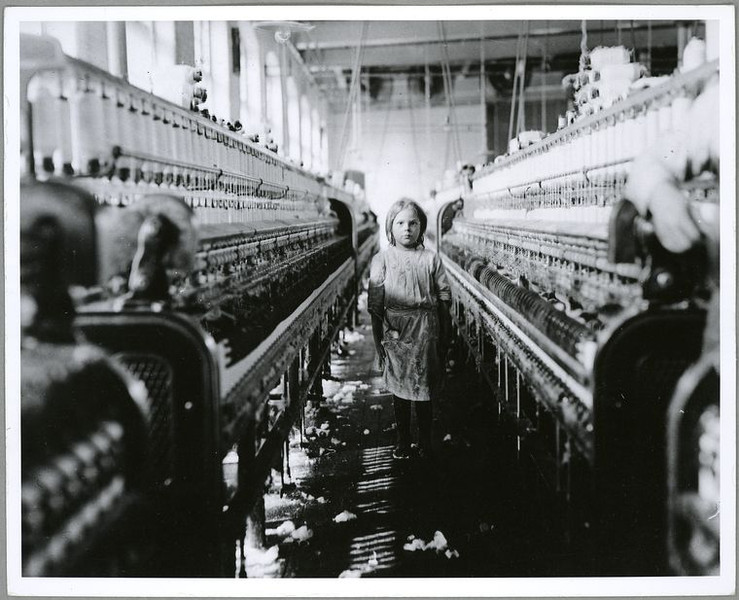
Child labor in a textile mill
How Workers Organized and What Unions Wanted
Workers organized because one person alone had little power against a corporation. They wanted higher wages, shorter hours, safer conditions, steadier work, and collective bargaining.
Major labor tactics
- Strike = workers refuse to work
- Boycott = people refuse to buy, handle, or transport goods
- Sympathy strike or sympathy boycott = support for another group of workers
Major employer countermeasures
- Lockout
- Strikebreakers or scabs
- Blacklists
- Yellow-dog contracts
- Pinkerton detectives
- Court injunctions
- State militias and federal troops
National unions
| Union | What it was | Main limits |
|---|---|---|
| National Labor Union (1866) | First major national labor federation after the Civil War; pushed the eight-hour day | Hurt by racial exclusion, internal division, political strategy, and the Panic of 1873 |
| National Colored Labor Union (1869) | Formed because Black workers faced discrimination | Showed labor unity had racial limits |
| Knights of Labor under Terence V. Powderly | Broad union of skilled and unskilled workers; included women, Black workers, many immigrants; wanted eight-hour day, end of child labor, equal pay, cooperatives | Declined after failed strikes and Haymarket backlash |
| American Federation of Labor (1886) under Samuel Gompers | Federation of craft unions for skilled workers; “bread-and-butter” unionism on wages, hours, conditions | More durable, but less inclusive |
The Major Labor Conflicts and Why Labor Usually Lost
These strikes show the same pattern again and again. Workers could disrupt the economy, but business and government usually had more power.
- Great Railroad Strike of 1877
Began in Martinsburg, West Virginia after wage cuts by the Baltimore and Ohio Railroad. It spread interstate across major rail centers in the East and Midwest. Rutherford B. Hayes sent federal troops and the strike was crushed.
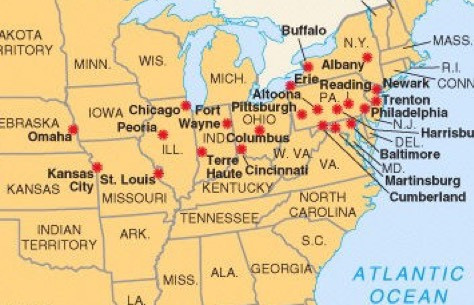
Spread of the Great Railroad Strike of 1877
- Haymarket affair (1886)
A Chicago rally for the eight-hour day followed violence at McCormick Reaper Works. A bomb killed police and civilians. The trial of anarchists was controversial, and public support for labor dropped. The Knights of Labor suffered badly. - Homestead Strike (1892)
At Carnegie Steel in Homestead, Pennsylvania, Henry Clay Frick used a lockout and Pinkertons against the union. The Pennsylvania militia helped defeat the strike. - Pullman Strike (1894)
George Pullman cut wages but not rents in his company town. Eugene V. Debs and the American Railway Union backed a boycott of Pullman cars. Grover Cleveland sent troops, and In re Debs (1895) upheld federal intervention.
Key Takeaways
Deskilling
Mechanization’s reduction of work into repetitive tasks, decreasing reliance on craft knowledge and increasing managerial control
Real Wage
A worker’s purchasing power; it rises when wages buy more goods and services, even if the dollar wage does not increase
Skilled Workers vs. Unskilled Workers
Skilled workers had specialized training and greater bargaining leverage, while unskilled workers were more easily replaced
Sweatshop
A small, crowded workplace, especially in the garment industry, where employees worked long hours for low wages
Child Labor
The expanding employment of poorly paid children in dangerous industrial jobs with long hours and little legal protection
Eight-Hour Day
Labor’s persistent demand to reduce the standard workday to eight hours
Collective Bargaining
Negotiation between an employer and workers acting through a union over wages, hours, and working conditions
Strike
A collective refusal by employees to work in order to pressure an employer
Boycott
A refusal to purchase, handle, or transport a company’s products in order to exert economic pressure
Sympathy Strike / Sympathy Boycott
A work stoppage or boycott undertaken to support workers involved in a separate labor dispute
Lockout
Management’s closure of a workplace or denial of employee access to defeat union demands
Strikebreaker / Scab
A worker hired or retained to replace an employee on strike
Blacklist
A list of union activists circulated among employers to prevent those workers from obtaining jobs
Yellow-Dog Contract
An employment contract requiring a worker to promise not to join a union
Pinkerton National Detective Agency
A private security agency employers hired to protect property and confront strikers, notably at Homestead
Labor Injunction
A court order stopping specified union activities, enforceable through imprisonment for contempt
National Labor Union
Founded in 1866, the first significant postwar national labor federation promoted the eight-hour day but collapsed after the Panic of 1873
Knights of Labor
A national labor organization that attempted to unite skilled and unskilled workers, including women and Black workers, and sought broad reforms and worker-owned cooperatives before declining after failed strikes and the Haymarket backlash
Terence V. Powderly
Leader of the Knights of Labor who favored education, arbitration, and cooperative reform over strikes
American Federation of Labor
A federation founded in 1886 that organized mainly skilled craft workers and pursued practical gains through bargaining and strikes
Samuel Gompers
Longtime AFL leader who promoted craft organization and bread-and-butter gains in wages, hours, and working conditions
Craft Union
A union organized around a particular skilled trade, such as carpentry, printing, or cigar making
Bread-and-Butter Unionism
Unionism focused on attainable improvements in wages, hours, and working conditions rather than broad social transformation
Great Railroad Strike of 1877
The first major interstate labor uprising spread from Martinsburg after wage cuts but was defeated when federal troops reopened rail traffic
Rutherford B. Hayes
President who sent federal troops to suppress the Great Railroad Strike of 1877 and restore rail traffic
Haymarket Affair
An 1886 Chicago labor rally where an unknown person threw a bomb, leading the public to associate organized labor with anarchism and violence and contributing to the Knights of Labor’s decline
Homestead Strike
An 1892 strike at Carnegie Steel defeated after a Pinkerton battle, state-militia occupation, and reopening with nonunion labor
Henry Clay Frick
Carnegie Steel chairman who directed the Homestead lockout, hired Pinkertons, and broke the steelworkers’ union
George Pullman
Railcar manufacturer who cut workers’ wages during the 1893 depression without correspondingly reducing company-town rents and charges
American Railway Union
Eugene V. Debs’s industrial railway union, which supported Pullman workers with a nationwide boycott of trains carrying Pullman cars
Eugene V. Debs
Leader of the American Railway Union who organized the Pullman boycott and was jailed for violating a federal injunction
Pullman Strike
An 1894 wage dispute that became a nationwide rail boycott and collapsed after a federal injunction and troops restored service
Grover Cleveland
President who sent federal troops against the Pullman boycott on the grounds that it obstructed interstate commerce and the U.S. mail
In re Debs (1895)
Supreme Court decision upholding federal authority to obtain an injunction and intervene against the Pullman boycott to protect interstate commerce and mail delivery
Company Town
A community in which a company owned workers’ housing and controlled services, increasing employees’ dependence on their employer
Notes
Deskilling
Mechanization’s reduction of work into repetitive tasks, decreasing reliance on craft knowledge and increasing managerial control
Real Wage
A worker’s purchasing power; it rises when wages buy more goods and services, even if the dollar wage does not increase
Skilled Workers vs. Unskilled Workers
Skilled workers had specialized training and greater bargaining leverage, while unskilled workers were more easily replaced
Sweatshop
A small, crowded workplace, especially in the garment industry, where employees worked long hours for low wages
Child Labor
The expanding employment of poorly paid children in dangerous industrial jobs with long hours and little legal protection
Eight-Hour Day
Labor’s persistent demand to reduce the standard workday to eight hours
Collective Bargaining
Negotiation between an employer and workers acting through a union over wages, hours, and working conditions
Strike
A collective refusal by employees to work in order to pressure an employer
Boycott
A refusal to purchase, handle, or transport a company’s products in order to exert economic pressure
Sympathy Strike / Sympathy Boycott
A work stoppage or boycott undertaken to support workers involved in a separate labor dispute
Lockout
Management’s closure of a workplace or denial of employee access to defeat union demands
Strikebreaker / Scab
A worker hired or retained to replace an employee on strike
Blacklist
A list of union activists circulated among employers to prevent those workers from obtaining jobs
Yellow-Dog Contract
An employment contract requiring a worker to promise not to join a union
Pinkerton National Detective Agency
A private security agency employers hired to protect property and confront strikers, notably at Homestead
Labor Injunction
A court order stopping specified union activities, enforceable through imprisonment for contempt
National Labor Union
Founded in 1866, the first significant postwar national labor federation promoted the eight-hour day but collapsed after the Panic of 1873
Knights of Labor
A national labor organization that attempted to unite skilled and unskilled workers, including women and Black workers, and sought broad reforms and worker-owned cooperatives before declining after failed strikes and the Haymarket backlash
Terence V. Powderly
Leader of the Knights of Labor who favored education, arbitration, and cooperative reform over strikes
American Federation of Labor
A federation founded in 1886 that organized mainly skilled craft workers and pursued practical gains through bargaining and strikes
Samuel Gompers
Longtime AFL leader who promoted craft organization and bread-and-butter gains in wages, hours, and working conditions
Craft Union
A union organized around a particular skilled trade, such as carpentry, printing, or cigar making
Bread-and-Butter Unionism
Unionism focused on attainable improvements in wages, hours, and working conditions rather than broad social transformation
Great Railroad Strike of 1877
The first major interstate labor uprising spread from Martinsburg after wage cuts but was defeated when federal troops reopened rail traffic
Rutherford B. Hayes
President who sent federal troops to suppress the Great Railroad Strike of 1877 and restore rail traffic
Haymarket Affair
An 1886 Chicago labor rally where an unknown person threw a bomb, leading the public to associate organized labor with anarchism and violence and contributing to the Knights of Labor’s decline
Homestead Strike
An 1892 strike at Carnegie Steel defeated after a Pinkerton battle, state-militia occupation, and reopening with nonunion labor
Henry Clay Frick
Carnegie Steel chairman who directed the Homestead lockout, hired Pinkertons, and broke the steelworkers’ union
George Pullman
Railcar manufacturer who cut workers’ wages during the 1893 depression without correspondingly reducing company-town rents and charges
American Railway Union
Eugene V. Debs’s industrial railway union, which supported Pullman workers with a nationwide boycott of trains carrying Pullman cars
Eugene V. Debs
Leader of the American Railway Union who organized the Pullman boycott and was jailed for violating a federal injunction
Pullman Strike
An 1894 wage dispute that became a nationwide rail boycott and collapsed after a federal injunction and troops restored service
Grover Cleveland
President who sent federal troops against the Pullman boycott on the grounds that it obstructed interstate commerce and the U.S. mail
In re Debs (1895)
Supreme Court decision upholding federal authority to obtain an injunction and intervene against the Pullman boycott to protect interstate commerce and mail delivery
Company Town
A community in which a company owned workers’ housing and controlled services, increasing employees’ dependence on their employer
