Topic 2.2 Notes – European Colonization
How European Colonies Developed Differently
European colonies grew from the same basic formula. Imperial goals + migration patterns + labor needs + Native relations shaped what each colony looked like. That’s the whole topic.
Start with the big picture. By 1750, Britain, France, and Spain had built very different colonial regions across North America.
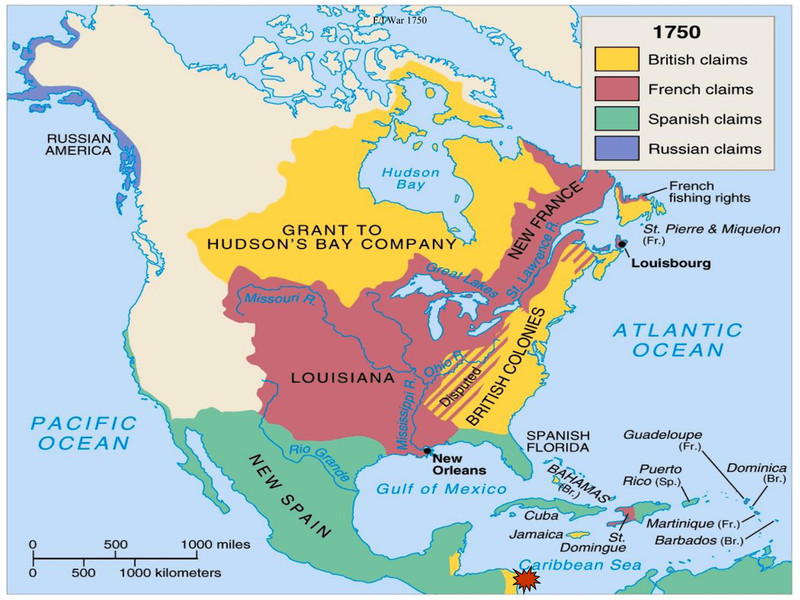
European claims in North America, c. 1750
Native peoples were not just background here. Europeans were entering Native-controlled land, and Native nations stayed major political, military, and economic powers the whole time.
The three main models:
- Spanish model
Conquest came first. Spain wanted wealth, Catholic converts, and imperial control. It usually ruled by subjugating Native populations and pulling them into colonial society. - French and Dutch model
Commerce came first, especially the fur trade. Because they sent fewer settlers, they depended on alliances, diplomacy, and some intermarriage with Native peoples. - English model
Permanent farm settlement came first. Large numbers of men, women, and families came looking for land, profit, and religious goals, and expansion usually meant taking Native land and living separately.
Spanish Colonization
Spain’s colonies in North America were the borderlands of a much larger empire. The usual phrase is “gold, God, and glory.” Key settlements were St. Augustine (1565) in Florida and Santa Fe (1610) in New Mexico. Spain also held parts of Florida, New Mexico, Arizona, and Texas. California is mostly later, so it’s outside this topic.
Institutions of control
- Encomienda system
Spanish colonists could demand Native labor or tribute. In theory they were supposed to protect and convert Native people. In practice it became coercive exploitation. - Repartimiento
A labor draft that forced Native people to work for the colony. - Missions and presidios
Missions tried to convert Native peoples and reshape daily life, labor, and settlement. Presidios were military forts that enforced Spanish rule.
Colonial society
Spain built a society that incorporated many groups, but in a strict hierarchy.
- Peninsulares were born in Spain and ranked highest.
- Creoles were of Spanish ancestry but born in the Americas.
- Mestizos had mixed Spanish and Native ancestry.
- Mulattoes had mixed Spanish and African ancestry.
This is the casta system. The key idea is easy to miss on tests. Spain incorporated Native Americans, free Africans, enslaved Africans, and mixed-ancestry peoples, but incorporation did not mean equality.
French and Dutch Colonization
France and the Netherlands built thinner, trade-centered colonies. Fewer settlers meant they could not just overwhelm Native peoples with population.
French colonies
New France centered on Quebec (1608) and stretched through the St. Lawrence River, Great Lakes, Mississippi Valley, Louisiana, and New Orleans (1718). A map of Louis Jolliet’s travels helps show how French activity linked the St. Lawrence region to the interior and down the Mississippi.
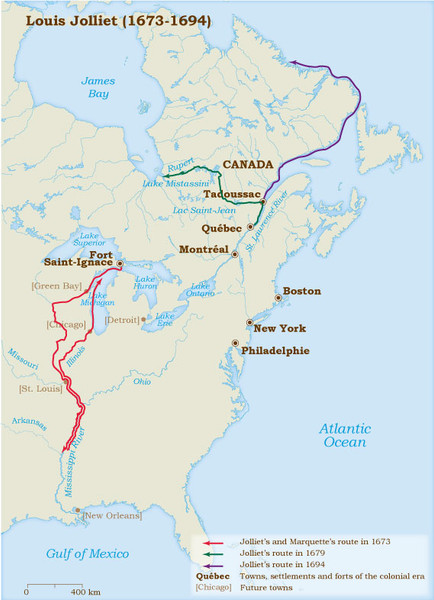
French exploration routes in New France
- The economic core was the beaver fur trade.
- Coureurs de bois and voyageurs moved deep into the interior to trade.
- Jesuit missionaries spread Catholicism.
- France allied with Algonquin-speaking peoples and the Huron/Wendat, and rivalry with the Haudenosaunee/Iroquois shaped conflict.
- Intermarriage was more common than in English colonies, helping create Métis communities.
- The seigneurial system supported farming along the St. Lawrence, but population stayed small.
Dutch colonies
The Dutch also cared most about trade. New Netherland grew after Henry Hudson’s 1609 voyage. New Amsterdam on Manhattan became the main port.
- The Dutch West India Company drove colonization.
- The patroon system offered huge estates to attract settlers.
- The Dutch had strong fur-trade ties with the Haudenosaunee/Iroquois.
- New Netherland became a diverse commercial society with Europeans, Africans, and both free and enslaved workers.
- England seized it in 1664 and renamed it New York.
English Colonization
English colonization stands out because it sent the most settlers and wanted the most land.
People came for land, profit, higher wages, social mobility, and improved living conditions. Religion mattered too. The Pilgrims founded Plymouth in 1620, and the Puritan Great Migration to Massachusetts Bay began in 1630. Because many migrants came as families, English colonies grew through natural population increase, not just immigration.
The colonies were usually financed by joint-stock companies and authorized by royal charters. The key example is Jamestown, founded in 1607 by the Virginia Company.
Jamestown
- Early years were brutal. Disease, starvation, weak planning, and dependence on Powhatan trade nearly destroyed it.
- John Smith helped impose order.
- The starving time (1609-1610) showed how fragile the colony was.
- John Rolfe’s tobacco made Virginia profitable.
- The headright system (1618) gave land to people who paid for passage, encouraging migration and larger landholding.
- The House of Burgesses (1619) gave property-owning colonists a representative assembly.
English colonies needed a lot of land for agriculture, so expansion meant settler colonialism. Colonists usually lived apart from Native communities. Labor first depended heavily on indentured servants. Africans were present from 1619, and slavery expanded over time.
The Big Comparison by 1754
| Empire | Main goal | Typical pattern |
|---|---|---|
| Spain | Wealth extraction + conversion | Native labor systems, missions, hierarchical mixed society |
| France and Netherlands | Trade, especially furs | Thin settlement, Native alliances, diplomacy, intermarriage |
| England | Land + agricultural settlement | Dense settler colonies, expansion, Native dispossession |
By 1754, the British mainland colonies had the largest settler population. France controlled huge territory with far fewer Europeans. Spain still held Florida and the Southwest. Those competing empires, plus Native alliances, set up later imperial wars.
Key Takeaways
Gold, God, and Glory
Phrase summarizing Spain’s pursuit of wealth, Catholic conversion, and imperial power in the Americas
St. Augustine
Spanish Florida settlement founded in 1565 that remained an important military and strategic outpost
Santa Fe
Spanish settlement founded in 1610 that became the center of Spanish New Mexico
Encomienda
Spanish grant allowing an encomendero to demand labor or tribute from Native communities in return for supposed protection and conversion
Repartimiento
Spanish compulsory labor draft that required Native communities to provide workers for colonial production
Spanish Mission System
Network of Catholic communities that sought to convert Native peoples while reorganizing their settlement, culture, and labor
Presidio
Spanish military fort that defended settlements, enforced colonial authority, and protected imperial frontiers and missions
Casta System
Spanish colonial hierarchy that associated ancestry with social rank and legal privilege while favoring Spanish ancestry
New France
France’s thinly settled North American empire, built along waterways through trade, missions, forts, and Native alliances
Samuel de Champlain
French explorer and colonizer who founded Quebec in 1608 and helped establish New France
Quebec
French settlement founded by Samuel de Champlain in 1608 on the St. Lawrence River and a center of New France
Fur Trade
Economic foundation of much of New France and New Netherland, exchanging European goods for Native-supplied furs, especially beaver pelts
Coureurs de Bois
Independent French traders who traveled through the interior to trade directly with Native communities for furs
Voyageurs
Licensed French workers who transported trade goods and furs between Native communities and French markets
Métis
Mixed French and Native communities that emerged through intermarriage and kinship, especially around the fur trade
Jesuits
Catholic missionaries who sought to convert Native peoples in New France while working within French trade and alliance networks
Seigneurial System
New France’s land system in which large grants along the St. Lawrence were divided into farms worked by tenants
New Netherland
Dutch commercial colony centered on the Hudson River and New Amsterdam, established to profit from trade, shipping, and furs
Henry Hudson
Explorer whose 1609 voyage for the Dutch opened the river later named for him to Dutch trade and colonization
Dutch West India Company
Dutch chartered company that established and administered New Netherland beginning in the 1620s
New Amsterdam
Diverse Dutch commercial port on Manhattan and the principal settlement of New Netherland; renamed New York after the English conquest
Patroon System
Dutch system granting large estates to investors who brought settlers to New Netherland, where tenants worked the land
English Seizure of New Netherland
England captured the sparsely populated Dutch colony in 1664 and renamed it and New Amsterdam New York
Joint-Stock Company
Business that sold shares to multiple investors, spreading the costs, risks, and possible profits of colonization
Colonial Charter
Crown-issued document authorizing a company or proprietor to establish, govern, distribute land in, and regulate a colony
Virginia Company of London
Joint-stock company chartered by James I in 1606 that financed the founding of Jamestown
Jamestown
First permanent English settlement in the future United States, founded in Virginia in 1607 and sustained eventually by tobacco and migration
Powhatan Chiefdom
Powerful alliance of Native communities in the Chesapeake on which early Jamestown depended for trade and food
John Smith
Jamestown leader who imposed military discipline and negotiated with the Powhatan chiefdom for food
Starving Time
Winter of 1609–1610 when hunger, disease, and conflict killed most Jamestown colonists and drove some to cannibalism
John Rolfe
Virginia colonist who cultivated profitable tobacco for European markets, giving Jamestown a successful export economy
Tobacco
Virginia’s principal cash crop, whose profitability increased demand for land and labor and intensified expansion into Native territory
Headright System
Virginia policy granting generally 50 acres for each passage financed, encouraging immigration while concentrating land among wealthy planters
House of Burgesses
Representative assembly established in Virginia in 1619 that gave property-owning colonists a limited role in local government
Indentured Servant
Worker contracted for several years in exchange for transportation and maintenance, unfree during the contract but not enslaved for life
Pilgrims
English migrants who founded Plymouth in 1620 as part of family-based religious colonization
Plymouth Colony
Permanent New England settlement founded by the Pilgrims in 1620 as a religious and family community
Massachusetts Bay Colony
Puritan colony founded in 1630 that became a center of family migration to New England during the 1630s
Puritan Great Migration
Movement of thousands of Puritan men, women, and children to New England, especially during the 1630s
Settler Colonialism
Colonization in which migrants establish permanent communities and transfer control of Indigenous land to settlers and their descendants
Peninsulares
Spanish-born colonists who generally held the highest political and social positions in Spanish colonial society
Creoles
People of Spanish ancestry born in the Americas who could be wealthy but were often excluded from the highest offices
Mestizos
People of mixed European and Native ancestry in Spanish colonial society
Mulattoes
People of mixed European and African ancestry in Spanish colonial society
Notes
Gold, God, and Glory
Phrase summarizing Spain’s pursuit of wealth, Catholic conversion, and imperial power in the Americas
St. Augustine
Spanish Florida settlement founded in 1565 that remained an important military and strategic outpost
Santa Fe
Spanish settlement founded in 1610 that became the center of Spanish New Mexico
Encomienda
Spanish grant allowing an encomendero to demand labor or tribute from Native communities in return for supposed protection and conversion
Repartimiento
Spanish compulsory labor draft that required Native communities to provide workers for colonial production
Spanish Mission System
Network of Catholic communities that sought to convert Native peoples while reorganizing their settlement, culture, and labor
Presidio
Spanish military fort that defended settlements, enforced colonial authority, and protected imperial frontiers and missions
Casta System
Spanish colonial hierarchy that associated ancestry with social rank and legal privilege while favoring Spanish ancestry
New France
France’s thinly settled North American empire, built along waterways through trade, missions, forts, and Native alliances
Samuel de Champlain
French explorer and colonizer who founded Quebec in 1608 and helped establish New France
Quebec
French settlement founded by Samuel de Champlain in 1608 on the St. Lawrence River and a center of New France
Fur Trade
Economic foundation of much of New France and New Netherland, exchanging European goods for Native-supplied furs, especially beaver pelts
Coureurs de Bois
Independent French traders who traveled through the interior to trade directly with Native communities for furs
Voyageurs
Licensed French workers who transported trade goods and furs between Native communities and French markets
Métis
Mixed French and Native communities that emerged through intermarriage and kinship, especially around the fur trade
Jesuits
Catholic missionaries who sought to convert Native peoples in New France while working within French trade and alliance networks
Seigneurial System
New France’s land system in which large grants along the St. Lawrence were divided into farms worked by tenants
New Netherland
Dutch commercial colony centered on the Hudson River and New Amsterdam, established to profit from trade, shipping, and furs
Henry Hudson
Explorer whose 1609 voyage for the Dutch opened the river later named for him to Dutch trade and colonization
Dutch West India Company
Dutch chartered company that established and administered New Netherland beginning in the 1620s
New Amsterdam
Diverse Dutch commercial port on Manhattan and the principal settlement of New Netherland; renamed New York after the English conquest
Patroon System
Dutch system granting large estates to investors who brought settlers to New Netherland, where tenants worked the land
English Seizure of New Netherland
England captured the sparsely populated Dutch colony in 1664 and renamed it and New Amsterdam New York
Joint-Stock Company
Business that sold shares to multiple investors, spreading the costs, risks, and possible profits of colonization
Colonial Charter
Crown-issued document authorizing a company or proprietor to establish, govern, distribute land in, and regulate a colony
Virginia Company of London
Joint-stock company chartered by James I in 1606 that financed the founding of Jamestown
Jamestown
First permanent English settlement in the future United States, founded in Virginia in 1607 and sustained eventually by tobacco and migration
Powhatan Chiefdom
Powerful alliance of Native communities in the Chesapeake on which early Jamestown depended for trade and food
John Smith
Jamestown leader who imposed military discipline and negotiated with the Powhatan chiefdom for food
Starving Time
Winter of 1609–1610 when hunger, disease, and conflict killed most Jamestown colonists and drove some to cannibalism
John Rolfe
Virginia colonist who cultivated profitable tobacco for European markets, giving Jamestown a successful export economy
Tobacco
Virginia’s principal cash crop, whose profitability increased demand for land and labor and intensified expansion into Native territory
Headright System
Virginia policy granting generally 50 acres for each passage financed, encouraging immigration while concentrating land among wealthy planters
House of Burgesses
Representative assembly established in Virginia in 1619 that gave property-owning colonists a limited role in local government
Indentured Servant
Worker contracted for several years in exchange for transportation and maintenance, unfree during the contract but not enslaved for life
Pilgrims
English migrants who founded Plymouth in 1620 as part of family-based religious colonization
Plymouth Colony
Permanent New England settlement founded by the Pilgrims in 1620 as a religious and family community
Massachusetts Bay Colony
Puritan colony founded in 1630 that became a center of family migration to New England during the 1630s
Puritan Great Migration
Movement of thousands of Puritan men, women, and children to New England, especially during the 1630s
Settler Colonialism
Colonization in which migrants establish permanent communities and transfer control of Indigenous land to settlers and their descendants
Peninsulares
Spanish-born colonists who generally held the highest political and social positions in Spanish colonial society
Creoles
People of Spanish ancestry born in the Americas who could be wealthy but were often excluded from the highest offices
Mestizos
People of mixed European and Native ancestry in Spanish colonial society
Mulattoes
People of mixed European and African ancestry in Spanish colonial society
