Topic 8.7 Notes – America as a World Power
How the United States Used Power in the Cold War World
After 1945, the U.S. kept troops, bases, alliances, intelligence networks, and nuclear weapons around the world. The main goal was containment, which meant stopping the spread of Soviet power and communism.
The U.S. used a whole toolkit at once:
- Diplomacy through recognition, treaties, mediation, and the UN
- Foreign aid to tie countries to the U.S. economy and model
- Military alliances and bases to project power quickly
- CIA covert action to influence events without open war
- Troop deployments when leaders thought force was necessary
- Nuclear deterrence to scare the USSR away from direct attack
- Technological competition like the space race
- Peace Corps (1961), which sent Americans abroad as a softer way to build influence
That policy had a constant contradiction. The U.S. said it defended freedom and self-determination, but often supported dictators if they were anti-communist.
Decolonization made this even messier. New nations in Africa and Asia were emerging from European rule, and both superpowers tried to win them over. In Africa, independence came in waves across the 1950s through the 1970s, which helps explain why the continent became such an important Cold War battleground.
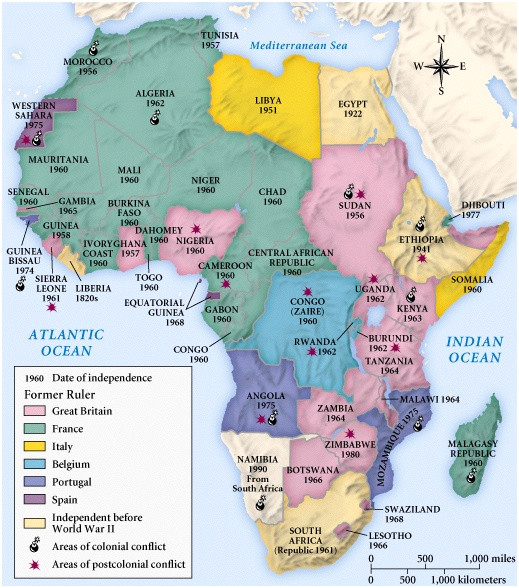
Decolonization in Africa
Many refused to join either bloc:
- Bandung Conference (1955) brought Asian and African leaders together against colonialism.
- Non-Aligned Movement (1961) organized countries trying to stay independent.
- Key leaders were Jawaharlal Nehru, Gamal Abdel Nasser, and Josip Broz Tito.
Congo
The Congo shows how local nationalism and Cold War fear got tangled together. Patrice Lumumba sought Soviet aid during a crisis after independence, so the U.S. and Belgium backed anti-Lumumba forces. Later, the U.S. supported Joseph Mobutu, even though he ruled as a dictator.
Latin America and Anti-Communist Intervention
In Latin America, U.S. leaders treated the region as a strategic sphere of influence and moved hard against leftist governments. The cases below center on the Caribbean, Central America, and South America.
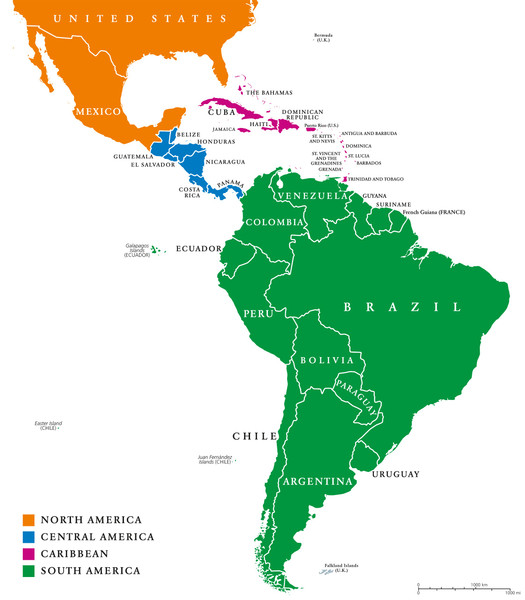
Latin America and the Caribbean
- Guatemala 1954: Jacobo Árbenz pushed land reform that hurt United Fruit Company interests. The CIA’s Operation PBSUCCESS helped Carlos Castillo Armas overthrow him. This is the classic covert-action example.
- Cuba: Fidel Castro overthrew Fulgencio Batista in 1959. The Bay of Pigs invasion in 1961, a CIA-backed exile attack under Kennedy, failed badly.
- Cuban Missile Crisis 1962: The U.S. discovered Soviet missiles in Cuba. Kennedy used a naval quarantine. Khrushchev removed the missiles, the U.S. publicly promised not to invade Cuba, and secretly removed Jupiter missiles from Turkey. Results included the hotline and the Limited Nuclear Test Ban Treaty (1963).
- Reform and force: Kennedy’s Alliance for Progress tried to reduce revolution through development. Johnson still sent troops to the Dominican Republic in 1965 to stop “another Cuba.”
- Chile 1970-1973: Salvador Allende was elected and pursued socialism. The Nixon administration and CIA backed destabilization. After Augusto Pinochet’s 1973 coup, the U.S. supported his anti-communist dictatorship despite human-rights abuses.
Jimmy Carter shifted emphasis toward human rights and negotiated the Panama Canal treaties in 1977.
The Middle East and the Limits of American Influence
The U.S. wanted four things here at once: contain the USSR, protect oil, support Israel, and keep Arab allies. Those goals often collided.
Keep the region itself in mind as you review these events, especially the eastern Mediterranean, Israel and its neighbors, Egypt and the Suez Canal, Iran, and the Persian Gulf.
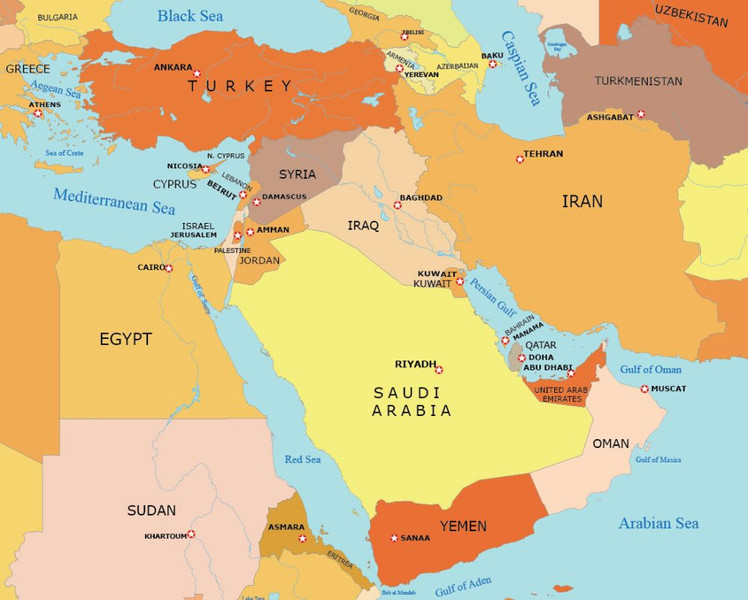
Political map of the Middle East
- UN partition plan 1947 split Palestine into Jewish and Arab states.
- Truman recognized Israel in 1948.
- The 1948 war created a large Palestinian refugee population.
- Iran 1953: Mohammad Mossadegh nationalized oil. A CIA and British-backed coup restored Shah Mohammad Reza Pahlavi. This is a key anti-communism + oil + covert action example.
- Suez Crisis 1956: Nasser nationalized the canal. Britain, France, and Israel attacked Egypt, but Eisenhower pressured them to withdraw. This showed old European empires weakening and U.S. influence rising.
- Eisenhower Doctrine promised aid against “international communism,” and in Lebanon 1958 the U.S. sent troops.
- OPEC was founded in 1960 by Iran, Iraq, Kuwait, Saudi Arabia, and Venezuela. The 1973 oil embargo showed oil producers had huge leverage.
- Camp David Accords 1978: Carter mediated between Anwar Sadat and Menachem Begin. Egypt recognized Israel, and Israel returned Sinai.
- Iranian Revolution and hostage crisis 1979-1981: Ayatollah Khomeini overthrew the shah. 52 Americans were held for 444 days. The failed Desert One rescue (April 1980) deepened the crisis. The Carter Doctrine, announced in January 1980, pledged to defend the Persian Gulf.
Nuclear Arms, the Space Race, and the Military-Industrial Complex
Global power depended on weapons, technology, and permanent military readiness. That also created fear at home.
- The nuclear triad was bombers, ICBMs, and submarine-launched missiles.
- MAD means mutual assured destruction. Each side could still destroy the other after a first strike, so nuclear war became a deterrent.
- Eisenhower’s massive retaliation relied heavily on the threat of overwhelming nuclear response.
- Kennedy’s flexible response built options short of nuclear war.
Americans argued over fallout, accident risk, giant defense budgets, and whether stockpiles went far beyond what deterrence required.
Military-industrial complex
In his 1961 Farewell Address, Eisenhower warned about the military-industrial complex, the close relationship among the military, defense contractors, Congress, universities, and federal agencies. He accepted the need for defense, but feared “unwarranted influence.”
Sputnik and the space race
- Sputnik (1957) made Americans fear Soviet scientific and missile superiority.
- The response included the National Defense Education Act (1958) and NASA (1958).
- Yuri Gagarin was the first human in orbit.
- Alan Shepard was the first American in space.
- John Glenn was the first American to orbit Earth.
- Kennedy set the Moon goal.
- Apollo 11 put Neil Armstrong and Buzz Aldrin on the Moon while Michael Collins remained in orbit.
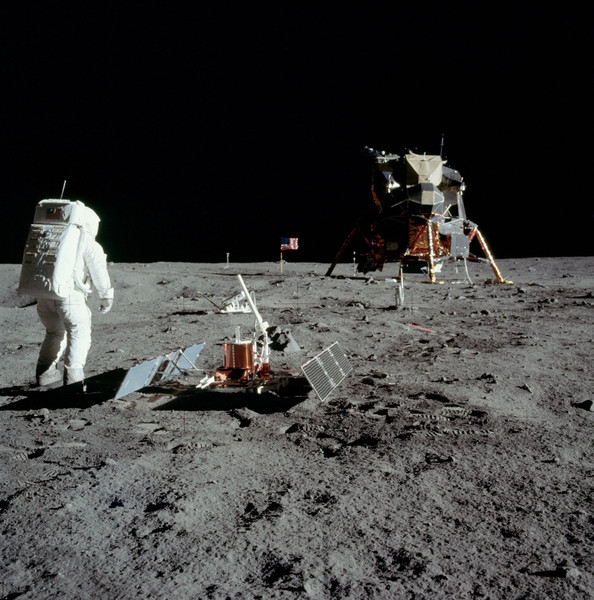
Apollo 11 on the Moon
The Moon landing became the clearest symbol of how the space race tied science, prestige, and Cold War competition together.
Eisenhower and Kennedy agreed the U.S. had to lead globally. Their difference was tone. Eisenhower warned about permanent militarization. Kennedy’s Inaugural Address promised energetic world leadership and to “pay any price” for liberty.
Key Takeaways
Decolonization
Post–World War II collapse of European empires and creation of independent nations across Africa and Asia
Anticolonial Nationalism
Movements seeking independence, control of resources, and freedom from foreign rule, which Americans sometimes misidentified as Soviet communism
Bandung Conference
1955 meeting of Asian and African states that opposed colonialism and promoted independence from the Cold War blocs
Non-Aligned Movement
Organization founded in 1961 by countries seeking independence from both Cold War blocs while accepting aid from either side
Third World
Cold War term originally describing countries aligned with neither the American-led First World nor the Soviet-led Second World
Peace Corps
Kennedy program established in 1961 that used technical assistance and personal contact to build American influence in developing nations
Congo Crisis
Post-independence crisis in which the United States and Belgium opposed Lumumba and the United States later supported the authoritarian anti-communist Mobutu
Patrice Lumumba
Congolese prime minister viewed as a communist threat after seeking Soviet aid; killed in 1961 by opponents with Belgian involvement
Joseph Mobutu
Authoritarian and corrupt anti-communist ruler of Congo supported by the United States after Lumumba’s removal
Jacobo Árbenz
Elected Guatemalan president whose land reform threatened United Fruit holdings before the CIA-backed 1954 coup removed him
Guatemalan Coup / Operation PBSUCCESS
1954 CIA operation using exiles, propaganda, and psychological warfare to overthrow Árbenz and install an authoritarian anti-communist regime
Fidel Castro
Cuban revolutionary who overthrew Batista, nationalized American property, and aligned Cuba with the Soviet Union
Cuban Revolution
Castro’s 1959 overthrow of Batista, followed by land redistribution, nationalization, and Cuba’s alignment with the Soviet Union
Bay of Pigs Invasion
Failed 1961 CIA-backed invasion by Cuban exiles that strengthened Castro, embarrassed Kennedy, and pushed Cuba closer to the USSR.
Cuban Missile Crisis
1962 confrontation resolved when the USSR removed missiles from Cuba and the U.S. pledged not to invade and secretly removed missiles from Turkey
Limited Nuclear Test Ban Treaty
1963 treaty prohibiting nuclear tests in the atmosphere, outer space, and underwater
Alliance for Progress
Kennedy’s 1961 aid program promoting development, education, land reform, and democracy in Latin America, with limited results
Dominican Republic Intervention
Johnson’s 1965 deployment of over 20,000 troops to prevent a civil conflict from producing what he feared would be another Cuba
Salvador Allende
Democratically elected socialist president of Chile whom the Nixon administration covertly worked to destabilize before the 1973 coup
Augusto Pinochet
Chilean general who overthrew Allende in 1973 and led a repressive anti-communist dictatorship supported by the United States
Jimmy Carter’s Human-Rights Foreign Policy
Policy giving human rights greater importance by reducing support for some repressive governments without abandoning all strategic alliances
Panama Canal Treaties
Carter’s 1977 agreements providing for the gradual transfer of the Panama Canal to Panama by the end of 1999
United Nations Partition Plan for Palestine
1947 proposal to divide Palestine into Jewish and Arab states, accepted by Jewish leaders and rejected by Arab leaders
Mohammad Mossadegh
Iranian prime minister who nationalized the British-controlled oil company and was overthrown in a 1953 CIA-British operation
Iranian Coup of 1953
CIA-British operation that overthrew Mossadegh after oil nationalization and strengthened Shah Mohammad Reza Pahlavi
Shah Mohammad Reza Pahlavi
Repressive, Western-oriented Iranian monarch strengthened by the 1953 coup and supported as a major American ally
Gamal Abdel Nasser
Egyptian president and advocate of Arab nationalism and nonalignment who nationalized the Suez Canal in 1956
Suez Crisis
1956 crisis in which Eisenhower pressured Britain, France, and Israel to withdraw after they attacked Egypt over Nasser’s canal nationalization
Eisenhower Doctrine
1957 pledge of American economic or military aid to Middle Eastern countries threatened by international communism
Lebanon Intervention
Eisenhower’s 1958 deployment of about 14,000 troops to support Lebanon’s government and prevent a hostile political outcome
Organization of the Petroleum Exporting Countries (OPEC)
Organization founded in 1960 to increase petroleum-producing nations’ control over oil production and prices
Arab Oil Embargo
1973 cutoff of oil to the United States and other supporters of Israel, demonstrating the diplomatic power of petroleum producers
Camp David Accords
Carter-mediated 1978 agreements leading to Egyptian recognition of Israel, Israeli withdrawal from Sinai, and a 1979 peace treaty
Iranian Revolution
1979 overthrow of the shah that created Khomeini’s Islamic republic and ended Iran’s alliance with the United States
Ayatollah Ruhollah Khomeini
Religious leader of the 1979 Iranian Revolution who established an anti-American Islamic republic
Iran Hostage Crisis
1979–1981 seizure of the U.S. embassy in Tehran, where 52 Americans were held for 444 days amid a failed rescue mission
Carter Doctrine
1980 declaration that the United States would use force if necessary to resist outside control of the Persian Gulf
Nuclear Triad
Bombers, land-based intercontinental missiles, and submarine-launched missiles designed to preserve a retaliatory nuclear force
Nuclear Deterrence
Preventing attack by maintaining a credible ability to inflict devastating nuclear retaliation
Mutual Assured Destruction (MAD)
Condition in which both superpowers could survive a first strike and retaliate, making a deliberate nuclear attack irrational
Massive Retaliation
Eisenhower strategy threatening a devastating nuclear response to communist aggression rather than relying mainly on conventional forces
Flexible Response
Kennedy strategy expanding conventional and special forces so the United States could respond without immediately using nuclear weapons
Nuclear Arsenal Debate
Supporters stressed deterrence and bargaining power; critics warned of accidental war, fallout, excessive costs, and weapons beyond defensive needs
Military–Industrial Complex
Eisenhower’s term for the interconnected military, contractors, legislators, agencies, and research institutions capable of gaining unwarranted influence
Sputnik
First artificial satellite, launched by the Soviet Union in 1957, that alarmed Americans about Soviet scientific and missile superiority
National Defense Education Act
1958 law providing federal support for mathematics, science, engineering, and foreign-language education after Sputnik
National Aeronautics and Space Administration (NASA)
Federal space agency created in 1958 to organize the American response to Soviet advances in space
Space Race
U.S.–Soviet competition for technological prestige that expanded federal research and culminated in the American Moon landing
Apollo 11
1969 mission that landed Neil Armstrong and Buzz Aldrin on the Moon, symbolizing American technological capacity and prestige
Eisenhower’s Farewell Address vs. Kennedy’s Inaugural Address
Eisenhower warned against unchecked defense influence; Kennedy emphasized active leadership and bearing burdens to defend liberty
Containment
Cold War policy of preventing further expansion of Soviet power and communist influence
Israeli Independence
Israel’s 1948 declaration of statehood, followed by Arab invasion, Israeli territorial expansion, a Palestinian refugee crisis, and no Palestinian Arab state
U.S. Recognition of Israel
President Harry Truman’s nearly immediate recognition of Israel after it declared independence on May 14, 1948
Dwight D. Eisenhower
President associated with massive retaliation, covert intervention in Guatemala, the Eisenhower Doctrine, and the warning against the military–industrial complex
John F. Kennedy
President who authorized the Bay of Pigs invasion, managed the Cuban Missile Crisis, and promoted flexible response, the Alliance for Progress, and the Moon program
Jimmy Carter
President who emphasized human rights, negotiated the Panama Canal treaties and Camp David Accords, and declared the Carter Doctrine
Notes
Decolonization
Post–World War II collapse of European empires and creation of independent nations across Africa and Asia
Anticolonial Nationalism
Movements seeking independence, control of resources, and freedom from foreign rule, which Americans sometimes misidentified as Soviet communism
Bandung Conference
1955 meeting of Asian and African states that opposed colonialism and promoted independence from the Cold War blocs
Non-Aligned Movement
Organization founded in 1961 by countries seeking independence from both Cold War blocs while accepting aid from either side
Third World
Cold War term originally describing countries aligned with neither the American-led First World nor the Soviet-led Second World
Peace Corps
Kennedy program established in 1961 that used technical assistance and personal contact to build American influence in developing nations
Congo Crisis
Post-independence crisis in which the United States and Belgium opposed Lumumba and the United States later supported the authoritarian anti-communist Mobutu
Patrice Lumumba
Congolese prime minister viewed as a communist threat after seeking Soviet aid; killed in 1961 by opponents with Belgian involvement
Joseph Mobutu
Authoritarian and corrupt anti-communist ruler of Congo supported by the United States after Lumumba’s removal
Jacobo Árbenz
Elected Guatemalan president whose land reform threatened United Fruit holdings before the CIA-backed 1954 coup removed him
Guatemalan Coup / Operation PBSUCCESS
1954 CIA operation using exiles, propaganda, and psychological warfare to overthrow Árbenz and install an authoritarian anti-communist regime
Fidel Castro
Cuban revolutionary who overthrew Batista, nationalized American property, and aligned Cuba with the Soviet Union
Cuban Revolution
Castro’s 1959 overthrow of Batista, followed by land redistribution, nationalization, and Cuba’s alignment with the Soviet Union
Bay of Pigs Invasion
Failed 1961 CIA-backed invasion by Cuban exiles that strengthened Castro, embarrassed Kennedy, and pushed Cuba closer to the USSR.
Cuban Missile Crisis
1962 confrontation resolved when the USSR removed missiles from Cuba and the U.S. pledged not to invade and secretly removed missiles from Turkey
Limited Nuclear Test Ban Treaty
1963 treaty prohibiting nuclear tests in the atmosphere, outer space, and underwater
Alliance for Progress
Kennedy’s 1961 aid program promoting development, education, land reform, and democracy in Latin America, with limited results
Dominican Republic Intervention
Johnson’s 1965 deployment of over 20,000 troops to prevent a civil conflict from producing what he feared would be another Cuba
Salvador Allende
Democratically elected socialist president of Chile whom the Nixon administration covertly worked to destabilize before the 1973 coup
Augusto Pinochet
Chilean general who overthrew Allende in 1973 and led a repressive anti-communist dictatorship supported by the United States
Jimmy Carter’s Human-Rights Foreign Policy
Policy giving human rights greater importance by reducing support for some repressive governments without abandoning all strategic alliances
Panama Canal Treaties
Carter’s 1977 agreements providing for the gradual transfer of the Panama Canal to Panama by the end of 1999
United Nations Partition Plan for Palestine
1947 proposal to divide Palestine into Jewish and Arab states, accepted by Jewish leaders and rejected by Arab leaders
Mohammad Mossadegh
Iranian prime minister who nationalized the British-controlled oil company and was overthrown in a 1953 CIA-British operation
Iranian Coup of 1953
CIA-British operation that overthrew Mossadegh after oil nationalization and strengthened Shah Mohammad Reza Pahlavi
Shah Mohammad Reza Pahlavi
Repressive, Western-oriented Iranian monarch strengthened by the 1953 coup and supported as a major American ally
Gamal Abdel Nasser
Egyptian president and advocate of Arab nationalism and nonalignment who nationalized the Suez Canal in 1956
Suez Crisis
1956 crisis in which Eisenhower pressured Britain, France, and Israel to withdraw after they attacked Egypt over Nasser’s canal nationalization
Eisenhower Doctrine
1957 pledge of American economic or military aid to Middle Eastern countries threatened by international communism
Lebanon Intervention
Eisenhower’s 1958 deployment of about 14,000 troops to support Lebanon’s government and prevent a hostile political outcome
Organization of the Petroleum Exporting Countries (OPEC)
Organization founded in 1960 to increase petroleum-producing nations’ control over oil production and prices
Arab Oil Embargo
1973 cutoff of oil to the United States and other supporters of Israel, demonstrating the diplomatic power of petroleum producers
Camp David Accords
Carter-mediated 1978 agreements leading to Egyptian recognition of Israel, Israeli withdrawal from Sinai, and a 1979 peace treaty
Iranian Revolution
1979 overthrow of the shah that created Khomeini’s Islamic republic and ended Iran’s alliance with the United States
Ayatollah Ruhollah Khomeini
Religious leader of the 1979 Iranian Revolution who established an anti-American Islamic republic
Iran Hostage Crisis
1979–1981 seizure of the U.S. embassy in Tehran, where 52 Americans were held for 444 days amid a failed rescue mission
Carter Doctrine
1980 declaration that the United States would use force if necessary to resist outside control of the Persian Gulf
Nuclear Triad
Bombers, land-based intercontinental missiles, and submarine-launched missiles designed to preserve a retaliatory nuclear force
Nuclear Deterrence
Preventing attack by maintaining a credible ability to inflict devastating nuclear retaliation
Mutual Assured Destruction (MAD)
Condition in which both superpowers could survive a first strike and retaliate, making a deliberate nuclear attack irrational
Massive Retaliation
Eisenhower strategy threatening a devastating nuclear response to communist aggression rather than relying mainly on conventional forces
Flexible Response
Kennedy strategy expanding conventional and special forces so the United States could respond without immediately using nuclear weapons
Nuclear Arsenal Debate
Supporters stressed deterrence and bargaining power; critics warned of accidental war, fallout, excessive costs, and weapons beyond defensive needs
Military–Industrial Complex
Eisenhower’s term for the interconnected military, contractors, legislators, agencies, and research institutions capable of gaining unwarranted influence
Sputnik
First artificial satellite, launched by the Soviet Union in 1957, that alarmed Americans about Soviet scientific and missile superiority
National Defense Education Act
1958 law providing federal support for mathematics, science, engineering, and foreign-language education after Sputnik
National Aeronautics and Space Administration (NASA)
Federal space agency created in 1958 to organize the American response to Soviet advances in space
Space Race
U.S.–Soviet competition for technological prestige that expanded federal research and culminated in the American Moon landing
Apollo 11
1969 mission that landed Neil Armstrong and Buzz Aldrin on the Moon, symbolizing American technological capacity and prestige
Eisenhower’s Farewell Address vs. Kennedy’s Inaugural Address
Eisenhower warned against unchecked defense influence; Kennedy emphasized active leadership and bearing burdens to defend liberty
Containment
Cold War policy of preventing further expansion of Soviet power and communist influence
Israeli Independence
Israel’s 1948 declaration of statehood, followed by Arab invasion, Israeli territorial expansion, a Palestinian refugee crisis, and no Palestinian Arab state
U.S. Recognition of Israel
President Harry Truman’s nearly immediate recognition of Israel after it declared independence on May 14, 1948
Dwight D. Eisenhower
President associated with massive retaliation, covert intervention in Guatemala, the Eisenhower Doctrine, and the warning against the military–industrial complex
John F. Kennedy
President who authorized the Bay of Pigs invasion, managed the Cuban Missile Crisis, and promoted flexible response, the Alliance for Progress, and the Moon program
Jimmy Carter
President who emphasized human rights, negotiated the Panama Canal treaties and Camp David Accords, and declared the Carter Doctrine
